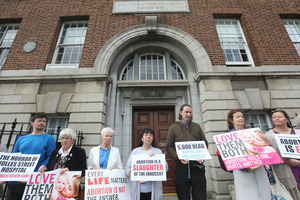
“I was at home in the living room at 10PM tonight with my girlfriend when we both heard something come through the letterbox at the front door. I was a bit startled as it was quite late and dark but became more concerned when I noticed through the window that whoever had posted the envelope was running away. When I looked out the window again it appeared that there were in fact several people running around posting these envelopes. What I got was the leaflet and envelope I’ve photographed and attached. I decided to chase after them and inform them that it was neither appropriate or sensitive to do so at that time especially for any households where there are elderly people living on their own. I spoke to a Garda who happened to be driving around the corner when I was on hot pursuit. She told that what they were doing wasn’t illegal but Jerry Buttimer might not be too pleased about it. I decided to try and find some of these thrifty postmen and women and eventually found a group of seven. I politely inquired if they were the people posting these letters and was astonished when all I got were blank stares. None of them would speak to me at all. When I then declared that it was like something from the Walking Dead or other zombie apocalypse scenario a man approached me to ask me what I was giving out about. He refused to give me his name or the name of the group but claimed that they could only do it by night because they ‘were being attacked’. I was about to get some answers when one of his silent drones appeared and dragged him away by the arm.”
“I decided to get my camera to photograph these people and approached one woman and asked what pro life group she was with. She then relaxed and said ‘Oh good, which group are you with? Are you one of us?’ I then photographed her and a man approached and asked what my concern was (he was also posting these envelopes). I told him that I was not happy about receiving junk mail at that hour as well as expressing my concern for the fact that his posters were fleeing when the posted the item in question. He claimed that he was the director of the group known as Cork Pro Life and that they had no choice but to do this by night. He gave me his first name (Kieran) but no other personal information. He then went on about their ’cause’ and assumed that I was a ‘Fine Gael’ man because of my ridiculing of his group’s activities. After he told me ‘my party was trying to force their views on the country’. I informed him that I was not affiliated with any party and that I disagreed with their (Cork Pro Life) views of for a number of other reasons. Can anyone here inform me of the legality of what they’re doing?”
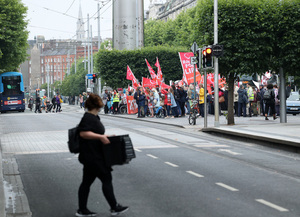
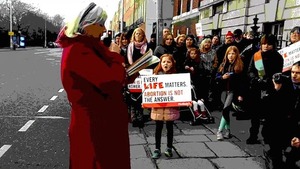
Just thought I’d share this with you. On Parnell St [Dublin], just after 3pm, a Hector look-a-like was tearing down Action on X rally posters at a fierce rate.
He was even wearing one of those nice red Life Institute/Youth Defence jackets. Seemed like he was on his way back to Castle Grayskull (60A Capel Street).
UPDATE.
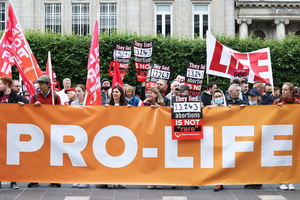
At the rally an hour later…
Is it poster boy?
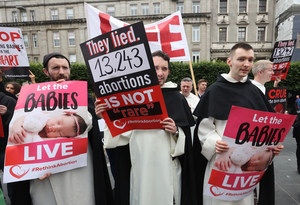
An oddly familiar pro-life protestor heckling and taking photos at the ‘Action on X’ rally.
“To have a man who spectacularly failed to protect children, who didn’t deign to pick up a phone and warn parents about the monster in their children’s midst, preaching about their protection is an affront to abuse victims, who were abandoned to the depravity of Smyth and clerics like him.
…
“…Cardinal Brady is more prominent than ever and still oblivious to his own breathtaking hypocrisy. Has the Church learned anything? Does it know anything about humility, or repentance, or sensitivity? Clearly not, when the threat of excommunication is being hurled at those politicians who support legislation designed to save lives — women imperilled by pregnancy.”
“Was Brendan Smyth, who began abusing children in 1952, ever threatened with excommunication? When his decades of disgusting abuse were revealed, did excommunication occur to any senior cleric? Evidently not, because, after he died, just one month into a 12-year jail sentence, in 1997, he was buried in Kilnacrott Abbey and a headstone describing him as ‘reverend’ was erected.”
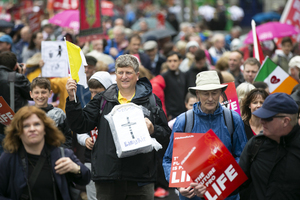
Catholic Church stewards, Cardinal Sean Brady and ‘maidens’ carrying a statue of the Virgin Mary as they lead a Rosary Procession of about 3,500 for a “National Vigil of Prayer for Mothers and their Unborn Babys” at the Knock Shrine in County Mayo.
Last night’s Tonight with Vincent Browne featuring pro-life Fine Gael TD, Peter Mathews (left), Sinead Kennedy, a pro-choice campaigner from NUI Maynooth, (centre) and Sara McInerney of The Sunday Times.
The transcript.
Go on.
Get yourself some tay.
(begins at 20:22 ends at 31.35)
Vincent Browne: “The reality is, simply Peter, deal with this simple point.”
Peter Mathews: “I’ll deal with the point. Do you know what the simple point is?”
Browne: “No, no wait a minute. The simple point, this is the law as it now is. So what’s the problem?”
Mathews: “And what’s the Constitution?”
Browne: “This is the law and the Constitution as interpreted by the Supreme Court. This is the Constitution as interpreted by the Supreme Court.”
Mathews: “Well let’s go back to the plain English.”
Browne: “No, no, just a minute just a minute now. That is the reality. Now what is the problem with simply codifying this legal reality. Not changing any laws, no difference, nothing else, what is the problem with changing that reality?”
Mathews: “Vincent, legislation nearly always in every area that it’s carried out gets amended. Constitutions only get amended when the people actually vote on the amendment, or change it.”
Sinead Kennedy: “And twice, and twice they have refused to exclude suicide as grounds, as grounds for a termination. I mean you can’t get around that, you can’t get around the fact that the vast majority of people in this country support X case legislation as a bare minimum.”
Sarah McInerney: “It’s interesting actually there are some in Fine Gael who think that you can get round it, again for people that I was speaking to last week, one of the alternatives, sort of, some people have come up with and which they would like to see is for the legislation to say where there is a real and substantial risk to the life of the mother that the medical profession can act or it can intervene and just not include suicide but not preclude suicide.”
Mathews: “Don’t specify it. Yeah.”
McInerney: “And they believe that that would possibly be a workable solution and that if it was challenged in the courts that the government should take up that challenge in the courts and use the new evidence that Peter is talking about to challenge anyone who wanted to challenge that in the courts and that is one of the, one of the schools of thinking as such, absolutely.”
Mathews: “But that’s, that was what I said Vincent.”
Kennedy: “But that’s not good enough, I do not think, but that’s not good enough.”
Mathews: “You were saying leave it there and it won’t be applied anyway, because it’s, you know, the experience is, you know, that it is not going to be a contentious area.”
Browne: “No, I didn’t say that it wouldn’t be. I was saying that if your premise is correct, that if there is no medical basis to terminate a pregnancy because of a threat to suicide, of suicide, if if that is correct then it will never happen under the legislation, therefore there is no issue of principle here.”
Mathews: “Therefore leave out the reference to it, therefore leave out the specific preference to it. And as you’ve said Sarah if there is a substantive risk to the life of the mother, then let the medical profession…”
McInerney: “Well I’m not saying that, I’m saying that is what some people would like to see happen, yeah,”
Mathews: “Well, this is the area of professional judgment, when the professional judgment is carried out on the solemn duty to implement the Constitution which says equal rights of life to everybody who comes into existence, whether it be a baby in the earliest stages after conception, the mother or the father, there’s three people involved in the family.”
Kennedy: “I accept that when those rights come into conflict, when the right to life of the foetus conflicts with the right to life of the mother including the risk of suicide. That is the law and that law, there has been a delay for over 21 years in introducing a legal framework in which to make that a reality and to be quite frank I think the people in this country have had enough and they want at a bare minimum, I don’t think X case legislation, X case legislation, goes far enough.”
Mathews: “Sinead, would you mind, when are the rights of life to those three people in conflict. They’re never in conflict.”
Kennedy: “The two people.”
Mathews: “There’s three. people a father mother and baby.”
Kennedy: “The right to life of the father is not at issue here We’re talking about right to life of pregnant woman and right to life of the foetus. That’s what we’re talking about. In a life-threatening situation.”
Mathews: “Of a baby, don’t say the word foetus.”
Kennedy: “In a life threatening situation.”
Mathews: “Do you believe that life begins at conception?”
Kennedy: “No I don’t.”
Mathews: “There you go, there now, we know where you stand.”
Kennedy: “There is no legal or ethical consensus on where life begins. Now you may believe that life begins at conception but that is not an issue, again it’s not what is at issue here..”
Mathews: “Sinead, our Constitution, before you even start wondering do you understand plain english, takes the precept that every life begins at conception.”
Kennedy: “I have no difficulty understanding plain English. Our Constitution conflates the life of a foetus with that of a pregnant woman and I disagree with this as do I believe the vast majority of people in this country, because when it comes down to it people do not think that its the same thing. They really don’t think it is the same thing. They do not think that woman with all her life in front of her, her hopes and dreams are the exact same thing as a fertilised egg. Nobody really believes that. Maybe a small number of people do but when those issues come into conflict the vast majority of people think what is the, the more valuable life in that context when you have to make a judgment and the vast majority of people will side with the pregnant woman.”
Browne: “A lot of people do believe that its, there is a human life there prior to birth and I don’t think that’s necessarily contentious. Peter can I just ask you one further point.”
Mathews: “Well, Sinead says it is.”
Kennedy: “I said there’s no consensus on the issue and there is no consensus philosophical and ethical.”
Browne: “Peter, suppose your daughter were to get married and she were to become pregnant. I’m sure you’d be delighted at the prospect of a child being born to her and you becoming a grandfather and I am certain you’d be a wonderful grandfather.”
Mathews: “Like you Vincent, as I understand.”
Browne: “I’m not a grandfather.”
Mathews: “But maybe soon.”
Browne: “But if in the course of the pregnancy your daughter became seriously ill and if it became obvious that if the pregnancy were to continue her health would be seriously impaired for the rest of her life, and would you think that anybody other than she should take the decision with regard to what should happen?”
Mathews: “But of course the mother, the expectant mother, will have a responsibility to the unborn child and she will make that decision.”
Browne: “And it should be up to her and her alone. Ultimately. Obviously her husband…”
Mathews: “But that’s a matter of fact Vincent. Yeah, and her husband too yeah…”
Browne: “But wouldn’t it be terrible, wouldn’t it be a terrible intrusion on her autonomy and her integrity to say that somebody else should decide what should happen to her and should…”
Mathews: “But you’re talking about a theoretical situation that probably wouldn’t arise.”
Browne: “But these things do arise Peter, but I’m just putting it to you. Isn’t there something terribly…”
Mathews: “Do they? Do they Vincent Can you name a case?”
Browne: “Okay, isn’t there something terribly arrogant about us men particularly deciding in the case of women that they have to carry to full termination a baby within their womb irrespective of the consequences to them throughout the rest of their lives of doing so. Isn’t there terrible arrogance in that, involved in that?”
Mathews: “Well, you’re suggesting that arrogance arises in the case of all men. It doesn’t in my case. I have huge respect for my mother who looked after me, you know, through, before my birth ,after my birth, I have huge respect for wife who has borne our children, and I have huge respect for my daughter. And also for all my nieces.”
Browne: “You’re not dealing with the point I’m making, Peter.”
Mathews: “I am, Vincent. Not the way you want me to.”
Browne: “Yes of course you’re not the way I want you to because, you’re not answering the question.”
Mathews: “Truthfully, Vincent.”
Browne: “I think that maybe you haven’t listened. If in the case I have postulated to you somebody else was to say that oh no under no circumstances can your daughter take decisions for herself in circumstances such as that, wouldn’t you be appalled.”
Mathews: “I’m saying Vincent, that the reality is that expectant mothers and fathers, their partners or husbands do make those decisions for themselves, the same way for instance, hold on, men, men, well, men….”
Browne: “But they don’t. Sure the law has intervened they make criminals over them.”
Mathews: “Look, Vincent, men went down the mines and ways, men went into the mines and ways to provide for their family and their health was impaired and they died young. Look, for goodness, life is tough…. Vincent you know that, the ‘The Road Less Travelled’. ‘Life is tough’ that’s the first sentence of it And it was written by a psychiatrist in 1957.”
Browne: “Ah well, it must be true then.”
Mathews: “It’s an interesting insight.”
McInerney: “I’d be interested to hear your explanation on that point, if you say the couple involved will take the decision for themselves, everything we know about the case now of Savita and her husband they wanted to take the decision for themselves and weren’t given that opportunity. So, what do you think could or should have happened in that case, where they wanted to take the decision for themselves and were told they weren’t allowed?”
Mathews: “Yeah. There was, the question of judgment about when the risk to life of the mother arose seemed to have got mistimed.”
Browne: “No It wasn’t.”
Mathews: “It was.”
Browne: “No it wasn’t. No it wasn’t.”
Mathews: “Oh I know, your interview with Peter Boylan.”
Kennedy: “Who was very explicit, about this.”
Browne: “Now, wasn’t it terrible, wasn’t there something wrong that this woman knew that the, her baby was going to die, she was, a baby she desperately wanted and was not going to survive without the womb, and she intuitively wanted to end the pregnancy there and then and had it happened her life would have been saved, isn’t there something terribly wrong, that our law wouldn’t…”
Mathews: “It was a extraordinarily sad occasion. Extraordinarily sad.”
Browne: “And isn’t it terrible, awful that our law doesn’t permit that to happen.”
Mathews: “I don’t believe it was our law, no, Vincent. I think it was a misjudgment, a medical misjudgment.”
Browne: “You’re wrong Peter, you’re just wrong, you’re actually wrong.”
Mathews: “All right I’m wrong.”
McInerney: “Just on that point, you think that the couple involved are allowed take the decision for themselves They weren’t allowed and if you think it was okay for the couple not to to be allowed the decision for themselves, that’s obviously a valid point of view. But I don’t think you can say that the couple is allowed to take a decision for themselves when we know…”
Mathews: “Vincent was talking about health.”
McInerney: “When they asked for an intervention they were talking about health.
Mathews: “When you’ve a man and a woman and you provide for the family, your health for different people at different times, is going to take a toll. That’s human life.”
Kennedy: “So you think it’s an acceptable risk for woman to be allowed to continue with a pregnancy even if that pregnancy would damage her health. You think that’s acceptable?”
Browne: “For the rest of her life. Seriously imperil her health for the rest of her life.”
Mathews: “But sure we’re all going to end up dead anyway.”
Kennedy: “Do you think that’s an acceptable risk? And do you think you get to make that decision for a woman? It’s not your decision to make. It’s the decision of the individual woman.”
Mathews: “Sinead, I have a responsibility to uphold the Constitution which is in plain English, elucidated by the Supreme Court in 1992, with a reference to include suicide for that specific case which is now not relevant given the evidence.”
Seana Stafford and William Binchy with a new billboard reflecting research carrried out on behalf of the pro-life campaign by Millward Browne Lansdowne.
John Hyland writes;
The poll commissioned by the Pro-Life Campaign and reported on in the Irish Times and elsewhere is, from a research design point of view, really flawed. Long, complicated questions that lead to the answers the campaign wanted to hear. That these responses apparently went so against the results of the Irish Times/Ipsos MRBI poll (lots of shorter, simple questions) should be ringing alarm bells. Populations don’t change their minds that quickly. There’s a good analysis from DCU’s political science lecturer Eoin O’Malley here.
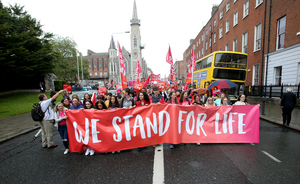
Taking up an entire side of Merrion Square, Dublin, on Saturday..
So, how many?
Anywhere from 25,000 to 50,000, claim organisers.
Rubbish, you say?
Time to call in Crowdsizeapp…
From Workers Solidarity Movement:
This is a simple process of pulling up a map of the area, drawing a box around the area occupied – very easy in this case as it was entirely enclosed by crowd control barriers and then entering a density estimate for the crowd. We were actually very generous and went for the maximum available density despite the fact it was obvious the crowd was not packed in that tightly. As can be seen [above] this suggests a maximum crowd size of 14,370. There is no physical way to fit 25,000 people into the available space without them being on each other shoulders – and the Vigil for Life crowd were really not up to such rock concert conditions. 30,000 or 50,000 are simply ludicrous estimates that would have required stacking people three high.
One of our scouts found these rather strange flyers circulating at the Vigil4Life event on Saturday. The one (above) is accusing a Lebanese man of harvesting embryo balls (NB testicle transplants don’t work let alone ones from a foetus to an adult male) and the above handout refers to kidneys.
The anti-choicers must have some new technologies the rest of us don’t. I’m first in the line for a nice clean pair of kidneys and a liver please.
Just to prove this is part of the mainstream anti-choice lingo, this is a screen grab from the Life Zone website: