




The Grand Canal at Portobello, Dublin 8 where La Touche Bridge, named after a banker and slave-owner, can be crossed
Portobello Harbour.
Harry writes:
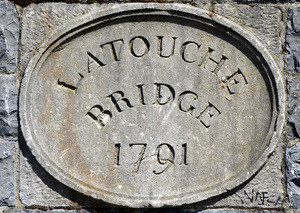
Portobello Bridge in Dublin with its distinctive lamp posts, red painted railings and deep Lock is one of the Grand Canal’s visually more attractive bridges. Dubliners just as frequently refer to it as Rathmines Bridge, it is of course correctly titled La Touche Bridge and it has a very interesting history.
The original La Touche bridge was constructed in 1791 and named after William Digges La Touché banker and a director of the Grand Canal Company. The La Touche family also “owned” slaves. Following the abolition of the slave trade the family received ‘compensation’ of £6000 (over £700,000.00 in value today) in 1834, for 400 of their slaves on two of their plantations in Jamaica.
Dublin’s Portobello shares its name with London’s Portobello Road and Portobello in Edinburgh. They were named to honour the capture by Admiral Edward Vernon in 1739 of the Spanish ruled town of Puerto Bello or Portobello on the Caribbean coast of Panama, during a war between Britain and Spain known as the War of Jenkins’ Ear when Robert Jenkins, a merchant sea captain, had his ear sliced off by a Spanish officer in Havana in 1731.
It led to calls in the British parliament for war with Spain. Captain Edward Vernon claimed he could take the Spanish town of Porto Bello with only six war ships and after a ferocious battle his very popular victory made Vernon a national hero. Portobello Dublin, still honours the Admiral’s victory to this day
In the 18th century Portobello began to develop as a small suburb in the south of the city of Dublin, expanding from Richmond Street. Portobello Harbour was built in 1801. The Grand Canal supplied water for Portobello Basin, the local areas reservoir and supply of fresh drinking water. It was in use until the 1860s when testing of the water quality identified too high levels of sulphuric acid and water was then sourced from Varty reservoir. The Basin was filled in 1883 and the harbour itself was largely filled in and in 1912 an Ever-Ready battery factory was built on the site.
By the 19th century Portobello Harbour was an important transport hub for traffic on the Grand Canal and a new hotel Portobello House, was built in 1807 to cater for passengers. It fell into decline after the success of the railways took away passenger transport on the canals. In 1858 it was taken over by a Catholic order of nuns, opening St. Mary’s asylum for visually impaired girls, after further incarnations it subsequently becoming a nursing home where the artist Jack B. Yeats passed away in old age. In later years it became a building for commercial use but still retains its visual charm along the canal.
The bridge and the lock have had its share of tragedies. At 9 o’clock Saturday evening on the 6th April 1861, a horse-drawn Omnibus with eight passengers, driven by Patrick Hardy, stopped at the crown of the bridge so a passenger and his young son could alight, the driver attempted to make the horses go on and as they clambered over the incline of the bridge one of the horses was startled and began to rear.
The driver tried to turn the horses to traverse the bridge diagonally but both lead horses became uncontrollable with fear. The back park of the Omnibus came in contact with a wooden fence between the Lock and the road, the back wheels went over the granite kerb causing the carriage to topple over and plunge six passengers along with two horses into the dark freezing waters of the canal Lock, which has a depth of over 6 metres.
The conductor managed to jump clear and the driver was pulled to safety from the roof of the Omnibus. The Lock gates were quickly opened lowering the water somewhat and two brave men, Police Constable Gaffney and Private Smith of the 4th Light Dragoon’s from nearby Portobello Barracks, with the aid of a ladder, used hatchets to break a hole into the roof of the Omnibus and diving into the flooded carriage, pulled out the now tragically drowned bodies of the passengers.
One of the victims was the father of the Gunne brothers, who opened the Gaiety Theatre in South King Street. Two women were mothers, each with a little daughter, one of them a niece of “The Great Emancipator”, Daniel O’Connell. Subsequently after the accident and until the bridge was redesigned, passengers on horse-drawn vehicles then had to disembark at Portobello Bridge and walk over the bridge before continuing on their journey.
But what spooked the horses leading to the accident? As with many tragedies’ legends sprung up. Some witnesses claimed they seen a bright light arising from the water and taking human shape, the ghostly form frightened the horses resulting in the tragedy.
There is an old ghost story about the Lock, that there was a previous avoidable accident resulting in a tragedy due to the Lock chamber overflowing with water, making the edge of the canal and the Lock chamber indistinguishable on a foggy night. The Lock gates should have been opened lowering the water table but were closed due to the Lock keeper being drunk at the time. The victim was crossing over the Lock’s footbridge and slipped fell in and drowned.
After that tragedy the Lock keeper was sacked from his job and in remorse drowned himself. On the anniversary of his death a bright light reportedly has been witnessed rising from the water. Supposedly the same phantom light arose when the horse drawn Omnibus was crossing the bridge, thereby spooking the horses. More realistically the horses lost their footing and the weight of the Omnibus pulled them backwards and toppled over the bridge.
During the Easter Rising in 1916. A group from the Irish Citizen Army seized Davy’s Bar (now the Portobello Pub) near the bridge, British army members were dispatched from Portobello Barracks and were pinned down by rebel fire. Army reinforcements set up a Maxim machine gun on the bridge and sprayed the bar with heavy calibre fire shattering windows, mirrors and embedding bullets in the walls and furnishings. After they ceased firing, they checked the premises but the rebels had made their escape.
It was along here that the anti-war pacifist Francis Sheehy-Skeffington was arrested on 25 April 1916 on his way home to Rathmines, he was taken to Portobello Barracks and murdered by the orders of Captain Bowen-Colturst in the barracks.
So, today La Touche Bridge and Portobello Harbour’s history continues. It is still making multiple news reports, as evidenced by Portobello Plaza having been closed due to copious amounts of outdoor alcohol consumption leading to antisocial and degrading behaviour by both sexes, coupled with the filthy littering of a residential area, or depending on your point of view, the abject failure by Dublin City Council to facilitate a public space with enough litter bins and toilet facilities along with the Gardai’s failure to properly police the area.
In some distant future when the pandemic has ceased and lockdowns have faded away to a memory that is best forgotten, Broadsheet readers may enjoy reading a brief history of Portobello that will include this era’s pandemic as an interesting historic footnote in time.
Harry’s Dublin appears here every Friday.
All pics by Harry Warren


Great stuff Harry, a wonderful read. Thank you.
Great read, a pipe leads from the harbour to St. Stephen’s Green supplying the ponds there with water. Another fun fact.
Hi GotRipped. thanks for that and by the way there is a fine set of pipes on display at Eustace Bridge, Leeson St
you can see them here
https://www.buildingsofireland.ie/buildings-search/building/50110528/eustace-bridge-leeson-street-lower-dublin-2-dublin
Many’s the dinner I had at lunchtime in La Touche Club on Earlsfort Terrace BITD.
Terrific, thank you
Excellent as always Harry, thank you. Excellent photos too.
Great read as always!
Great article Harry, thank you
enjoyed that
Another great read. Thank you.
Thanks everyone for taking the time to comment I hope all of your weekends are good ones! :)
Enjoyed that. Am a La Touche descendent and it’s a family legacy, while sometimes/often uncomfortable, it is none the less fascinating.
Thanks Harry, I have some good memories of the area back in the day!
Hi H,
I have a lot of happy memories in that area too!, especially one of the pub there,
The Lower Deck and Ron Wood dropping in to see the Fleadh Cowboys, ( Ron Wood, The Rolling Stones resident of Kildare) he genuinely enjoyed the band, he quietly turned up there at their Sunday afternoon residency along with . . . But that’s another story :)
Great article Harry.. old stomping ground for me. I met the man who repaired the metal sides about 20 years ago. It’s one of the few canal bridges with metal and had been off for quite a few decades by all accounts. Thanks so much for writing.
Hi Cú Chulainn,
I don’t imagine there would be too many men with the skills to repair the metal sides around today, he probably had some stories to tell.
All the same the Waterways Ireland folks do excellent work today maintaining our inland waterways
And thanks again folks for all of the kind words
Great bit of History and so wonderfully written.
When’s the book coming out Harry? Or is there one already?
Ahh now Luke, you’re only giving me ideas :)
Harry you are one of the best reasons to visit this site. Cheers
Great read again!