
Author Archives: Eamonn Kelly

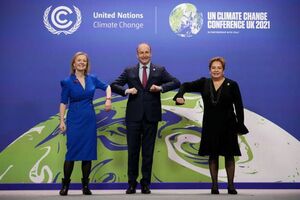
From top: Taoiseach Micheál Martin is flanked by British Foreign Secretary Elizabeth Truss (left) and United Nations Framework Convention on Climate Change Executive Secretary Patricia Espinosa (right) as he arrived for day two of COP26 on November 1 in Glasgow, Scotland; Eamonn Kelly

The week that was

Most people instinctively sense that when politicians start making promises they might as well be blowing up balloons. A politician’s promise has a half-life that can be counted in minutes and there is no reason to suppose that this will change relative to the importance of the issue at hand, in this case, climate change.

It would be nice to be optimistic, but with capitalism married to consumption and the majority of politicians in its back pocket, we are ultimately dependent on the largesse of a few billionaires to save the world, which is a whole new species of philanthropism.

Still, it was good to see the Cop 26 conference go ahead, even if Russia and China couldn’t be arsed sending a representative. But the fact of the conference taking place is a bit like the US having to acknowledge the possible existence of God. Even if they don’t believe in a deity, they at least have to cut their cloth to make it seem like they do.

So, in that sense the conference may serve some positive purpose. But realistically, what are we actually going to do to save the environment? Stop consuming? Sit in the cold and the dark eating cold beans waiting for the climate to right itself? Is anyone seriously going to do that?

But not to worry. The politicians are on the case, hoping to create new markets of consumption in the sale of electric cars, windmills and solar panels, continuing with the basic paradigm of capitalism, endless consumption, greenly tweaked by politicians.

Fine Words

Boris Johnson most likely has a team of researchers working full time to find the right things for Boris to say, which they then type up and put before him. But by the time the words move from Boris’s eyes to his mouth they invariably develop a patina of a sneer, and somehow, despite the fine words, Boris’s sub-textual message is always one of smirking insincerity.

He was at it again at COP 26, immediately turning the conference into Cop-Out 26. It’s Boris’s brand of cynicism that will likely finish us, because it’s everywhere, residing comfortably in high places.

Micheál Martin seemed delighted to be on the world stage at last, framing a first for a Fianna Fail taoiseach in setting out his stall to save the Earth. Prior to this they were happy luring multinational companies to set up base in Ireland. But Micheál is going for the big one before handing the reins back to Leo.

The Irish Examiner reported that Facebook is responsible for disseminating up to 90% of the climate denial rubbish that appears online, and the majority of it comes from less than twelve identifiable pages, which Facebook refuses to close-down because that might undermine their click-based business model. Mark Zuckerberg, estimated to be worth $98 billion, still apparently needs those few extra cents from fake news merchants.

Blackouts and Copouts

Facebook’s activities, along with Google, may also result in blackouts here in Ireland in the near future, because data centres are hogs for electricity and when push comes to shove the tax-free corporate giants will get first preference. It’s important that they safeguard your data to sell to advertisers because that’s the business model that helps sustain the economy, and the cost for you may be sitting in the dark while your data is being cooled by 24/7 computer fans.

Michael’s contribution towards saving the Earth might begin by paying a visit to Facebook down the road and maybe use the tax exemption deal as a lever to put some pressure on Facebook to close down those climate denial pages, and maybe reduce some of that data hoard and free up the grid for people to charge their new electric cars.

The problem with politicians managing the climate crisis, and with corporations pledging all kinds of reforms, is that both are winners in a capitalist system that relies on cynicism to make its sales.

You can have your markets for windmills and electric cars and solar panels, but until the cynicism that lies at the root of market capitalism is faced head on, all of it will be just the same old marketing spin, with advertising shaping up to sell a shiny, hollow version of environmentalism, without ever challenging the fundamentals of capitalism, such as perpetual growth and built-in obsolescence. Maybe it’s time to start fixing machinery again rather than dumping it. That would be something.

Turning Point

Cop 26, though it was peopled by many of the leading cynics of the corporate consumer system, sporting their spin, was also a positive gesture in the face of that cynicism, most notably in the figure and words of naturalist David Attenborough, and in its sincere attempt to put survival of the species on the agenda, ahead of apparently more important considerations, such as Mark Zuckerberg’s click profits.

David Attenborough, who, at 95, likely won’t be with us much longer, could see the conference in its historic perspective, in the way in which it might be viewed in 50 or 100 years, either as a turning point, or as a last missed opportunity.

Eamonn Kelly is a Galway-based  freelance Writer and Playwright. His weekly round-up appears here every Monday.
RollingNews

From top: Dublin city centre; Eamonn Kelly

The week that was

The clue to the possible causes of the fourth wave came when Joe Biden met the Pope and told him he was the only Irishman the Pope has ever met who has never taken a drink.

It’s not accurate of course. For one, Joe is an American, shamelessly proffering his Irish heritage, wrapped in a quippy cliché, to get on the Pope’s good side. The truth is, 25% of Irish adults don’t drink alcohol, though many believe that the other 75% over-drink to compensate. We like balance, and will stagger in droves to achieve it.

It might be that the handling of the virus in Ireland has come up against the elephant in the Irish living room. There isn’t really a whole lot about this in the media. That’s not surprising, because discussion of alcohol in Ireland is notoriously scant. It’s the great unmentionable, with 75% of adults apt to become surly and defensive at even a whisper of criticism of the gargle.

But the re-opening of the “economy” in Ireland appears to have really meant the re-opening of the pubs. There has been tremendous pressure to get the nightclubs and pubs up and running, but little attention has been paid as to what this actually might mean in the context of a pandemic where a highly infectious virus is doing the rounds.

Bravado

Stephen Donnelly told Pat Kenny on his radio show last week, that the re-opening is made possible by the vaccine. The vaccine is the key to allowing the pubs and nightclubs to re-open. This is why the push to get 100% vaccination coverage, on the assumption that the vaccine controls the virus.

However, the vaccine isn’t 100% effective, and neither does it prevent transmission. During the week the Indo claimed that it reduces transmission, but the expert cited, a Dr Monica Gandhi from California, made those comments back in January/February 2021.

So NPHET recommends the vaccine being supplemented by mask-wearing, hand-washing and social distancing, which many night-clubbers are apparently not doing.

Everyone has a fair idea what happens with masks, social distancing and handwashing when a group of people get drunk. The combination of sentimentality and bravado that comes over people when they are drunk is almost a perfect combination of forces to undermine recommended approaches to contain the virus.

Responsibility

Jordan Peterson, who did his PhD on the subject of alcohol abuse, argues that many people drink alcohol to escape responsibility. This makes a nonsense of the safety directive to “drink responsibly”, which totally misses the point of drinking, as practised by many people.

This may be called “relaxing”, “socialising” “letting your hair down” or any number of similar euphemisms. To escape responsibility. To put all the worries of the week away and just relax and have some fun. And there is nothing wrong with that. It’s a perfectly natural desire.

Problems arise however, when you factor in the virus and the necessary safeguards needed to contain the spread, such as hand-washing, mask-wearing and distancing.

Since we have been given to believe that vaccination reduces or even prevents transmission, the vaccine certs seemed like an ironclad way to admit people into a re-opened economy without risking a resurgence of the virus. But this has led to a dangerous relaxation.

Innocent Misinformation

On Newstalk, Ciara Kelly, ranking the importance of safety measures to prevent transmission of Covid, decided that hand-washing wasn’t as important as social distancing or mask-wearing because… the virus is airborne.

Her assumption appears to be that the virus can only be in one place at one time, and if it’s airborne, well it can’t be on surfaces…or something like that. The thing is, the idea wasn’t thought through and a lazy assumption was arrived at and broadcast over the airwaves to a mass audience that hand-washing is not very important in containing the spread of the virus.

This is probably a costly miscalculation, as is the idea that the vaccine prevents transmission, particularly when coupled with the Irish approach to drinking.

Denial

We’ve had a few weeks now of the 10% unvaccinated being held responsible for the latest surge, despite the high vaccination uptake and the conundrum of the high infection rate relative to the rest of Europe.

Last week it was the turn of East Europeans and children to carry the blame can. But it seems quite clear that people flooding into the pubs and nightclubs, mask-free, may be the primary cause of the fourth wave, through simply letting their guard down and having a long awaited “night out”.

No one’s really to blame in all this, except perhaps the culture itself, in not recognising that alcohol consumption was a serious problem in Ireland long before covid came along, and it is now simply contributing its own particular and predictable complication to the problem of the virus.

Once you factor in the role of alcohol, and once you look at all the other reasons that have been put forward to explain the surge in infections, the conclusion has to be that the ongoing denial the culture has engaged in about the destructive role alcohol plays in the society, is now manifesting as the fourth wave, accompanied by an habitual cultural unwillingness to query alcohol’s role in the spread.

Eamonn Kelly is a Galway-based  freelance Writer and Playwright. His weekly round-up appears usually here every Monday (but owing to the Bank Holiday it was delayed for a day).

RollingNews

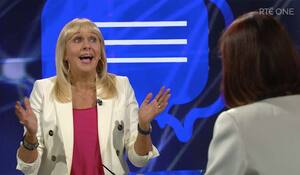
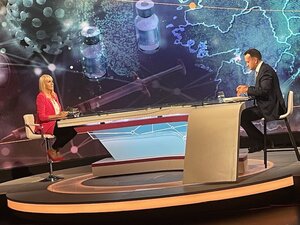
From top: Tanaiste Leo Varadkar on RTÉ One’s Prime Time with Miriam O’Callaghan; Eamonn Kelly

The week that was

On Friday some clarity was brought to bear on the efficacy or otherwise of the vaccines, by Dr Anne Moore, senior lecturer in Biochemistry and Cell Biology at UCC. She spoke with Bryan Dobson on RTÉ Radio’s News at One.

Dr Moore said:

“…these vaccines aren’t made or designed to prevent transmission…they’ve fantastic ability to keep people out of hospital; but they’re not going to prevent transmission in the community and we need to be aware of that.”

Clearly this revelation got through to all the unmasked people queuing outside nightclubs during the week.

Meanwhile infections rose among hospital staff, curtailing health services, while a new delta variant is reported in the UK. Paul Reid called for booster shots for healthcare staff, while the taoiseach, speaking in Brussels, said that annual booster jabs, like the flu jab, may become the norm.

By week’s end the Tánaiste announced that the virus would be here “forever”. And forever, as the song says, is a long, long time; certainly, more than the previously predicted six months.

Claire Byrne Live

On Monday, the Claire Byrne Live show conducted a poll of 1,000 respondents (no details of demographics, class etc were provided) and asked them were they in favour of mandatory vaccination. The response was scary, but not really surprising for Ireland, which appears to have a long, unaddressed authoritarian thing going on. 46% were in favour of mandatory vaccination, the result arguably saying more about Irish people than it does about vaccination.

On the same show, journalist Joe O’Shea claimed to be shocked by this support for mandatory vaccination, but recommended an equally intolerant “compelling” of people by effectively locking them out of “our” society. Using vaccine certs as a tool, what he was recommending was a kind of siege on a target minority.

If everyone in a contained space was admitted to that space on the strength of a vaccine cert, does this ensure that the virus does not exist in that space? Joe O’Shea certainly seemed to think so, but, given Dr Anne Moore’s warning, things may not be so clear-cut.

A vaccine cert only proves that you have had the recommended vaccines, but doesn’t prove that you are asymptomatic. The vaccine doesn’t prevent transmission.

So, the collective possession of covid certs in a closed space does not indicate absence of the virus, or protection from the virus. The certs only provide proof that all present have been vaccinated.

Prime Time

The Tánaiste braved RTE’s Prime Time on Tuesday to face some pointed questions from Miriam O’Callaghan on his contribution towards the dismantling of the public health service, as minister for Health, as Taoiseach and as Tánaiste. To which the Tánaiste responded in his defence that the government has an arrangement with private hospitals to take on any overspill, should the need arise.

And, presumably, any over spill of extra public money that might be lying around, which would likely be much safer in private hands anyway.

A cynic might say that a qualified doctor overseeing the dismantling of a public health service is hardly in the spirit of the Hippocratic Oath.

On Wednesday, Senator Sharon Keogan called attention to the growing discrimination against those who have chosen not to be vaccinated. She described to the Senate the demonising of a minority being led by well-known media personalities.

Kathy Sheridan

On the same day Kathy Sheridan lost the run of herself in the IT and wrote the most amazing article, conflating people who haven’t been vaccinated with online trolls, violent insurrectionists and the murderer of the unfortunate David Amess MP. She was fired up on similar energy exhibited by Joe O’Shea on the Claire Byrne Live show.

But I must have imagined all that, because Áine Lawlor said on Morning Ireland that she hadn’t seen or heard any vilification of the unvaccinated.

If a tree falls in a forest and Áine Lawlor isn’t there to witness it, did the tree fall at all?

The Good and the Angry

The problem of the virus may be as much about how Irish people are handling the crisis as it is about how we are dealing with the virus. So far, we have been very self-congratulatory about the 90% uptake of the vaccine, which is the best uptake in Europe, even if the infection rate is the worst in Europe.

But it is as if there is a shadow side to this compliant behaviour. We like ourselves when we’re being “good” and agreeable, and we hate those, with apparent equal intensity and self-righteousness, who we deem to be not “good”, by failing to conform to current herd consensus.

The flaring tempers are eerily familiar. The spectre of angry, unhinged authority still ghosts around the folk memory, threatening with righteous anger all those who would dare to defy its power.

Eamonn Kelly is a Galway-based  freelance Writer and Playwright. His weekly round-up appears usually here every Monday (but owing to the Bank Holiday it was delayed for a day).

Pic via Twitter

From top: Tanaiste Leo Varadkar has said all restrictions would be lifted if 100 per cent vaccination is achieved; Eamonn Kelly

It was a week of disappointment and confusion. Disappointment that the promised lifting of restrictions could not go ahead as planned, and some confusion as to why this was so.

A publican said that his business was being held to ransom by the 10% who haven’t been vaccinated. The publican’s assumption appears to be that the restrictions are in place because of the unvaccinated and not because of the virus, which he apparently believes has been nullified by the vaccine.

Naturally, everyone wants the pandemic to be over, but wishing it so doesn’t make it so. Yet, this desire for normality is adding to the confusion, not least in terms of those people who appear to assume that the vaccine is 100% effective and that all other safeguards can now be shelved.

On Saturday the Indo reported that Dr Susan Hopkins told a seminar in Dublin that the pandemic was likely to last at least another six months. At the same seminar Dr Cillian de Gascun said that the current generation of vaccines were “not enough to end this pandemic”, adding that “Pandemic viruses don’t just disappear.”

Confusion

Earlier in the week, the Tánaiste, contributing to the confusion, told the Dáil that he was in no doubt that if there was a 100% vaccination uptake that business would return to normal. But the Tánaiste has a track record in scapegoating minorities and parking blame elsewhere, and it would appear that he was politicising the confusion and essentially framing the unvaccinated 10% as the primary cause of the delay in re-opening the country.

He contradicted this view a day or two later when he said that booster vaccines would be necessary, because the vaccine is not 100% effective.

As for the 10% unvaccinated, it would appear that these are mainly made up of people who have either had the virus and have produced their own anti-bodies and see the risk of vaccine side-effects as an unnecessary one; and people of a certain frame of mind who simply don’t trust the authorities’ making health decisions in their best interests. A stance that is not really so incredible when you consider the shortcomings of privatisation of services that led to oversights in the cervical smear scandal, for instance.

The Sunday Indo then reported that only 30% of pregnant women had opted for the vaccine. Clearly these aren’t “anti-vaxxers” in the classical sense of irrational naysayers, but are simply women concerned for the welfare of their unborn children, reluctant to expose them to a vaccine which is still essentially in trial.

And yet this idea persists that people who haven’t opted for the vaccine are somehow wrong-headed or misled. The Examiner reported that “Professor Pete Lunn, head of the ESRI’s Behavioural Research Unit, said research shows concerns about the speed of vaccine development still linger.” But he also said that the unvaccinated were likely out of touch with mainstream society. Which seems like a nice way of saying that they don’t know their arse from their elbow.

Information

“NIAC Chair Professor Karina Butler” told the Indo that “health officials and Government need to work to ‘fill the information gaps’ so that the 370,000 adults that are not fully vaccinated in Ireland are given the ‘confidence and trust’ about getting vaccinated.”

When Colm Henry of the HSE was asked on Six One News (October14) why Ireland’s covid infection rate is the worst in Europe while its vaccination uptake is the best in Europe, he produced a temporary information gap by initially evading the question, going on to talk about the hospitals being busy with other things at this time of year, and how people need to get vaccinated to help prevent the spread of the virus, in order to alleviate pressure on the hospitals.

He eventually came around to a kind of answer to the question when he said that people need to continue to take the standard precautions like social distancing, hand-washing, mask-wearing and so on.

But his initial evasion and reference to hospitals under pressure implied that the unvaccinated are solely responsible, for not only the latest resurgence of the virus, but also for the ailing health service, which has been systematically picked apart and weakened by neo-liberal politicians, particularly over the last 10 years.

Confusion is also sewn when mainstream reporters routinely lump the covid vaccine in with vaccines in general. RTÉ Six One did something similar on this during the week when they screened an item on the late cervical cancer campaigner, Laura Brennan, who had raised awareness on the HPV vaccine. Somehow the item ended on a kind of ad for vaccines being uniformly “good”.

Lots of Questions

The current climate seems like one of evasion, lack of clarity and a covert presumption to manipulate the population like a herd of cattle. And still questions remain unanswered.

What is a booster jab anyway? Does it necessitate two vaccine jabs and then a booster? Or is it a stand-alone kind of jab, doing the work of what it previously took two jabs to achieve? Will you need another one next year? Or in six months’ time? Or every year?

And what of those people who have developed natural immunity? Does the vaccine interfere with or undermine their natural immunity? Do they need booster shots too? If so, why?

And what of primary school-children? Are they not also susceptible to catching and spreading the virus? If not, what do they have that rest of us don’t have? Some kind of enzyme? Can it be packaged to stop the spread? Or is their supposed immunity baloney?

And where are the media reports of people with vaccine side-effects? Are there none? There must be some. All studies admit that statistically there are some, no matter how small that number may be. Are their stories to be concealed in the wider interest of achieving a 100% vaccine uptake?

Professor Kingston Mills told RTÉ that booster jabs are necessary due to waning vaccine immunity. Does natural immunity also wane? If so, is the rate of waning of natural immunity different from waning vaccine immunity? Which is best: natural or artificial immunity? Are political choices between the two shaped by market considerations?

False Impressions

These are valid questions and they are not really being addressed. Instead, it seems as if a false impression is being deliberately cultivated at official level that “antivaxxers” are causing the pandemic to continue, by holding everyone back from achieving the magic 100% vaccine uptake.

That 100% vaccination target is a simple statistical goal, the type of thing that politicians love to get behind. But it is as if all other questions are being side-lined in favour of pursuit of that one statistical goal, which is itself undermined by the simple fact that the vaccine is less than 100% effective.

Eamonn Kelly is a Galway-based  freelance Writer and Playwright. His weekly round-up appears here every Monday.
Previously: Eamonn Kelly on Broadsheet

Earlier: Derek Mooney: This Week’s Reopening Must Go Ahead

‘Draft-Dodgers’

RollingNews

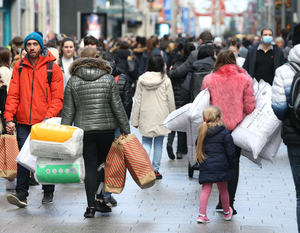
From top: Christmas shopping in Henry Street, Dublin 1 last December; Eamonn Kelly

One of the ideas at the centre of David Edward’s book “Free To Be Human: Intellectual Self-Defence in an Age of Illusions”, is the idea that corporate consumerism is actually a religion.

The book draws on ideas contained in a wide range of other books, by people like Erich Fromm, Sigmund Freud, Carl Jung, Noam Chomsky and others, bringing together various useful observations made by these writers, in order to build a persuasive argument for the ill effects of corporate consumerism, not just on the environment, but also on society and the individual.

The Economy

It is as if all existential concerns have been subjugated to the one task of continued economic development through perpetual consumption. During the boom, RTÉ used to lead the news every day with a story on the economy’s health, as if for all the world the economy was a being, like some kind of queen bee people were serving.

Edwards characterises this enslavement to the economy as being similar to people serving a religion, with the advertising of the lifestyles promised by corporate consumerism as the liturgy.

Even though it is clear by now that corporate consumerism is eating up the planet, the system must continue as if that is not the case. This is the delusion on which corporate consumerism and advertising depend. The idea that it is possible to consume indefinitely within a finite system, without adverse effect. Once you look clearly at this proposition, as Edwards does here, the delusion collapses.

However, advertising, which is corporate consumerism’s propaganda, is tasked with keeping people blind to this contradiction at the heart of corporate consumerism.

Atheism

Edwards identifies atheism, which he also characterises as a “religion”, as being the underlying “belief” system that allows for the pursuit of perpetual consumption. Atheism is a religion in the sense that, like religions, it is founded on a “certainty”, a belief, the certainty in atheism being that life is meaningless. Whereas in religion the “certainty” is that there is a God and a divine plan and so on.

In both cases neither can know with any certainty whether there is or isn’t a God or a purpose to life. That’s where faith comes in. With atheism, the “faith” is that faith is also meaningless, since the certainty is, in atheism, that the universe is Godless.

It is into this vacuum that corporate consumerism inserts itself, becoming a religion of its own, based on the belief that life is meaningless and short, and should therefore be enjoyed to the fullest by consuming.

When put like that it is immediately obvious that such a belief system has absolutely no regard or concern for anything that may happen after the current “enjoyers” of this system of consumption have faded to their own personal oblivion.

The idea is to take what you can because “you deserve it”, one of the tenets of this religion, and let future generations make what they can of what’s left, if anything is left. If nothing is left: well, tough shit.

No Conspiracy

This system, as described by Edwards, is not like some kind of conspiracy, but operates by a series of filters that have the effect of filtering out those who might be opposed to such a short-sighted system, while favouring those who serve the system. The filtering works a bit like an algorithm set to always make choices, both in people and things, that ensure short-term profits and instant pleasure.

This filtering occurs across all aspects of the system, having the effect of rewarding those with “success” who support the system, while side-lining critics of the system, who are often characterised as “odd” or even “insane”. This is the system’s way of disarming criticism and is used routinely, through media, to discredit critics of the system, including scientists warning about impending climate catastrophe due to over-consumption.

A good example of how the system protects and perpetuates itself would be the manner in which whistle-blowers are treated, often characterised as “enemies” of the system they are reporting on, or delusional, or working some, as yet undiscovered, angle of self-interest.

The point is, the system doesn’t need a “conspiracy”, or some collective of “controllers” or planners to ensure outcomes that, even in the face of climate disaster, ensure that it’s always business as usual in the system.

In fact, corporate consumerism works at its most efficient when people are asleep to its logical outcomes, in this case the certainty that unfettered consumption in a finite system must eventually end up consuming everything, like a black hole.

Corporate consumerism not only seeks to deny that such an outcome is inevitable, but also implies that if this is the case then, so what? Enjoy yourself, have fun while you still can.

Contempt For Life

This is what makes this ideology an enemy of nature, and is perhaps one of the reasons why its political representatives, the neo-liberals here at home, chiefly in the person of Varadkar, are suffering so badly in the polls.

It would appear that ordinary people are beginning to realise the nihilism at the heart of the neo-liberal ideology. The uncaring creation of poverty and homelessness, and ultimately, on the macro level, the destruction of the environment itself and the planet’s life support systems, in the name of short-term profits and share-holder satisfaction.

Corporate consumerism, the ideology served by neo-liberalism, is a project which encourages the abandonment of ideas of social justice, along with the abandonment of those people perceived to be expendable, along with a disregard for impending climate catastrophe; all in the name of business requirements and short term-profit. An ideology that amounts to a declaration of contempt for life.

Eamonn Kelly is a Galway-based  freelance Writer and Playwright. His weekly round-up appears here every Monday.

Previously: Eamonn Kelly on Broadsheet

RollingNews

From top Former Fine Gael minister, independent Tipperary TD and Ireland’s wealthiest parliamentarian Michael Lowry; Eamonn Kelly

Someone once quipped that champions league football is a game where 22 millionaires kick a ball around a field. In the same vein you might say that the Dáil is a place where an assembly of millionaires discuss budgeting and poverty.

Wealth Creation Is Easy

I know it can seem mean-minded to go on about politician’s pay and pensions. But they really are quite generous and it’s no surprise to anyone really that we are represented by so many millionaires. They can’t help but be millionaires with the kind of pay, pensions and perks they enjoy.

But, apart from what some might think about wage and pension fairness and so on, such well-paid positions may actually have the effect of putting politicians out of touch with the lives of ordinary people. If wealth is coming to you as easy as it comes to Irish politicians, it must be very difficult for them to conceive of people who cannot create any wealth whatsoever.

It’s little wonder then that wealthy right-wing politicians from privileged backgrounds often conclude that poor people aren’t trying hard enough. To the fortunate in this society, wealth acquisition is a cinch, because wealth begets wealth.

But for a class of people who are creating policy and budgeting for others, it is a deadly delusion to assume that wealth creation is easy, particularly when you consider that Irish people were landed with such a huge bill after the banking collapse, along with austerity for their “sins”, due in no small way to gross mismanagement by the same overpaid political class.

The Political Rich List

Michael Lowry, the disgraced Fine Gael politician, now independent, tops the rich list, because the people of his constituency re-elected him in a landslide, impressed no doubt by the following Wikipedia entry, and deciding he was just the man to be sending to Dublin to crack open the coffers.

“A succession of political scandals pursued Lowry throughout his time in office. These included allegations of irregularities relating to the granting of a mobile phone licence to Esat Telecom, which were later investigated by the Moriarty Tribunal, plans for the Dublin Light Rail System and the closure of rural post offices. The 1997 McCracken Tribunal revealed supermarket tycoon Ben Dunne had paid IR£395,000 for an extension to Lowry’s home in Tipperary.[5] The Tribunal concluded that Lowry had evaded tax. This allegation prompted Lowry’s resignation from the Cabinet in November 1996. Taoiseach John Bruton announced that Lowry would not be allowed to stand as a Fine Gael candidate at the next election, and he resigned from the party.”

He ran for election as an independent, topping the poll in three successive elections, and now tops the political rich list.

You hear the word mandate bandied around a lot in politics, but what exactly is the mandate for this politician from the people of his constituency? It’s a fair question, because he’s not alone among Irish politicians in having a chequered career endorsed by poll-topping returns. Maybe they just think he’s good at appropriating lots of cash from various sources. Which he apparently is. And that, in an Irish politician, are really the only skills required by a hungry electorate.

The Public Sucks

Maybe the reason Irish people keep re-electing millionaires, even those ones with dubious pasts, is that ultimately, the electorate doesn’t admire policy creation or social equity quite as much as it admires raw brute power and cold cash.

The American comedian George Carlin once said that he never complains about politicians. He listens to other people complaining, as if politicians come from some other rarefied reality, rather than from the ranks of ordinary people. He reasons that if politicians suck, well then, the public must suck too. The politicians are a reflection of the electorate. You’re simply not going to produce a high-minded politician from a low-minded electorate. As Carlin quips, it’s a case of garbage in, garbage out (the exception to this of course is Michael D. Higgins, a testament to the high-mindedness of the Galway electorate).

Over-paid, over-pensioned and overbearing

Ultimately, the electorate are the architects of an arrangement where an assembly of over-paid and over-pensioned millionaires make budgeting decisions for everyone else, and then the same electorate, with their Christian credentials to the fore, are aghast at the social injustices this system produces, blaming it all on the politicians.

While George Carlin makes a valid point, he spoils it a bit by saying he never votes. But he’s a comedian and this is just a setup for a fresh joke: he reasons that if he doesn’t vote he has every right to complain, but that if he did vote he’d have no right to complain, because he’d be partly responsible for electing the self-serving politicians in the first place. By voting, he has relinquished his right to complain.

Eamonn Kelly is a Galway-based  freelance Writer and Playwright. His weekly round-up appears here every Monday.
Previously: Eamonn Kelly on Broadsheet

From top: Tanaiste and Fine Gael Minister for Enterprise, Trade and Employment, Leo Varadkar; Eamonn Kelly

The student accommodation issue brings several ideas together into an interesting concurrence. When Leo Varadkar said that one person’s rent is another person’s income, you can only assume that this also includes student accommodation.

However, students generally come from the wealthier families who can afford the fees, since free education is also an impossibility in the neo-liberal world. Education has long since been monetised by the colleges, where educational attainments are often little more than tickets for inclusion in the working life of this, or some other nation availing of Ireland’s educated classes as a source of intellectual labour.

Because of this arrangement of pricey education, only affordable by the middle-classes, and private student rents, only affordable by the middle-classes, it means that the middle-class is essentially preying on its own young.

Always a Borrower Be

They have to do this to remain middle-class, a state of economic standing which depends largely on having a comfortable income. And since one person’s rent is another person’s income, and one person’s educational fees are also another person’s income, it stands to reason that the middle-class will happily be the flea on the back of some other middle-class person’s youngster in order to sustain their middle-class lifestyle.

Then, when you factor in the idea of student loans, which, in the United States, keep some students in hock to banks for years, the way a mortgage might, but this for education, based on the assumption that an education will equate to a well-paid job, which, once attained, will easily cover the repayments on the student loan as well as funding a future middle-class lifestyle; the only word to describe this system is the Dublin street-word of being “rode” by all and sundry.

Wealthy Parents

But not to worry, because as the Tánaiste reminded us during his time as taoiseach, young people, if stuck for a quarter of a million, can borrow the money from their parents, the same middle-class parents who are the traditional voting base for Fine Gael.

But, as the last election showed, the middle-classes may already have cottoned on to this cute system of double-dealing where their own children and, by extension, themselves, are little more than market commodities for neo-liberal FFG, where one person’s exploited teenager is also another person’ income.

The picture emerging in the phrase, One person’s rent is another person’s income, is the official validation, at government level, of the exploitation of the young by the established, whether that establishment is banks, landlords, educational providers or corporate employers, who can pick and choose the cream of the crop of each generation emerging from the colleges.

Market Realities

So when Leo Varadkar, or any politician facilitating big business and the profit motive, says that one person’s rent is another person’s income, what he is actually saying is that there is a lucrative system of exploitation of the young in place and, so long as I am in power I am not going to lift a finger to alleviate this burden from the young and their parents.

Because this is the market reality and the market reality is what I stand for and represent. (And that’ll be €172,000 per annum for that advice.)

Eating Your Young

The whole deal then, the high rents, the shrinking job market, the pricey education, the student loans, the “market realities” that neo-liberals love going on about, is a kind of ponzi scheme where one person’s misery is another person’s wealth.

The fact that this system of exploitation impacts so heavily on the young, amounts to the actual realization into political reality of that old joke once used to describe a rough neighbourhood: they eat their young in that place.

Eamonn Kelly is a Galway-based  freelance Writer and Playwright. His weekly round-up appears here every Monday.
Previously: Eamonn Kelly on Broadsheet

From top: Former Taoiseach John Bruton; Eamonn Kelly

The week that was

Just when Fine Gael had cleared the no-confidence vote in Simon Coveney, John Bruton, demonstrating how long a week can be in politics, burst from retirement to pick a fight with President Higgins.

It all came down to a word, as so many things often do. The word in this case was “partition”, used in such a way as to suggest that its inclusion in the invitation sent to the president of a republic opposed from day one to partition, wasn’t entirely innocent.

Later, after the President’s response to that word and to his being misaddressed by the DUP leader, Jeffrey Donaldson, and after social media let loose with its own words like “snub” and “boycott”, and after John Bruton hauled the hefty “unconstitutional” to the party, realising too late that it was the wrong word, with constitutional experts popping up to correct him; and after an Irish Times columnist took the President to task for failing to practice patience on the road to peace, and after the President assured everyone there was no snub intended to the Queen, no boycott intended, no insult intended towards the churches organising the event; after all this it emerged that the President was simply annoyed with the DUP.

He was annoyed at the inclusion of the word “partition” in the official title of the event. And he was annoyed at Jeffery Donaldson for affecting to “forget” his official title, President of Ireland.

Those who said the President should attend the event were coming from a place of “diplomacy”, another word. Diplomacy is when you resolve to meet the other side halfway.

But sitting dangerously next to “diplomacy” is the word “appeasement”.

Elastic Diplomacy

Appeasement arises when the other side, to test the elasticity of your diplomacy, steal a little bit more than what was agreed upon. If the bit extra is ignored, for the sake of diplomacy, you enter the hazardous would of appeasement, which is the political equivalent of interpersonal bullying.

The problem with appeasement is deciding where to draw the line. Before you sell out Czechoslovakia, or after?

The President mulled over the poorly worded invitation and its accompanying forgetfulness concerning his official title, for close on six months, no doubt aware of the diplomatic implications of declining the invitation, before finally deciding it was time to draw a line.

As President Higgins noted, the actual border, strictly speaking, didn’t come into effect until 1925, whereas the commemoration was concerned with the centenary of the establishment of the Northern State in 1921. Whoever had decided to include the word “partition” in the official title of the event had apparently reached a bit, as they say.

Though a spokesperson for one of the churches involved in organizing the event claimed that the inclusion of the word “partition” in the title of the event was intended to appeal to nationalists, to ensure that the event would have something in it for all persuasions.

Yes, it must be clear to everyone by now that nationalists just love that word. Like honey to bears.

Practical Joke

The President’s later remarks suggest that he regarded the inclusion of the word “partition” as a deliberate political choice, a kind of word trap. But President Higgins is the wrong person to be attempting to trap with a cleverly placed and politically motivated word trap. Language is his specialty.

If he had attended, for the sake of diplomacy, as suggested by John Bruton and others, his attendance would have had the effect of compromising the integrity of the presidential office and would have set off more emotive words elsewhere.

The inclusion of that one emotive word in the official title of the event may even have been a kind of prank, a practical joke of sorts. One that betrayed not only a disrespect for the President of Ireland, but also a disrespect for the learning and intelligence of Michael D. Higgins.

The irony of this is that this cheap shot has had the effect really of undermining the dignity of the commemoration of the founding of the Northern Irish State, by using that commemoration as an excuse to deliver a not very subtle dig at Southern institutions.

Back to Reality

In the same paper where Jennifer O’Connell was happily scolding the President for his diplomatic “failure”, Fintan O’Toole wrote an interesting article on our relationship with the questions pertaining to a united Ireland and the use of the Irish language, wondering were these aspirations just a form of “virtue signalling”.

While a majority of people are in favour of the Irish language, hardly anyone bothers to speak it. O’Toole then wonders might the same apply to the idea of a United Ireland? A situation where a majority are in favour, in theory, but who may find the reality not much to their liking.

His conclusion is that we haven’t had an honest discussion among ourselves about the North, and that a majority of people seem to have sentimental attachments to what are essentially abstract romantic notions of a united Ireland, without really examining the reality.

For instance, once you introduce the idea of taxes to fund such an entity, to keep the North in the style to which it’s accustomed under empire, (you might have to buy them a nuclear submarine), not to mention the possibility of an FFG DUP coalition government, and a giant bonfire in your backyard every 12th of July, with an effigy of yourself on top, the actuality of a united Ireland immediately looks a little less attractive.

Eamonn Kelly is a Galway-based  freelance Writer and Playwright. His weekly round-up appears here every Monday.

Previously: Eamonn Kelly on Broadsheet

Earlier: Derek Mooney; Three More Reasons Why The President Is Right

RollingNews

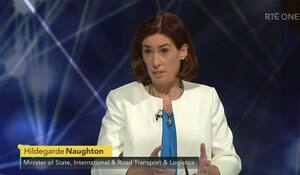
From top: Hildegarde Naughton and an exasperated Miriam O’Callaghan on last Thursday’s Prime Time on RTÉ One; Eamonn Kelly

Confidence in the Crony System

This week’s confidence/no-confidence votes in Simon Coveney seem less about Coveney and more about confidence/no-confidence in the old ways of doing things.

The taoiseach seems to be sub-consciously aware of this, since he has accused Sinn Féin of playing “Old style opposition politics”. As opposed, presumably, to the new style agreeable opposition politics mentioned on RTÉs Prime Time the week before last, and discussed here last week.

A new style of agreeable politics that sees a Fianna Fáil taoiseach threaten Fianna Fáil TDs with suspension should they fail to vote confidence in a Fine Gael Minister accused of cronyism.

May we all live in interesting times.

Meanwhile, on Newstalk, FG Minister Colm Brophy was making the case for it being a waste of talent for Simon Coveney to resign, an argument never made by FG/FF when arts funding is cut, or people are denied access to Third Level education due to economic constraints, or the best and the brightest graduates are expected to emigrate rather than stay at home and compete with favoured cronies.

Please Stop Talking

One of the highlights of the week came when Miriam O’Callaghan on Prime Time, wading through a blizzard of accusation from Hildegarde Naughton directed at Pearse Doherty, framed on a big screen somewhere in Donegal, finally surrendered to exasperation and politely asked Hildegard to please stop talking.

Hildegard was relying on an old argument strategy, where you win by simply making so much noise that no one can hear the opposing view. In the blizzard of Hildegard’s words there was a denial that Katherine Zappone knew about the job on March 3.

There was also an accusation that Doherty was impugning the reputation of a senior civil servant, for reasons that were lost in the thick undergrowth of smokescreen verbiage, and it was into this that Miriam O’Callaghan, like a firm parent, finally asked Hildegard to please stop talking, allowing Pearse Doherty to return once again to the crux of the matter, that the entire Zappone appointment was a case of cronyism in action.

This is a proposition that many people are reluctant to accept, despite the fact that every soc/pol student in Ireland for the past 40 to 50 years has been informed, with stats, graphs and comparative academic musings, of this unfortunate and undeniable aspect of Irish cultural life, where the habit has leeched into all other systems.

Information

Prime Time also looked into another aspect of the political class that has been uncovered as a result of the Zappone case, the fact that so much official government business is “informal”, leaving no record, and that official texts are routinely deleted, which is the modern equivalent of the missing hours from Nixon’s tapes.

Prime Time also reported routines within government where possible problematical papers are marked for destruction should anyone ever request them. A solution to journalistic Freedom of Information requests that must surely have been borrowed from an episode of Yes Minister.

It is possible in all this that Simon Coveney, as Hildegarde Naughton has it, is an honourable person, and that he was simply conducting himself in a normal fashion by the lights of those old understandings, seeing absolutely no wrong in arranging a political posting for a crony. Because this is the way it has always been done.

In this sense, cronyism is an Irish political tradition, almost a conservative approach to public life that has likely arisen in the wake of generations of mass emigration. The best, arguably, always emigrated, while the mediocre friends of friends ruled the roost, owned the houses, rented the flats, sold the beer and so on. They’ve had it their own way for so long that they think cronyism is normal.

The Zappone story is not just about the Zappone appointment, or whether or not Simon Coveney is a good guy. I’m sure he is. The story is more about the unmasking of a political system of who you know, not what you know. About the example being set for how things are done, and the standards that are acceptable at official level in how appointments are made and how official documents are managed.

Spoilsports

The brightest are no longer emigrating. Instead, they are looking straight back at this sham of a crony show and they are not amused. A generation far too copped on to be taken in by those old spiels that once worked so well on what was essentially a rural peasantry.

But the real giveaway of a government out of touch with basic democratic ideas is that many of the ministers, including the taoiseach, genuinely appear to believe that the opposition are “spoilsports”, and not a valid democratic opposition to an entrenched conservatism. As if the mistakes of government are the fault of an opposition for pointing them out.

Because behind Hildegarde Naughton’s attempt to talk over Pearse Doherty lies the unspoken belief, essentially class-based, that some people have the right to speak and others the duty to listen. And that’s a problem in a republic. That’s an aristocratic attitude, concealing a litany of class-based expectations and sense of entitlements.

Owning Up

What the Zappone case has shown, is that the days when influential politicians could simply slip cronies into advantageous positions without being held to account are now over.

In this regard, the confidence vote in Coveney then becomes not a show of loyalty, as Micheál Martin appears to believe it is, but rather a denial that anything untoward has occurred. Ultimately, the confidence vote is a denial that the crony system even exists, despite all academic and anecdotal evidence to the contrary.

This ongoing denial and refusal to own up to such a glaring case of cronyism as the Zappone case, really is the worst form of political gaslighting on a fair-minded public, always more than patient with the often-dismissive attitudes of their comfortable political representatives and their equally comfortable media apologists.

Eamonn Kelly is a Galway-based  freelance Writer and Playwright. His weekly round-up appears here every Monday.

Previously: Eamonn Kelly on Broadsheet

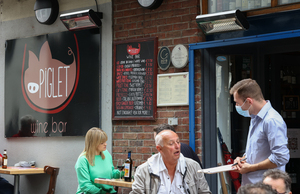
From top: Piglet wine bar, Dublin; Eamonn Kelly

And the new season kicked off with the reopening of the Zappone controversy, resurrected by what appears to be an internal Fine Gael leadership contest, with Varadkar one-upping Coveney by releasing text messages which his department had earlier refused to journalists under the Freedom of Information act.

Labour TD Brendan Howlin, who was instrumental in drafting the Freedom of Information act, told the IT on Friday that Simon Coveney may have been in breach of the act by deleting texts related to his office.

Meanwhile, Coveney was questioned by a committee formed to look into the controversy and, according to various commentators tasked with going through this stuff, his and Varadkar’s stories differ from earlier versions.

By Thursday, Micheál Martin was miffed at having his thunder stolen by the Zappone saga as he unveiled a new housing plan which will allow for 10% social housing, 10% affordable housing (€250,000), and 80% neither social nor affordable housing, to be bought up in great swaths by billionaires to rent back to us. You might call them anti-social housing.

Micheál called for common sense to be brought to bear on the Zappone saga, calling the reaction melodramatic, while the Irish Examiner called for a line to be drawn under the whole affair. A resignation would be a line, I suppose.

By week’s end, Leo Varadkar, not content with being ahead of Coveney on brownie points for volunteering his texts, squandered the lead by attending a music festival in the UK. Remember them? The ones we can’t have here, because of… Well, because of Leo.

Dogsbodies

Meanwhile, employers availing of the JobBrdge 2 scheme as a source of cheap labour are being outed by the non-profit organisation “ScamBridge”. The latest “lucky break” was a dog grooming service offering €3.43 an hour to a dog-washer.

The lucky candidate would have to posses the following attributes: A full driving license; confidence in handling dogs of various sizes (Ya got the job big dog); good customer service skills; ability to take instruction from the employer to help the poor crayturs with their workload; ability to work as part of a team with good time-keeping and good attitude; and, ability to live on less than €150 a week.

Just kidding, I added that last condition myself, based on a 40-hour week. But it’s more likely that such an exploited candidate would be expected to work more than 40 hours, so it’s possible that they might actually knock a living wage out of it. Theoretically there are enough hours in the day to hold down a full-time barely-paying position and make the rent, if you don’t bother with sleep. Only cissies sleep. That was Leo’s message when he became FG leader.

This idea of being “positive” is being routinely exploited by just about everyone. If you don’t have a good attitude, apparently, you’re unlikely to find an employer to exploit you. And if you are lucky enough to find an employer to exploit you, you are expected to always put their needs first. It’s only fair. They’re the employer, while you… well, you’re nobody, aren’t you?

Positivity

The idea of positivity also crept up on RTE’s Primetime when the RTE interviewer accused Sinn Fein’s spokesperson for Housing, Eoin Ó Broin, of being negative about the government’s new housing plan.

But in politics it’s the opposition’s role to be “negative”. That’s the actual engine of democracy. To ask that the opposition take a positive attitude to a government proposal is badly missing the point of parliamentary debate.

But as we have seen with the dog-washing position, this idea of being agreeable, no matter what the circumstances, is now endemic in the culture. It’s an American import, from the home of can do and fuck you, where it is widely and neo-liberally used and abused for exploitation.

The concept of exploitative positivity was brilliantly dissected by journalist Barbara Ehrenreich in a series of books, among them the tellingly titled “Smile or Die”, and “Nickel and Dimed”, where she went undercover as a low-paid worker and found her confidence, positivity, money and health draining away over a matter of weeks, while her various employers thrived.

She describes washing a floor in a private house while the woman of the house stood behind her, arms folded, looking down on her, deriving clear satisfaction from being able to afford to have another Human Being literally down on their knees at her behest.

This is the promised land of privatisation promoted by our neo-liberal government. A world where the exploited worker is also expected to smile and be agreeable.

Human Rights

Simon Coveney, when asked by the Oireachtas committee about how he defined the UN envoy role intended for Zappone, replied that the thinking was around human rights in general and that he plumped for a focus on freedom of expression and LGBT rights, which also happened to conveniently match Zappone’s qualifications.

In the neo-liberal world, it is considered a human right to declare yourself LGBT, but you have no right to shelter, unless that shelter is provided by a privatised company eager to cut costs for profit. This explains the tents on Dublin’s streets, because the privatised homeless shelters are authoritarian hell holes.

Coveney told the committee that he went through the UN Declaration of Human Rights looking for ideas. It must have been a necessarily politically biased search, because if he had bothered to linger on Article 23 he’d have seen there was no place in the human rights catalogue for JobBridge.

“Article 23 (2) Everyone….has the right to equal pay for equal work.”

“Article 23 (3) Everyone who works has the right to just and favourable remuneration ensuring for himself and his family an existence worthy of human dignity, and supplemented, if necessary, by other means of social protection.”

He must have missed this one. And there is a good reason why. He was likely less interested in human rights and more interested in altering the job description of “Special Envoy for Freedom of Opinion and Expression” – concepts which relate strongly to journalism, arts and social equality – and more interested in shaping the job description to match the qualifications of a favoured candidate, in this case a government crony with a background in campaigning for LGBT rights.

Reduced Freedoms

As a result, the concepts of freedom of opinion and expression have now been collapsed in the public mind to infer only those issues related to LGBT rights. A move which could be regarded as the political appropriation of the concept of gender equality, cynically used as an instrument to ensure a placement in a “glamourous” UN role for a crony, while narrowing the meaning of freedom of opinion and expression, as an unfortunate by-product of this self-serving meddling with the UN Declaration of Human Rights.

Is this the first time that Irish parish pump crony politics has attempted to bluff a political appointment on the international stage? And why does the taoiseach see this as a trivial matter? Can he genuinely not see the problem? Maybe such blindness is not surprising, since Fianna Fáil has been the home of cronyism for generations.

Coveney told the committee that Zappone didn’t lobby him for the position, but rather “reached out”, another annoying American corporate-speak phrase designed to ward off truth.

When you make a complaint to a corporation, maybe feeling fit to nuke them, their representatives are inclined to twist the knife by sweetly thanking you for “reaching out”. Soon, all criticism of government policy may be handled with that same calculated eff-you phrase.

Finally

Employers were complaining during the week that no one wants to work anymore, while it was also reported elsewhere that recorded suicides are at their lowest level in two decades. Make of that what you will.

Nanu Nanu. Smile or die.

Eamonn Kelly is a Galway-based  freelance Writer and Playwright. His weekly round-up appears here every Monday.
Previously: Eamonn Kelly on Broadsheet

RollingNews