



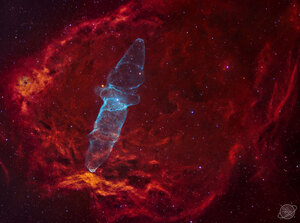
Behold: Ou4 (in blue), and Sh2-129 (in red), aka the Giant Squid Nebula enclosed by the downward flapping wings of the Flying Bat Nebula as seen against the backdrop of the constellation of Cepheus. Quite a shot. To wit:
Composed with 55 hours of narrowband image data, the telescopic field of view is 3 degrees or 6 Full Moons across. Discovered in 2011 by French astro-imager Nicolas Outters, the Squid Nebula’s alluring bipolar shape is distinguished here by the telltale blue-green emission from doubly ionized oxygen atoms. Though apparently completely surrounded by the reddish hydrogen emission region Sh2-129, the true distance and nature of the Squid Nebula have been difficult to determine. Still, a more recent investigation suggests Ou4 really does lie within Sh2-129 some 2,300 light-years away. Consistent with that scenario, Ou4 would represent a spectacular outflow driven by HR8119, a triple system of hot, massive stars seen near the center of the nebula. The truly giant Squid Nebula would physically be nearly 50 light-years across.


(Image: Yannick Akar)
Looks like Zeus left a used condom floating around the universe by accident
As above so below
I know these posts don’t get many comments, (I love ‘em), but this is a fuppin’ cracker!
+1
Some of the best posts on here have no comments cos they’re not comment-bait.
Having said that, I also like the comment-bait posts!