



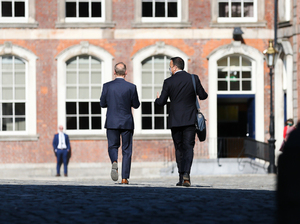
From top: Taoiseach Micheal Martin (left) and Taniaste Leo Varadkar; Eamonn Kelly
The week that was
Last week, Micheál Martin, apparently out to prove that politics can be kind, and against a backdrop of howls of complaint and derision from members of his own party, passed up a golden opportunity to take an authoritative stand and request Leo Varadkar’s resignation.
What was his thinking? That the coalition and his own leadership might be weakened by Varadkar’s resignation? Or was he practising a kind of fair play? If so, does he really believe that if their positions were reversed that his Fine Gael counterpart would be so charitable?
On Tuesday, Ógra Fianna Fáil called for Varadkar’s resignation, to which a Fianna Fáil TD growled, “They’ve asked the wrong man to resign.”, meaning Martin. With that kind of heat from his own party he might soon be looking to join Fine Gael.
They say nice guys come last, and I can only imagine that this rule of thumb is ruthlessly amplified in the world of politics. If Martin was being “nice”, or loyal, it may have been a fatal political miscalculation.
Not only has he passed up an opportunity to humble his political Fine Gael rival, but he has also passed up the opportunity to put a solid Fianna Fáil stamp on the coalition job-sharing arrangement.
By the end of the week there were reports of a potential heave against Micheál Martin from 11 FF rebels, while in FG, there were reports that Leo Varadkar’s support base in the party was rapidly deteriorating.
Cattle Flatus
Apart from that, the world appears to be actually ending, according to the Intergovernmental Panel on Climate Change (IPCC) report, issued on Monday. As if Mondays weren’t bad enough.
Ireland has two major carbon producing entities to be dealing with: cows and cars, with cattle flatus, or cows’ farts, accounting for one third of Ireland’s CO2 emissions. In this case you certainly don’t need a weatherman to know which way the wind blows.
With cars, the idea is to change over to electric cars, but Irish motorists haven’t really bitten the electric car idea yet, while public transport is still regarded by many as a step down socially, so the car won’t be going away just yet.
Ireland is peculiar in that it is a collection of disconnected cities, towns and villages that rely for connection almost totally on the private car. A serious climate plan would have to look seriously at an electric network of public transport serving the entire island.
To this end, senator Timmy Dooley of Fianna Fáil called for free public transport as a means of attracting people out of their cars, where they clog up the roads to and from the industrial estates, each carrying one person and re-defining the meaning of a waste of space.
Taxes
But free public transport is never going to happen with neo-liberals in power. They are more of the castles and moats lineage, and as things worsen, exclusion will likely become the norm.
At the moment, according to Paul Murphy of People Before Profit, they are trying to privatise public transport and are pressing bus drivers to work 10-hour days. That’s a long way from thoughts of free transport.
But conservatives don’t really do progressive social ideas. That’s what conservative means after all: avoidance, at all costs, of progressive ideas. They much prefer taxes and calculating percentages and declaring who can and can’t come to ball.
Finance minister Paschal Donohoe is the political equivalent of the concept, Give-a-man-a-hammer-and-all-he-sees-are-nails. Give Paschal a problem, any problem, and all he sees are taxes. Which is ironic, given that Ireland is a proud tax-free haven for people who don’t really need tax breaks.
The carbon-tax idea will likely impact on poor people the most. The idea is that the tax is a punitive measure taken against those reliant on fossil fuels, applied at point of sale. So, the more you use the more you are taxed. Carbon tax is a cousin of cigarette and alcohol taxes.
Percentages
Conservatives also feel comfortable with percentage targets and long-term deadlines to be met, even in a collapse of civilisation scenario. They can calculate the percentages down to annual increments, and fit the sums inside the assigned time-frame window, with the result that all looks to be under control.
If you have to achieve x carbon reduction by 2050, it means an annual target of y, plenty of time to do it, and plenty of wriggle room for finger pointing at the Left.
But this is badly missing the point of what is required to offset an increasingly unpredictable climate emergency. It is the type of thinking that still has both feet in the old world, when what is required is a total rethink of the way things are done.
On this note, Diarmuid Ferriter, writing in the Irish Times, says that Ireland needs a green social revolution similar to the social revolution that brought rural electrification: a total game-changer to quickly usher in a green infrastructure.
A beginning might be to look at creating an electric public transport network and Dutch-style flood defences; invest in a diversification of agriculture, and ditch half the cows and half the cars, halving CO2 emissions at a stroke.
Eamonn Kelly is a Galway-based freelance Writer and Playwright. His weekly round-up appears here every Monday.
Previously: Eamonn Kelly on Broadsheet



Lots of good sense in this. The portrait of once bitter foes offering little in the way of cut and thrust of the forefathers whose seats they occupy today really does underline how neither one would be any great loss. The conservative approach has seen its day, based always on preservation for a future time with an unhealthy social division maintained in the present. It is likely already known that this is so and neither fg nor ff wish to engage in a like for like exchange because it will become very obvious that in their relationship to a voter base each offers little of any worth to our present circumstance. The farmer’s would be in uproar if there were less cattle and the wider business sector simply don’t like any change, so it is we must get back to normal has been cried out into a void for long enough that its echo is all that seems to make sense anymore. Sadly this is in many instances shouted by small business owners who must service hefty loans that were taken to stay financially viable or even more upsettingly, to provide supposed meaning to their lives. Social division has over decades created a situation where individuals presume to know their place and in many instances come to dominate it as if it is theirs alone, whether oversized vehicles on the roads or the everyday antics experienced by people who share public transport. The ideas proposed here are sound but they will be a hard sell and will not encourage much political support so long as irish politics is sustained as a duopoly, where neither side is willing to push the other to do better by effectively holding one another to account.