



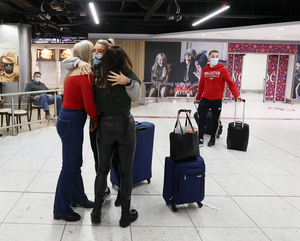
 From top: Home for Christmas at Dublin Airport on Saturday; Derek Mooney
In his hefty 2011 tome, The Better Angels of Our Nature, cognitive psychologist, Prof Steven Pinker argues that the lesson of history is a society that has become less violent. His central premise is that there has never been any time, in the history of mankind, when we were less likely to die at another’s hand, than now.
It’s an uncommonly positive and optimistic analysis of the state of the world. Right now we need as much of that as we can get. Pinker’s outlook is not unique to him. Many others have reached the same conclusion. This is no surprise. The statistics are convincing.
Life expectancy across the globe is more than double what it was 100 years ago. While 10% of the world’s population still lives in extreme poverty, two centuries ago the figure was over 80%. Over the same period, and in a not unlinked development, the level of world illiteracy has fallen from 88% to 10%.
Globally, we have created more wealth over the past forty years, than we did in in all human history before that (the share-out is still problematic). War, disease, and natural disasters now claim fewer lives than ever, even allowing for Covid-19. Child mortality (dying before the age of five) is 4% today. That’s a tragically high rate, but only a fraction of the 50% rate that prevailed two centuries back.
In his book Pinker speculates on what he calls the “source of our strange idiom: To Cut Off Your Nose To Spite Your Face.” Citing sources from the late medieval period onwards, he says the cutting off someone’s nose was a prototypical act of spite. This was done as “an official punishment for heresy, treason, prostitution, or sodomy,” but also as “an act of private vengeance.”
But as gross and inhumane as medieval behaviour was, even they were rarely moved to self-harm as a way to spite others. In these more advanced, enlightened, and more peaceful times, neither are we.
Opinions polls, surveys, and actual votes, conducted across Europe show that two-thirds of us broadly support and back government imposed Covid restrictions. In a heated and fraught referendum held at the end of November, 62% of Swiss voters rejected libertarian claims that the government’s Covid certificate “implicitly induces a forced vaccination”. It was the second time this year that Swiss voters have backed governments measures to restrict Covid.
This does not mean that they like the measures or that they believe that the particular measures represent the very best the State can do. It means that people will follow guidance and protect themselves and others by following the same guidance as everyone else. They will not cut off their nose to spite their face… or, the government of the day. They act for the greater good.
Neither does it mean that voters believe that their governments are doing all that they can to counter the disease, but it does point to people understanding the severity of the potential threat and seeing the restrictions, curfews, lockdowns, and circuit breakers as not unreasonable responses.
Though they do not have the pub and restaurant curfews we have, publicans and restauranteurs across the UK report significant fall-offs in bookings, with the people deciding not to wait for Boris Johnson to act. They are deciding to voluntarily curfew themselves. Friends of mine report that their local pubs are almost empty after 7pm.
Are British voters content with Johnson’s government not giving them the advice that our government is giving us, and is allowing them to decide for themselves?
Is the fall-off in support for the Tories that we see in the polls and in last Thursday’s North Shropshire by-election due to public dissatisfaction at the government’s handling of the Covid response? Or, is it a more general despair at Johnson’s bumbling style of leadership? It is hard to know for sure.
I suspect most voters, in most countries, feel their governments could be doing better, or more, especially as they see what is happening elsewhere.
Saturday’s announcement, by the Dutch government, of even stiffer Covid restrictions was seen by some here as a vindication of what our own government had done, with more than a hint of the “there but for the grace of God, go we.”
But is that a fair assessment? Many think not. Including Prof Anthony Staines, who I also quoted here two weeks back. Responding to the news of the Dutch decision on Twitter, Prof Staines said they were now doing the right thing, but that was because “The Netherlands public health response has been as weak as ours…”
This is the real issue for the Dutch, Irish and many other governments is not the scope or pace of their responses via curfews, lockdowns, or restrictions, it is the seeming paucity of their substantive preparedness to cope with a threat… albeit a threat that history tells us will abate with time.
So, I think the fundamental question facing our government, and many other governments, is this: If, over a year after you first imposed a lockdown to halt the spread of a virus, you find yourself doing the same thing again; to stop what is essentially the same virus; and despite an impressive vaccination campaign, then isn’t there something seriously wrong with your response?
Identifying this “something”, this key missing element, is in all our interests.
This is not a party-political point. While the main opposition parties have been vocal in calling for “more”, they have been less robust in expanding on what that “more” might be.
In fairness, the opposition – and many backbench government TDs and Senators – have rightly identified the gaps in the State’s approach, specifically how the departments of Finance, Public Expenditure and Health have managed to leave us with 30 fewer ICU beds than planned just three years ago. By itself, this is a stunning failure of basic statecraft.
Listing the problems and failings is not a difficult task. There are plenty to choose from. The general problems with contact tracing, including the NPHET advice to stop contact tracing in schools from 27 September; the early mistakes made in nursing homes; the mixed messaging on Antigen testing; the confusion around Covid-19 advice for migrant communities, and this is before we get to the long-standing issues of recruitment and retention of nurses and consultants.
No, the key policy issue is to identify which of these items are understandable errors by a system that is progressively getting to grips with the situation, and which are fundamental failures of structure, of policy or of understanding.
One of the best decisions of the last government was (on May 6th, 2020) to establish a Special Dáil Committee on Covid-19 Response. One of the most churlish of the current government was to allow the dissolution of the committee on Oct 8th, 2020, after it published its first report.
I can see why some officials might utter a sigh of relief at seeing the oversight of the State’s response diffused across a number of Oireachtas committees, rather than to just one. But why would their political masters go along with it? The elected politicians who agreed to dissolve the committee have metaphorically cut off their political noses to spite their faces.
It was a bad move. It should be fixed ASAP. The committee should be re-established, with a remit to tackle the question I posed above. It will do us all an enormous service – and prove that an all-party political approach can work – by helping identify the something, or things, we to should do to help avoid going through this merry-go-round again when the near inevitable next wave comes.
May I wish you, and yours, a very Merry Christmas and a happier and New Year. History tells us that – in all likelihood – 2022 will be better and more peaceful than 2021. I believe in history as strongly as I believe in science.
Derek Mooney is a communications and public affairs consultant. He previously served as a Ministerial Adviser to the Fianna Fáil-led government 2004 – 2010. His column appears here every Monday. Follow Derek on Twitter: @dsmooney



The something of which the writer refers is accounted for perhaps as the discrepency that exists between the actual role of government and its presumed role. As a previous ministerial advisor he is in a good position to recall this essential dynamic character of state leadership.
A health based emergency has taken root in ireland since those extra 30 icu beds were recomended three years ago it seems. It makes you wonder what were the projected figures for transfers from public to private health care for the year 2019, prior of course to the occurence of covid, and not least the role since of private insurance at a time of other such market uncertainties.
Is it wrong to see it that governments are only implementing measures which they have forecast will not lose them their position of leadership? In Italy where fascism is not only a word but a lived experience for some, the situation appears to be more clear cut regards the government’s applied measures.
In ireland the role of the church in state governance has its own history. And people who want to believe in something is not new. Politics or science, conspiracies of control or simply motivated by profits, but none of these have provided much resolution to a virus that passes indiscriminately and whose threat for the most part exposes the vulnerabilities of those who remember church influence with a certain fondness, perhaps for the safety it inscribed, much as in Italy it may be that fascism is remembered by those who again are proven most vulnerable to the health implications of covid.
Profits and conspiracies reflect the values of a younger demographic, effected less by direct health complications and for whom politics is only a side note and of a very different image. The writer and many like him talk about the government’s response to covid like it matters yet government has only ever publicly deferred to the science so in the end none if it describes a strong leadership. The so called science representatives are bad actors, as are the politicians who claim to have no choice. At least the multinationals and various other business enterprises are sincere about making profits off of the situation but that is a very bad message to take into the new year. It is likely one that will no less continue to dominate how government and science are used to serve these ends.
Lockdowns were entirely logical and necessary in March->May 2020 when we had no idea what to expect from covid.
Another lockdown from January 2021 until early April to prevent the health system from being overwhelmed, and allow the most vulnerable in society to get vaccinated, would also have been completely understandable and necessary. Staying locked down until October of this year however was completely idiotic behaviour, that prevented us from having any decent base level of natural immunity going into winter.
Locking down again, now, with literally nothing going to change in the future is a complete failure of government. We’ll likely never again reach such high levels of vaccination as in the first drive, and the most vulnerable have already received a recent booster.
What exactly is the plan going forward? Covid isn’t going away. Vaccine protection lasts a period of a few months at best it seems. Lockdowns are ruinously expensive. Sooner or later our government needs to admit that we just need to expand ICU capacity rapidly and live with the virus. Everyone is going to catch it, some people will die, theres no magic bullet here.
‘What exactly is the plan going forward?‘
Going forward adds nothing to this sentence. Have you ever come across a plan that goes backwards.
have you seen the current housing situation, there’s a plan that not only went backward, it ate itself.
Yes. Our current trajectory is backwards not forward
We should have a campaign to encourage everyone within reason to catch covid and be damned.
Get Covid Done’. You heard it here first.