



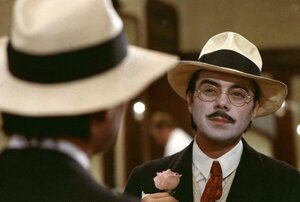

From top: Dirk Bogarde in the 1971 film adaptation by Visconti of Thomas Mann’s novella ‘Death in Venice’; David Langwallner
I have been asked by several organs and journals to review Colm Tóibín’s book on Thomas Mann, The Magician, and it is, in my view, beautifully written. But that is an aside.
The reasons that I have been asked, so plentifully, to review are patently obvious in some respects and ought to dictate, in these perilous times, a level of circumspection.
In fact, modesty aside, and he was modest and hardworking, I am like a pale zeitgeist anomaly of Mann. I reserve it for Broadsheet, and it is an especially important text, The Magician, and says a lot by implication. In fact, it is one extended foreboding metaphor for our time.
The very civilised editor of one organ who has published me, although liking my content, does not like my prose style.
Let us remind ourselves this is what the magician Thomas Mann said about his prose style self reflexively and with innate protestant judgment and modesty. He said it is ponderous, ceremonious, and civilised. The same could be said about me. It is certainly not sexy.
Of course, Mann followed that observation with a very pregnant sentence: it is all the thing the fascists hate. Well Touché. That is because they burn books, peddle disinformation, do not like nuanced or reasoned argument and resort to hysteria. As a writer of prose, he is lesser than Kafka and Musil and Broch in the Austro German 20th century canon though he did win the Nobel prize and early (1929).
Buddenbrooks which won him the prize and The Magic Mountain – though suffused with good things – are written in terrible Hoch Deutsch Prussian turgid prose, stilted, civilised and bourgeoisie to quote himself on himself again. So, though much celebrated, they are not terrific books, which is not to diminish that they are particularly good Sehr Gut books of educational and instructional value. If that were all he would be a very minor writer indeed but that is not all. The best was yet to come, in exile.
Death In Venice, though earlier, is a terrific book is a kind of cry of his repressed same-sex attraction and of the end of that that hyper civilised aesthetic intelligence and it is a masterpiece. The film by Visconti with Dirk Bogarde, though laboured, also so. The film includes at length the famous adagio by Mahler and Mann knew Mahler. In fact, he knew everybody and was very catholic in his tastes and his company even extending to rum company.
The literary reputation of which Tóibín does not deal with deliberately is not just based on that short novella or other great short novellas such as Mario the Magician, but of his end-of-life books. Peripatetic and a moving target where he correctly saw himself as a potential golden prize for the fascists. Those late books are after the deluge where the Lübeck conservative let fly at all he hated.
The book traces in detail how the arch senatorial conservative and custodian of the system simply could not deal with Nazis. At an implicit or explicit level, it is a simply a judgment of taste and he had impeccable personal and aesthetic taste and was cosmopolitan but not decadent in same.
As an arch conservative from an arch conservative family, he saw no difficulty in marrying a converted Jewess who he was deeply in love with. At all levels, the book shows how conservative apolitical manners are a force for the good. The book constantly stresses from observation and quotation from his speeches and writings that he was a very apolitical and private man and often observed he was a social and family-oriented person focused on the work. He liked nothing better than to go out for walks with his wife after making love to her.
His mother was Brazilian and his father a toad and a martinet who dictated coercive tones towards family regulation on his death, as the book establishes. So, his attitude towards women was much better and he he disapproved of dissolute men from Oscar Wilde to his lesser writer brother, the fecklessly irresponsible Heinrich Mann.
The reason, I suspect, Tóibín has engaged in his subject, though not explicit in the text, is that Mann is central to our age. He faced an ethical dilemma. He was the famous and esteemed writer in Germany, but he could not abide the boorish and uncivilised Nazis, so he left for Switzerland, America and Switzerland again.. A forced Goethesque grand tour as I am sure he might have framed it. But it led to the greatness Tóibín only touches on.
Dr Faustus is one of the terrific books of all time written when he was near 80. It is a masterpiece. The book is about the composer Leverkuhn who sells his soul to the devil. Fascism. It is also about the corrupting influence of atonal music and its nihilistic dissonance which creates a valueless universe. As do the structuralists and deconstructionists of our age.
Also, I think, it is about Martin Heidegger as the two central intellectual figures in Germany they were both presented with a dilemma. Heidegger fell for the bait and took all the Nazi accolades. He took the Faustian pact even with a Jewish mistress, Hannah Arendt, who wrote eloquently subsequently about the banality of evil. Mann, though wealthy, did say no and there his greatness as a human being resides. In a speech in America, championed indirectly by Eleanor Roosevelt, he said:
“They cannot last, they must not last, they will not last/”
It is what is needed in our time and a kind of parable. The reassertion of civilised cosmopolitan tolerance. Of decency, rigour, and moderation. Of stable family structures and hardworking routines. Of civic decency and private ordering.
And when the magician, the most private of men, feels he must become public.,well that is also necessary for many now.
David Langwallner is a barrister, specialising in public law, immigration, housing and criminal defence including miscarriages of justice. He is emeritus director of the Irish Innocence project and was Irish lawyer of the year at the 2015 Irish law awards. Follow David on Twitter @DLangwallner
MGM



I think that Hannah Arendts thesis about the banality of evil has been debunked in the face of all the interviews Eichmann gave to his fanclub in Argentina.
Colm Toibin is a terrible person: https://www.irishtimes.com/news/writer-admits-aggravated-sexual-assault-of-15-year-old-boy-1.944352
How does this article make Colm Tobin a ‘terrible person’? It refers to a writer named Desmond Hogan.
Did you read the article? That might help. Toibin gave Hogan a glowing character reference.
Yes, 14 years ago when character references were a thing. I doubt he endorsed Hogan’s crime. Is Anthony Farrell a terrible person too?
Character references for child rapists were not ‘a thing’ 14 years ago. That’s an awful way to dismiss the trauma that kid went through. Toibin has never apologized to the victim. In fact, Toibin’s PR people often prevent interviewers asking about his defense of Desmond Hogan. Not going to commnet on Farrell, but if you think Farrell is an honest person, with no skin in the game when it comes to Hogan, then that’s your problem.
I won’t comment any further on this except to say I didn’t know it involved rape, which is not to say that sexual assault is excusable.
rte.ie/amp/915044/
So, if you’d a friend, and your friend raped a child with special needs, you’d provide the court with a character reference for them? Really?
If I were your editor, David, I’d be saying this is all good and well but where’s my book review. I enjoyed The Master and am looking forward to this one too.
Whats the name of your book
I meant, where’s the book review of The Magician as requested. I’d want more than ‘it’s beautifully written’.
it was not a book review but the review of a life well led as was the novel
Okay, my mistake. I read it as you being in demand as a would-be reviewer of the Colm Tobin book but deciding to grant BS an exclusive. Nice piece in any event :)
I am glad to know that Thomas Mann slammed atonal music. Did he express any views about modern art trends from Marcel Duchamp and Picasso onwards?