




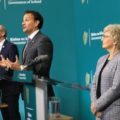
From top: Chay Bowes (left), HSE CEO Paul Reid; Eamonn Kelly
Chay Bowes, former head of the VHI Homecare division, spoke to Cassandra Voices last November about the HSE and the dysfunction he witnessed within the system. What was chilling about the interview was that the dysfunction was not accidental, it was as good as designed, specifically to benefit the private medical sector.
Bowes met with considerable obstacles when he tried to establish a community care model to alleviate pressure on over-crowded hospitals. He worked with elderly patients in St James’s Hospital as a phlebotomist (the guy or gal who takes your blood samples), where he formed the opinion that health care in Ireland seemed to be focused more on “financial outcome than patient outcome”.
It seemed to him that a lot of elderly people were making needless trips to large general hospitals for routine interventions, where they mingled with others and picked up colds and flu and God knows what else. That these visits to large hospitals, far from being good for their health, as intended, were actually a health liability.
Community Care
Bowes saw an opportunity to develop a community-care business whose basic idea was to bring the hospital to the elderly rather than the other way around. The idea suited the elderly, suited their families, suited over-worked staff in the always-busy general hospitals. Suited everyone in fact, but the managerial fraternity of the HSE.
Bowes’ business, starting off with himself working alone taking blood samples in people’s homes rather than having them sit all day in some hospital waiting room, developed through several incarnations until he finally had 200 people working for him and held a contract with the HSE worth €14 million, the company now called Tara Healthcare.
The developing community-care scheme, which really had the effect of taking “business” away from hospitals, was met with scepticism by the medical establishment, with petty rivalries causing some hospitals to refuse to send patients to Tara Care because this guy didn’t like that guy, and so on. Schoolyard stuff.
Then, following the financial crisis of 2008 the HSE closed the contract for Tara’s services, despite pressured hospital staff lobbying to be included in the service.
Bowes recalls:
“They had to pay us a penalty for terminating the contract prematurely, which cost them more than running it for the subsequent two years.”
Which suggests that the financial crisis was used as an excuse to cull the service rather than a pressing and necessary cutback. A senior HSE person told him:
“What you’ve done in Dublin is almost too good. Everyone’s going to want it. They’re going to want it in Galway. They’re going to want it in Limerick.”
Yes, you heard that right, the HSE refused to fund a successful community-care service, which everyone wanted, because the service was “too good”.
Dysfunction Pays
Bowes concluded from this that people in the HSE, at management level, were personally benefiting from the HSE’s dysfunction, to the extent of perpetuating that dysfunction for profit. This perpetuation of dysfunction involved, as we saw, needlessly summoning elderly people to large hospitals for routine procedures that could easily be done in the comfort of their homes.
The bottom line is, that “the hospitals want to hold onto patients because without patients occupying beds, they can’t justify their budgets.”
But Bowes’ perception of this needless use of old people goes far deeper than just working an angle to procure public monies. To Bowes, what he was witnessing was an antiquated class system of prejudice and disregard towards those dependent on the public health service, describing the large general hospitals as”
“Victorian constructs, where we put all the sick people who are susceptible to infections, so that they can mix with other sick people.”
So, the necessary over-crowding of hospitals by hospital management, to justify the continued procurement of public funds, is based partly on an attitude of disregard for the health of a certain class of people: that is, poor people dependent on the public health service. To simplify it even more, they needlessly endanger the health of poor and vulnerable elderly people to justify maintaining their standards of funding.
As Bowes put it to Cassandra Voices:
“…because budgets are pinned to occupancy and the size of the facility, hospitals seemed slow to manage overcrowding at the cost of lesser funding.”
Waiting Lists
According to Bowes there are now almost a million Irish people on hospital waiting lists. Some will never be treated. They will literally die waiting. That is one-fifth of the population, waiting, often for rudimentary treatments, in a system where the same doctors and consultants that occupy and derive payment from the public health system can offer private treatment for the same ailment “tomorrow”, if you have the money.
Bowes says:
“it just so happens that the man running the show, Paul Reid, has no specific health care experience… The UK’s NHS employs around 1.4 million people to serve a population of nearly 67 million. Its CEO Simon Stevens is paid €210,000 a year, while Ireland’s HSE employs around 102,000 people with a population of only 4.9 million, Reid is astoundingly paid over €426,000 a year.”
When he puts it like that the HSE really does sound like a bit of a racket. He goes on to describe the Irish Health Care system as medieval, dysfunctional and immoral.
“We have a segregated, apartheid system in health care. It simply isn’t based on needs of the patients… There are super doctors out there, super surgeons, super nurses and staff operating in the health system. It’s definitely a case of lions being led by donkeys.”
In other words, as I understand it, the managerial structures of the HSE exploit even the good will and intent of serious medical personnel, for profit.
Health policy in Ireland, Bowes told Cassandra Voices, reflects,
“the laissez faire attitude of a class of people who are running the medical system, advising the agency and the legal system. They of course all have health insurance. I don’t know anybody who served on the board of the VHI or any doctor working in the system who doesn’t have private healthcare… unlike more than 50% of the most needy In our society…”
The question is, is the health service that Bowes describes an outlier in the Irish system of public services and the wider social strata, or is it just the grossest example of an institutionalised attitude towards public money, public services and poor people? Do we live in an apartheid state based entirely on land and wealth acquisition and possession, or is the HSE an anomaly?
We Are Stardust
On this 41st anniversary of the Stardust fire I see Charlie Bird made the point again that if this fire had occurred in a more salubrious neighbourhood that the families wouldn’t have been waiting for over 40 years to learn what caused it.
The unspoken belief (it can’t be spoken for legal reasons) is that business interests were protected from liability through a process of official “forgetfulness” and neglect. This studied neglect seems like yet another fractal of the larger neglect of ordinary people by Ireland’s elite.
On RTE’s Claire Byrne Show last night any time the subject of class division was raised it was quickly talked over. As comedien Martin Beanz Ward put it, They are now doing to ordinary “Irish people” what they used to only do to Travellers.
Eamonn Kelly is a Galway-based freelance Writer and Playwright.
Previously: Eamonn Kelly on Broadsheet
Getty/RollingNews



“As comedien Martin Beanz Ward put it, They are now doing to ordinary “Irish people” what they used to only do to Travellers.”
A systems integrity in contingent upon how it treats or neglects any grouping within it. If one cohort can be mistreated, so can the whole. The smokescreen of ‘rights’, when legally, all people are already entitled to the same treatment – shows they we’re never serious about protecting anyone.
The HSE is clearly ‘captured’, the last financial crisis and ‘austerity’ policies hastened the shackles.How dysfunctional it will be allowed to become, before the admittance of a ‘public / private partnership’ is a grim thought. A not insignificant amount of Americans have had to learn how to exist outside of ‘healthcare’, acquiring antibiotics from pet stores etc, because they can’t afford to pay into the insurance/healthcare ‘racket’.
+1
Very interesting, Thanks Eamonn
Always insightful. Thanks. Eamon
Eamonn, are you suggesting that the HSE should outsource more of its services to commercial interests?
Loaded question from regular contrarion..
No Cian, the article(s) are suggesting that the HSE should deliver the public services it claims public monies to deliver. The privatization aspect clearly led to Bowes’ contracted service being elbowed out because it was interfering with the profit-making model being enjoyed by some within the HSE, showing up the HSE as not being interested in delivering “good” service to public patients, on a class prejudice basis.
So the HSE were right to remove Bowes’ contract, but should have implemented a similar scheme themselves. Gotcha.
Cian, you’re being deliberately obtuse and annoying. The articles are saying that the HSE ought to be more progressive in using public money to create community-care options along the lines created by Chay Bowes, which they contracted his company for as part of their love affair with privatization. This would alleviate pressure on the general hospitals. But if you read the articles you would know that they depend on pressure on the general hospital system to justify their claims on public money, which is why they dropped the community-care contract, because it was interfering with profits derived from an apparently intended dysfunction of the system. Got it?
Thanks for the supportive comments, folks. EK
Thanks eamonn. Very informative
Excellent article thank you
Thanks Eamonn
This is a very depressing read if not thoroughly expected given the people in charge have to seem to merit their disgustingly inflated wages.
Have you ever looked at state of the homeless orgainsations especially the DRHE and how they operate?
a wonderful article on Chay Bowes a noble savage, unlike his patrons Paddy Cosgrave (Glenstal), Michael Smith (Gonzaga) and Johnny Ryan (CBC Monkstown) the leaders of the Irish left who have all promoted Gemma O’Doherty and Maria Bailey, anti-establishment heroes who saw kindred spirits in one another; not to do things for their own sense of entitlement and aggrandisement but for the greater good of less well educated non Trinners folk.
Chay was plucked from obscurity by these titans after a mere “21 years of being an uneasy insider” he immediately decided to stop profiteering from privatised healthcare after these short… two decades – https://www.socialistparty.ie/2020/11/whats-behind-the-leotheleak-scandal/
Quick question Eamonn could you ask Chay Bowes in your next article what he said when the topic of profiting from Direct Provision was broached over text message? No doubt he told the person in question to begone from his sight but unfortunately the Village in what I assume is an oversight redacted Chay’s part of that conversation which no doubt paints him in a great light?!?!
Wonderful hard hitting interview here.