



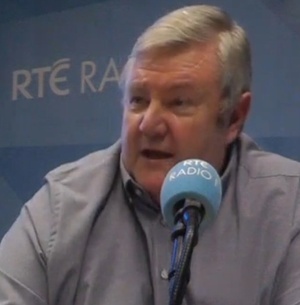
 From top: Tanaiste Leo Varadkar (left) and Minister for Foreign Affairs Simon Coveney; Derek Mooney
For as long as I’ve been writing for Broadsheet I have been writing about defence. My first Broadsheet column on Irish defence policy appeared in August 2016. In each of the six years since then I have written numerous columns arguing for (i) increased defence spending, (ii) greater focus on cyber security and (iii) a grown-up debate on defence policy.
As time progressed, my columns became increasingly critical of the political neglect of defence shown by the last two Fine Gael led governments. Not that I think there was some golden age of defence policy. There is no time when our Defence Forces received all the money and all the political attention it deserved or required.
Most governments could have done more. This includes governments I worked for and wholeheartedly supported, but I can say with some pride that it those governments which delivered one of the most important developments in the maturing of defence policy and in the modernisation of our defence organisation: the 2000 White Paper on Defence.
Though it was a very important document, it was just a starting point. It was never intended to be an endpoint.
After over six years of writing about defence and often fearing that I was just shouting into the wind, I do know believe that the recent report of the Commission on the Defence Forces signals the most important and significant step forward for Irish defence policy for over a decade. Indeed it is the most important defence document since the 2000 White Paper.
But with opportunity, comes risk.
The risk is that we allow this moment to pass by confusing and unnecessarily coupling two related, but very separate, issues and thereby allow controversy around one to frustrate and defer progress on the other.
The two issues are:
- The need to increase our defence expenditure and deliver a level of national defence that is fit for purpose
- The future of our militarily neutrality. Put simply, do we join NATO, or not?
My concern is partly born out of Defence Minister, Simon Coveney’s announcement that a
“…period of four to five months is now required to facilitate appropriate consideration and consultation on the report and to prepare a proposed response and high-level action plan”
I worry that this could be stretched out to seven, eight or twelve months as the political debate around NATO membership that arises out of Russia’s brutal invasion of Ukraine dominates the political discourse.
I also worry that the Green Party’s perpetual anxiety over any question related to defence, here or abroad, could delay government action to reverse that decade of neglect. To judge from the comments made last week, it seems that some in the Green Party are happy to boast about preventing Ireland from donating to the EU’s programme to provide Ukraine with the weapons and defence equipment it needs to face down the Russian Army.
Having lived through the Green Party’s difficulties over Ireland’s membership of the European Defence Agency back in 2009, I know how slowly and painfully this can play out. I also know that the Greens need to be seen by their members to score wins and wring concessions can trump sound decision making.
Returning to Coveney’s five months, let us dispel the notion that the Department needs five months to consider its response. The Commission’s recommendations hardy came as a shock to the Minister or his officials. The Commission was open about its deliberations, publishing regular updates and minutes of its discussions. So, the focus must now be on speedy implementation, not continued consideration.
The Commission offered three stark options, which it labelled “Levels of Ambition” (LOAs).
LOA 1 would continue us on the current path, maintain defence expenditure at its paltry 0.3% of GDP and “leave the Defence Forces unable to conduct a meaningful defence of the State against a sustained act of aggression from a conventional military force.” No reasonable person, especially not one who believes in the concept of military neutrality and non-military alignment could support this option.
So, LOA 1 is clearly a non-runner. This leaves us with LOA 2 and LOA 3.
See… it barely took five minutes – never mind 5 months – to whittle the choices down from three to two. The remaining two options are complementary with LOA 3 being a logical step up from LOA 2.
LOA 2 would probably entail increasing annual Defence expenditure to 0.7% of GDP – on par with where it was over a decade ago by “building on current capability to address specific priority gaps in our ability to deal an assault on Irish sovereignty.”
LOA 3 goes further, possibly requiring an annual defence expenditure in region of 1.2% to develop a “full spectrum defence capabilities to protect Ireland and its people to an extent comparable to similar sized countries in Europe.”
In my view, we should immediately commit to LOA 2 and see how speedily and efficiently we can proceed with the various components of the LOA 3 in view of the national defence threat assessments.
Above all, we must not allow any delay to the immediate implementation of LOA 2. Not even a public debate on continued military neutrality, or taking out full NATO membership, or any of the permutations in between.
Frankly, attempting a meaningful public debate without being well on the way to fully implementing LOA 2 (at a bare minimum) is akin to committing to run a marathon before you have finished learning to crawl. Those who talk of NATO membership without first demanding a full Government commitment to full and immediate delivery of LOA 2 are wasting their own time, and ours.
I have no problem with debating the merits and demerits of NATO membership or on defining our military neutrality, but that is separate issue to the full implementation of LOA 2.
Uncoupling these two discussions is critical to making progress, whether your aim is full NATO membership or a total commitment to continued military neutrality.
Either way we must still possess the capacity to deal with an assault on Irish sovereignty and to serve in higher intensity Peace Support Operations… and that means increasing defence expenditure today.
It is just that simple – no matter how much Deputies Mick Barry, Bríd Smith or Boyd Barrett tell us that they will “…oppose any major increase in Ireland’s military spending.” Simply bringing the pay and conditions up to scratch will require a sizeable increase in defence spending, as over 70% (in reality it is probably closer to 80%) of the annual defence budget goes on pay and pensions alone).
Though I am yet to be persuaded of the merits of full NATO membership, my reservations have softened dramatically in the harsh light of the invasion of Ukraine. The attack on Ukraine has significantly changed things – for us and for our EU partners.
This seismic change in the European and global security environment has led to major changes in defence policy in Germany, but also in such military neutral counties as Sweden and Finland. Two countries with whom we frequently partner on UN mandated peace support operations. Just as events have changed their appraisal of what is their most appropriate defence and security response, so must ours.
This is also the case with our attitude to the production and supply of defence equipment. There is nothing in our current policy of refusing to supply Ukraine with the lethal equipment it needs, in which we should take pride. As I said last week: we should be gifting Ukraine’s forces with all the anti-armour, anti-tank, mortar, unmanned aerial vehicles and other systems our Irish Defence Forces currently possess.
If we are going to consider NATO membership, and the increased defence expenditure that must go with that, then we should ask ourselves why must almost all that money leave this country?
This does not mean we must develop a munitions or armaments industry, but we could become a centre for the production of dual use technology, especially for cyber defence. Then any increase in defence expenditure can go into both better Defence Forces pay and conditions and more well-paying local jobs.
Though these are not words I utter all too often, the Tánaiste was right last week when he told the Dáil that we need to rethink the assumptions we have made for 70 years around military neutrality.
He was right. He was also correct when he said that:
“…we need to increase defence spending. We need to pay our military personnel more. We need better equipment. We need to be able to guard our own seas. We need radar over our own airspace.”
These things did not suddenly become true, however. They were also true between June 2017 and June 2020 when he was Minister for Defence and while the governments of which he was a significant member neglected defence.
He has a rare chance to undo that damage. But he can do more. Having spent so long walking us backwards on Defence, he can give our Defence establishment the resources and scope to start walking forwards again before allowing the Fine Gael fringes to commit us to a headlong race into NATO.
Derek Mooney is a communications and public affairs consultant. He previously served as a Ministerial Adviser to the Fianna Fáil-led government 2004 – 2010. His column appears here every Monday. Follow Derek on Twitter: @dsmooney


Varadkar/Martin are hoping to bounce us into NATO using the Ukraine invasion as a pretext.
If there were any two men worth dying for it’s not them
This is not going to end well
Russia has every European capitol targeted by missile and if we join NATO another will be aimed at us
I am old enough to remember the aftermath of WW2 and we through our neutrality escaped the ravages of the UK and mainland Europe
I think you’ll find that it was geography and not neutrality that saved Ireland the physical destruction seen on the continent. Irelands sons and daughters died in their tens of thousands when they answered the call to fight fascism. The ones lucky to survive were then denounced by people who risked nothing, shouting neutrality like you. I was born in the middle of the carnage in Europe. My family experienced unimaginable suffering at the hands of nazis, the red army and the aerial bombing by allied forces. My family were from a neutral country before the war. Neutrality is a fancy word to allow people like you sleep better, knowing you prefer other Europeans sons and daughters to die for your protection and way of life.
A well considered piece there, particularly regarding the ominous prospect of NATO membership.
However, if increased resources are to be allocated for defense spending, what type of army do we need?
It seems to me there is a good case to increase performance capacity for certain elements, i.e, a well trained and equipped reserve corps, and to specialise in non-offensive roles useful for UN peace keeping.
Expenditure should not be focused on shiny big costly toys that would be useful for wars of bigger powers.
If 30000%of gdp was spent on an army good enough to defend our country we would have just enough to last one week
We neither have the population or taxes to build one
All this drum beating is because Barack are and Coventry are on the security council and want to play with the big boys
Just spend the money on housing our people not acting like the drunk at the pub drinking his dole as his kids starve at home
Well said.