



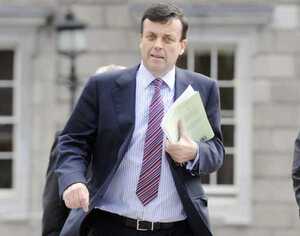
Former finance minister Brian Lenihan this evening went on Drivetime with Philip Boucher Hayes on RTE Radio 1, to discuss the Nyberg report and Colm Doherty’s €3m pay-off.
Guess what?
We all partied.
Boucher Hayes: “I will grant you that €2m of the €3m was a pension that he had accrued through years of being with the bank but the other €1m is, therefore, 11 months’ work, Minister – sorry, Deputy.”
Lenihan: “Again the position of the bank, as you know, is that they had to remove him. They weren’t in a position to give him notice and they believed they were legally constrained to paying him his notice period.”
Boucher Hayes: “You wanted him gone. Do you not think that you might have taken your eye off the ball in not paying a little bit closer attention to how he departed?”
Lenihan: “Well, you know, you want to put that construction on it, and that’s the purpose of this interview. I don’t accept your view.”
Boucher Hayes: “The other purpose of this interview is to take a look at the terms of reference for the Nyberg report. You pulled quite a fast one, didn’t you, in limiting his remit and not allowing him to essentially name names and to apportion blame?”
Lenihan: “I didn’t limit his remit in any way. He was given terms of reference which were voted on in Dáil Eireann. Eh, the terms of reference allowed the report to be conducted in as speedy a manner as possible. That has happened. I don’t think we wanted a bank tribunal enquiry that went on the length of some other tribunals we’ve seen, and I don’t mean that out of any disrespect to other tribunals. The public wanted to know and wanted to know fast, and that has been done. I think names are very clear in the report. The entire boards of several of the banks are clearly identified in the report as being primarily responsible for the banking crisis and failing to supervise the internal operations of those particular banks. Building on that then, you have the failure by the regulatory and central bank system which was clearly identified…”
Boucher Hayes: “And what of that did we not already know?”
Lenihan: “Well, again, there was a demand for an inquiry. I was determined as minister for finance in setting up this inquiry that the cost of the inquiry be limited as far as possible for the taxpayer, and I did that through ensuring that the terms of reference were precise, that the report would be published within a defined time scale and that matters would be brought to finality. As you know the opposition parties at the time wanted an open-ended inquiry into these matters, and I didn’t believe that an open-ended inquiry would be in the best interest of the taxpayer.”
Boucher Hayes: “And such prudence is laudable but the net effect of it has been essentially to tell us not an awful lot that we didn’t already know, and there’s been no apportioning of blame, therefore there has been no accountability, so one wonders what was the point of the exercise in the first place?”
Lenihan: “Well, I think the argument has been that the apportionment of blame is that we were all to blame, which, that is one construction and there are others.”
Boucher Hayes: “Some more than others now.”
Lenihan: “Yes that that’s the construction you put on it this evening [laughs] on RTE on the main news on television. I don’t accept that’s what the report says. The report clearly does say – and Mr Nyberg said this evening – that governments that presided over this are to blame. But the report also says that other politicians, public opinion, banking, the commercial classes – and the media – acted as cheerleaders in this particular property boom which brought the country to the peril it entered into.”