
Author Archives: Slightly Bemused

Slightly Bemused writes:

They say a picture paints a thousand words. Well, if photographs count, they certainly spawn a thousand words.

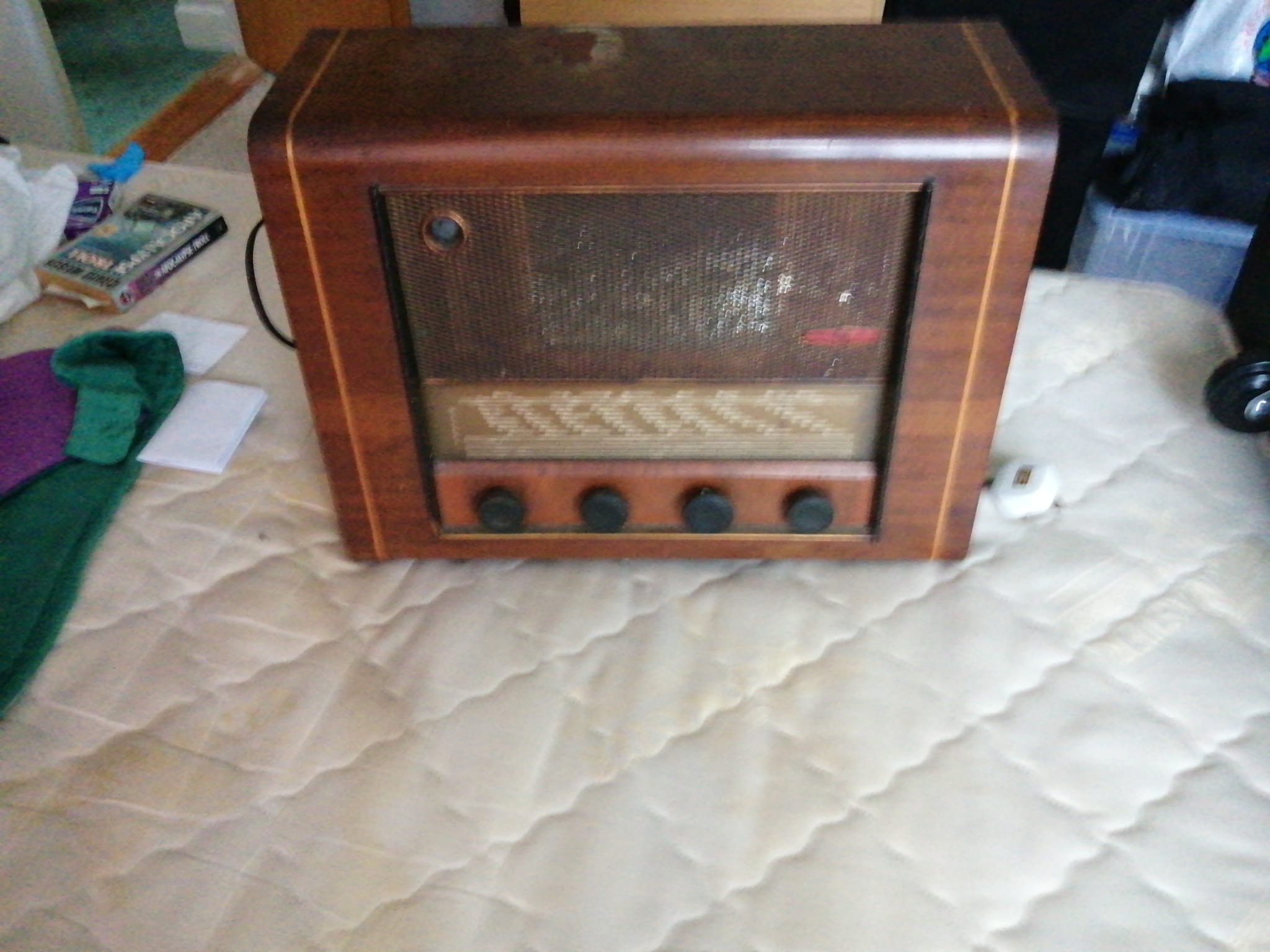
I have been gradually cleaning out the house and getting rid of the rubbish, one box at a time. In one cupboard in my back bedroom, I made a renewed acquaintance with an old friend of my childhood – the kitchen radio (above). I shared a photo with the family group in case anyone wanted it, and it sparked a tide of memories. Some from before I was born, some I recall vividly.

An old valve set, it sat on top of the fridge in our house in Dublin, then later in the new house in the town where I still live in Kildare. I understand it sat in my Dad’s house in Cork when he was a lad growing up, but I am not sure if it sat atop his fridge, though. That lore has not been shared.

In the morning it was the start of the wake up ritual before school, as my Dad would get up with his trusty transistor radio (my brother calls it his ‘shaving radio’, although it doubled as the car radio on the dashboard of the whenever Dad drove) tuned to Radio Éireann, as the rousing tones of O’Donnell Abú signalled the start of a new day.

Then the sober tones of Charles Mitchel or Don Cockburn would read out the tidings of the hours since Closedown, and into morning programming. I forget what was that first programme, but it was replaced by Morning Ireland in later years.

As the radio signalled that Dad now had full control of the bathroom (separate in the early house from the toilet) , a waft of ciggy smoke before the door opened and the maternal alarm clock got into full swing. Time to get up, get dressed, and down for breakfast, where the kitchen radio was now in full voice, and the valves nicely warmed up.

After breakfast, it was up to the now vacant bathroom to wash faces (including behind the ears and the back of the neck) as teeth. My toothbrush of the time was a translucent purple handled Colgate model. No idea why I remember that.

Then we moved, but little had changed. Still only one bathroom, but a separate loo outside for the desperate as Dad shaved. The kitchen radio was once again ensconced above our heads on the fridge, obtained from our aunt Nuala when she sold her house in Dublin and moved to live with her husband in Connemara. And the continuity announcer effectively changed channels as the programming moved from news (ugh) to light entertainment (phew).

Mitchel and Cockburn gave way, and O’Donnell Abú now signals the transition from nighttime programming to the day schedule for Rising Time and Morning Ireland, but I do not recall who at the time. Somewhere in my early secondary school days, Anne Doyle‘s dulcet tones started to grace the airwaves, and Éileen Dunne joined soon after, and the male-dominated programming gained more female representation.

So off to school in the new house in particular, as the first notes of The Gay Byrne Hour started. School was close enough to come home for lunch. Greeted by the tail end of the One O’Clock News, we ate our lunch to the dramatic events of Harbour Hotel.

It was to these stories I learned to make French Toast, Sliced Bread Pizza and quick spaghetti, cooking up just the packet of sauce to go with the pasta. We knew it was Summer when Mum made egg spread to have with slices of tomato between two fresh slices of Brennan’s bread, and listened to the seaside shenanigans.

The old radio, which worked the last time it was plugged in, had this ‘magic eye’ that showed two arcs on either side, with the same centre point. As you tuned in, the arcs got bigger, the gaps between them lessened, until at last they met, and you were properly tuned on station. I remember wondering as a kid how it knew when you were tuned in, and would pull a chair over to the fridge to wiggle the tuning knob and watch the green eyed arcs vary.

Before we moved, I recall that my eldest brother found a damaged similar radio. The electronic chassis was intact. After checking it out, he used our working one as a model, bought the new valves, made up a new wooden casing, and sold it.

He was, and still is, extremely gifted with anything electronic. Recently his latest chip design was taken up for upcoming deep space explorers. From repairing a valve radio, to making an oscilloscope from an old broken valve TV set (because Dad would not buy him a real one), to making chips to explore the universe! I just might be able to tune your new TV, but only if it has auto mode :-)

But the magic eye will work no more. The set only received AM signals, and when the final move was made to FM, the old kitchen radio was put aside, and replaced by a newer transistor radio. I don’t know where it travelled over the years, but it was a surprise to find it at the back of my cupboard.

So after offering the radio around, and getting a no from every one, I donated it to our local drama group. They were delighted as they often do shows set in the 30s/40s/50s, and the radio would fit any of those periods.

I was told, also, that many drama groups share props, so it is my hope that our kitchen radio, which was the background to my childhood, will entertain many a house across the country for years to come.

The magic eye may no longer work, but the magic is still there.

Slightly Bemuseds Column appears here every Wednesday

Pic by Slightly
Slightly’s towels – folded with care and precision

Slightly Bemused writes:

Over the weekend I managed something that in ways has been months in the coming. After Little Slightly left, I retook control of the front bedroom, which had always been my preferred. I used the back one as I had purchased a new mattress, and did not want to risk getting too many dust mites in it, as she is allergic.

So I moved back up front, stripping the bed of the sheets used during her stay and transferring those of mine from the back. Don’t worry, they got a wash, but such is the power of a washer/dryer and the upstairs rail of a bannister they were dry the same day. And the extra time allowed the mattress to breathe, for which I was glad.

The duvet cover, my favourite, I bought in Michael Guiney’s on Talbot Street the first day I moved into my own apartment, and is older than Little Slightly by a goodly margin. Well, bedsit, but my own space for all that. Its welcome embrace allowed me to sleep well on the new mattress.

Over the following months, I have been slowly picking up after Little’s stay. I found some things that needed to be sent over, but many that she asked me to hold on to for the next time. Even typing that ‘for the next time’ makes my heart soar. But laziness and sentimentality made me slow, and I must admit it was a hard day when I took her bathroom items out of the shower, off the windowsill, and from the ledge of the basin to put in a big plastic box to await her return. The bathroom seemed bare with just my soap, shower gel, and tooth brush and paste.

One of the fun bits though has been collecting up the Kinder Egg toys. Since she was a really little one, I would bring her Kinder Eggs, illegal in the US, and she loved them. While other Kinder products were available, she loved the eggs and the toys inside. And here, she discovered giant Kinder Eggs! So the little figurines and crocodiles and other shapes are dotted about the house. I have a small tub just for them, and every time I find one I grin before putting it on the stairs for the next time I go up.

But finally, over the weekend just gone, I found all of my own clothes, all my towels and had a major washing day. Everything that was not already (as some was packed away to clear space for Little Slightly in the main wardrobe) was cleaned and eventually only the clothes I stood in and the hand towels in use were not cleaned.

Anyway, over the weekend, all bar the clothes on my self and my bed were washed, what needs to be was set aside for ironing, the rest folded and put away, first in the hot press, before finally retaking their homes in my front wardrobe and drawers

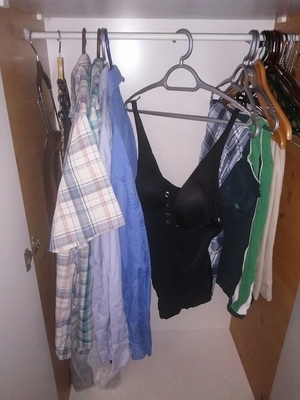
I found an item  (above centre) definitely not mine, and I honestly do not know what to call it. With cups for boobs that a few years ago would have fit me (thank god I am losing fat), it is black with golden eyelets down the centre of the breast and a string to pull everything together. Perhaps a modern corset? Either way I was informed there is no need to send it home, it can stay until she returns, so it currently resides on the rail between my shirts and my trousers. For decorum, the cups face the shirts.

So with the clothes gone from the hot press, I was folding the last of the towels before I realised something. I am still folding them the way I was taught when I was six years old. The same way I was told to do it when I started first aid and later volunteer ambulance duty. It takes just three folds, and you are done, and if put right, your towels stack neatly. The same method is used for sheets, blankets, pillow cases – anything roughly rectangular. Square terry nappies were a bit of a challenge, but the same principle applies. Fold along any side first, then fold along the long side.

What you do is you hold the item (I will stick with towel) by two corners along the long edge, allowing it to fall. Fold together and make sure the edges line up and the fold is crisp. Now the long side is perpendicular to the original, so you fold again, settling the towel to be neat and straight. Usually the third fold, now again at 90 degrees to the last, should be the final fold.

This leaves you with a towel with one full fold on one edge, a double fold on one side, and the tailings, as my Dad would call them, on the other two sides. To stack them, you put them so the single fold is to the outside, and the double to the right. You stack largest (bath, beach, etc) together, hand towels together, and if you have them, face cloths atop the hand towels.

We only had a small hot press, and the nappies, bedsheets, and our clothes had to fit too. And you always took the bottom towel, the large fold allowing one hand easy access to lift the others while the second hand withdrew the base holder. This allowed for a sort of natural rotation of towels.

Pillow cases have a knack to them, too. Folded the same way, it is how you put them on the pillow. For this, I assume a normal pillow, not a special shaped one for neck support, as I use. Normal pillow cases are broadly the same: a tube of material big enough to fit around and along a pillow. One of the open sides has a flap into which the end of the pillow is tucked. There are what my mother called hospital pillows and what we at the time used on our ambulances, long cases many inches longer than the pillow, but with no flap. These had a special way of tucking the extra length back in on itself around the end of the pillow.

The pillow was then placed on the bed or gurney, open end away from the door, and flap uppermost. A double bed had open ends facing each other in the centre. Next time you are lucky, check your hotel rooms, they should be the same. Regrettably, we did not put chocolates on our gurneys.

The result of this was you could easily count how many blankets and sheets and pillow cases you have. In our ambulances, these were normally kept in the cupboard above the driver’s cabin. In a recent ambulance trip, I was amused to note the NAS ambulances do the same.

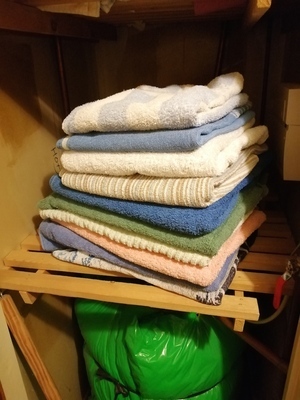
In the photo of my hot press (top), I have pulled my bath towels out so as so show what I mean. The single fold allows you to count how many towels are there, the line-up of the double fold believe it or not makes it much easier (at least as a right-handed man) to shake open the towel for use, or the sheet or blanket for spreading on the bed or gurney, without letting an edge drop to the floor, even for short people like me.

In the photo, the light green towel third from the bottom is my first towel, bought for me at six years old. When I was four, a new swimming pool, Glenalbyn, opened close to my school. They had an offer for the first month for £20 (a princely sum in that day) you could get life membership for your family. I think they were taken aback when my Dad rocked up with us all. We numbered eight at the time – my next younger brother was not yet born, but due in a few months.

I recently found that membership card, and years ago when staying briefly with my aunt in Mount Merrion, I popped along to chance my hand. Willing to pay if the card was not recognised, it turned out not to be necessary, I presented it, and the receptionist checked her book. She had a computer, but this was older, so they just kept the original enrollment book. Sure enough, there was my name, a confirmation question as to my address, and in I was allowed go.

I used my own swimming towel, one bought for each of us as Dad got fed up of there not being dry towels for his Saturday bath. In those days, we all trained early in the morning before school, and the damp towels remained in our bags all day until we got home. Saturday mornings were intensive training days. Each of us was given a different colour, and I got a then much darker green. But it was not folded.

For some reason when swimming, we would fold the towel along the lengthwise twice until we had this long, thin strip. A starter roll at the top, then in went the togs (I could manage Speedos then, today it would be a crime against humanity) and, if used, a swim cap), then the rest of the roll until a short, sausage shaped tube emerged.

When recently Little Slightly and I visited my sister (she of ‘the Nuala’ fame) she asked me to get the towels ready for her grandkids and Little Slightly and herself while she attended to other things. When she came back, six towel rolls poked out of the bag, and she started laughing. She had just meant me to put them into the bag, but so ingrained in me was it that a towel for swimming was tightly rolled.

So after resettling the towels, I looked up toward the bed linen shelf, and sighed. It seems someone cannot fold fitted sheets, and there is a neat underlayer of folded sheets and duvet covers, with a topping of scrunched up fitted sheets and at least one duvet cover.

But that is for another day. Today I am one hoopy frood who knows where his towels are, and which is the next one to be used for his shower.

Slightly Bemused‘s column appears here every Wednesday.
Pics by Slightly

Slightly Bemused writes:

As I write, today is February 1. And every year the arguments start over when is the first day of Spring.

February first here is celebrated as St Brigid’s Day, patron saint of Kildare. The church in which I was wed is named in part for her (St Patrick and St Brigid). As a child I was taught the seasons were:

Spring – February, March, April; Summer – May, June, July; Autumn – August, September, October; and Winter – November, December, January.

Under traditional Celtic ways, this is the start of Spring, and was known as Imbolc. The Celtic seasons were around agriculture, and February is traditionally the coldest month.. It was the time that the soil was turned so the frost would kill the weeds and the bugs.

The full moon is known as the Snow Moon, symbolising the cold. So a cold ploughing in February, followed by the harrow in March when, under the Worm Moon, the little wriggly beasties that do so much to aerate the soil and make it fertile start coming out of hibernation.

The final plough was in April, so the rains would water the soil and make it fruitful. And the first planting would begin, usually early potatoes, so simple ploughing was not enough but the rills had to be raised. Potatoes do not do well in wet ground, and the rills helped drain them. The full moon is called the Pink Moon, and I am not certain why. However this is the time when a plant called phlox grows and first spreads its pink petals, so maybe it is that.

Then comes Bealtaine, or the fire of Baal, with May warming up the soil and helping the seeds sprout new life and promise for another year’s harvest. It falls between the equinox and the solstice, and traditionally is celebrated on May 1.

This marked the time to drive the cattle to their summer pastures, celebrated in poem by Pádraic Colum in The Drover. I learned this in school, but only recall the opening line: “To Meath of the pastures from wet hills by the sea”. The full moon is the Flower Moon, signifying the sprouting and blossoming of the wild flowers, and the first sprouts of the cereal crops.

June continues the rise of heat, but also the ripening of many of the berries. and currants planted. The soft fruits ripen during the month, giving the full moon the name of the Strawberry Moon. Given how clever crows are, I often wonder how they protected the berries before the invention of tunnel netting. Although I must admit to witnessing several crows acting together, with two tugging up the side, and one crawling in and plucking their bounty, to be shared. Crows are very clever birds. This time was also the start of canning – turning the fruits to jam and sealing it to last the winter.

June is also the month of Midsummer’s Day, with the Eve dedicated traditionally to bonfires and dancing at the crossroads. Usually happening at the summer solstice, it marks the longest day of the year, and the shortest night. It marked the celebration of the burgeoning crops in the field, and the turning point of the year towards the harvest.

It also is the time for harvesting the early potatoes and planting the next crop, usually a different variety that will last better through the winter. Many is the time I spent on the back of some machine or other sorting the spuds, and later sitting on the tail seat with mud to my knees feeding the new ones across for even planting.

July marks the ripenening of the crops, and where I live a crop producing rape-seed oil lends a beautiful yellow glow to the fields as you take the bus to Dublin. Interspersed are the cereal crops, usually barley, giving the full moon the name of the Buck Moon in Ireland. The Irish celebrated the rutting of the deer whose antlers had grown and the bucks fought for the right to leave their own genetic line behind.

The end of Summer is Lúnasa, named for the god Lúgh, also known as Lúgh Lámh Fhada (Lugh of the long hand). This marked the beginning of the harvest period. When I was a wee one, the Irish for August was Fómhar, meaning harvest, with Lúnasa just the festival. But somewhere along the way, Lúnasa has become the Irish for August. Celebrations would be had over the first harvests, particularly of the cereals. So the moon here is the Barley Moon. Other countries have other names, reflecting which crop is ripening, but the principle is the same. Most popular is Harvest Moon.

The end of Autumn, is usually a quiet affair, as many farmers work to get their crops in. This marked the beginning of the the harvest. The full moon that month is known as the harvest moon for this reason, largely I think because of that dreadful song. The Harvest Moon covers September (Mean Fómhar, or mid harvest) and October but September’s own moon is the Corn Moon, symbolising the ripening of all cereal crops. A corn officially is the name for the seed that comes from a cereal crop, but in recent years has come to mean maize only.

October (Deireadh Fómhar, or end of harvest), and marked the final reaping, the gathering of the straw and hay for the animals for the winter, and the final means of preserving food. From such times come ham and bacon, corned beef, sausages, black and white puddings, and so on. Nothing was wasted. Hides were cured for leather and suede, and certain parts rendered for glue and other necessities. As little was wasted as possible. The full moon was the Hunter’s Moon, as the people sought to supplement their stores. With the breeding season over, hunting of the stags for their skins and meat to tide over the winter could start. Traditionally, only those unsuccessful stags were taken, leaving the leaders to mind the hinds and the fawns.

The end of Summer and beginning of Winter, is the Celtic celebration of Samhain (pronounced Sowan) which is marked these days by Hallowe’en, a festival overtaken by American movies and new traditions. I was once asked by Little Slightly when she was young if we had Hallowe’en in Ireland. I was polite and merely chuckled. But I was adamant to her mother that she should never, ever, be dressed up as a leprechaun. She complied, but got her own back when one of her later sons sprouted a red beard and green outfit (at 8 years old).

The traditional name, Samhain (pronounced Sam hain in the first dreadful Halloween film) is the tail end of Imbolc, and the Irish for November, and marks the time of descent into the darker days of winter. With the full moon known in Ireland as the Oak Moon, it marked the Celtic New Year.

An industrious month, seasoned wood or turf was stacked and prepared for the fires. Chimneys cleaned, and carpets and blankets beaten once more when it did not rain to remove the dust, and the mites. In older homes, the mattresseses had the straw replaced, and all made ready for the coming two cold months.

December, or Nollaig, usually marks the preparations for Christmas. Advent, presents, preparing the feast, and all the trimmings. There are discussions as to the name of the full moon, with some liking Cold Moon, and others Yule Moon. I prefer the latter.

Of course, December also marks the Winter Solstice, and a national lottery to see who gets to get to see the sunrise in Newgrange, or more likely the slight brightening of the sky through the clouds. Midwinter’s Day, halfway between Samhain and Imbolc, reinforces the old Irish seasonal calendar.

Finally back to January, or Eanáir, which is basically a Gaelicisation of the Latin for January. Traditionally a lean month as stocks run low, it also marked the time to start cutting turf and felling trees. Not for use now, but for seasoning over the year for the next winter, this was tough, cold work. And in the past, done to the howling of the wolves as they prepared for their own breeding season. As a result, a January full moon is a Wolf Moon. And preparations were made to celebrate Imbolc, and the start of new growth once more.

This is out of kilter with the astronomical seasons, which change at the solstices and equinoxes, and the meteorological calendar which looks at average temperatures. For the former, March 21 is the start of Spring, and the latter is March 1. I recall once having an argument where my colleague got very heated and stated categorically that the start of Spring was March 21. I eventually calmed her down by saying I was explaining the old traditional seasons.

Officially, Ireland follows the meteorological calendar. In this they choose the month based on average temperature, and so February, being traditionally the coldest month, is still Winter, with March 1 being the start of spring. You would think that it should be easy to standardise these things, but then I remember all the electrical adapters I have had to tote around so all the ‘standard’ plugs could fit.

In so many places I worked it was much easier. You had two seasons: rainy season and dry season. And they were pretty self explanatory.

Useful to know if you end up in a trivia competition.

Slightly Bemuseds column appears here every Wednesday.

Celtic Winter scene by Jim Fitzpatrick

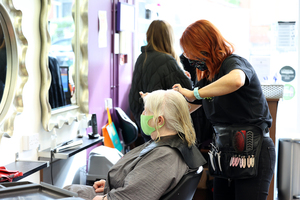
Zinc hair salon, Dublin last Summer

Slightly Bemused writes:

So, as the Erc Carmen song went, I ran a comb through my hair. This morning, I had snarls. I did not think my hair was long enough for snarls, and certainly it is short enough that they were easily dealt with.

Now, her Little self has longer hair, and she had snarls. She would not let me help, as she said she needed to feel them as she freed them. Makes sense to me. But whether related or not I am still finding strands of long hair about the place. And before anyone asks, yes, I did clean and hoover. I think though that these are like the pine needles off a Christmas tree. No matter how hard you try, some will still turn up in July.

She had to clear the shower drain several times while here. While I did my best to keep it clean, snarls of hair were never the problem.

Where I work is at a hospital. I am not clinical staff, at best I am support, and I will do my best to support. But one of my jobs has me randomly walking about the building. On one of those days, I crossed paths with a nurse taking to an older lady, who would be about my mother’s age. They were going down to an empty room so the lady could get her hair washed, and combed. A seemingly simple thing, it was about restoring the dignity to the lady. The remnants of her auburn  locks were visible even before the wash.

It reminded me of my own mother, and hers. My Grandma, for all the time I knew her, had white hair. Not silver, white. And my mother once told me that she always wanted white hair like that. She never dyed her locks, but as her younger sisters grew grey and some added colour to retain their honestly youthful looks, my mother’s hair stubbornly did not change, and for so many years retained the kind of lightly reddish brown that I also ended up with, after apparently having very white blonde hair as a child. My Dad’s was much darker, and a brother and sister in particular ended up with his very dark black hair. So we were all of us either slightly auburn, or very black.

And over the few too short months she was here, my Little one’s hair grew out. The remnants of the colour she had put in it cleared, as it does, and underneath her original colour returned. A colour I see in the filaments I still find around the house. A colour that reminds me, every time, of her grandmother. My Little one, looking at the photos, wanted the black from my father, with whom she was very close, but she got me. And she got her Grandma.

Slightly Bemused writes:

I have been having trouble sleeping recently. And the other day I figured out a reason. I felt I needed an extra hour of sleep before the schlep to my work. So I used my kitchen egg timer, a simple clockwork jobbie, and it ticks. I fell right off.

Many years ago, as I started on my travels, my beloved aunt Nuala gave me a travel alarm clock. A simple folding job, when closed it was encased for travel, and unfolded open when needed. Mostly I kept it closed, under my pillow when no bedside table was available. And it ticked, quietly as it lulled me to the land of nod.

I have had many other clocks, but there was something sweet in the gentle lure of that one. Without making a pun, I am not sure where it wound up, but I always slept well with it by my side.

These days I have a digital clock radio. It uses a system known as a phase locked loop to ensure it keeps time. My digital phone is locked to the phone company’s time clock. But my radio drifts by a minute a week. My phone company occasionally drifts.

But a man called John Harrison, not a watch maker but a carpenter, invented a clock running on gears and springs that was less than a second out across thousands of miles of turbulent seas to allow sailors know where they were. A clock made in the 1700s by the hand of a carpenter was, and possibly still is, more accurate than my digital clock. And my aunt’s little clock kept better time. The tick of the kitchen timer lured me, with true clockwork precision. The tick of the new clock is merely that.

Strangely I am reminded of the wonderful television adaptation of The Hitchhiker’s Guide to the Galaxy from the 80s.They thought digital watches were the greatest thing ever, and Arthur Dent got upset when he lost his. Admittedly he lost his arm too, decided to go mad, and chased a sofa. I am not sure what any of that had to do with digital watches.

Where I work I am constantly reminded of that show. The lift talks to me. Thankfully does not say ‘Glad To Be Of Service’, but it is not far off. And we play what I like to call lift lottery. Different people can call it as a priority, so you get in, and think you are going up, but you may end up going down. A lot more more accurate than my current clock, it knows where it is going, but sometimes I do not.

Somewhere out there is a timepiece that kept time to the dreams of my soul. I hope I can find it, and pass it on to the Little lady of my heart, and it can keep her safe too.

Slightly Bemused‘s column appears here every Wednesday.

Alamy

Slightly Bemused writes:

My Little one has gone home, but the resonance of her stay is still here, in every facet of my life. From the mess on the floor in her bedroom, to the mess on the couch, to the ton of dishes I need to clean.

And she said the most wonderful thing. “Can I leave stuff here for the next time?”

Oh, she managed to break Geoff the dishwasher again. She was surprised when I called him by name. “You named your dishwasher?” Of course I did. But this time it will need a little surgery. And this morning as I sought a clean t-shirt, I pulled the grey one off the drying rack in the kitchen, and realised this is not mine.

I am thinking of doing an instructional video. How to service a baby dishwasher. It would have been useful to have one earlier, but I had to figure it out for myself. Before you get worried, don’t. My Dad was an engineer, and I follow in his exalted footsteps.

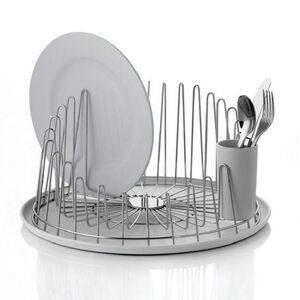
Growing up, we had this wonderful round rack for drying dishes. As part of a large family, we were set into teams.

One would set and one would clear the table, one do washing up. One team to wash, one to dry, and one to put away. And in the middle of all of this was this round drying rack. If done right, you followed the march of the dishes around the rack as they dried a bit before getting the towel. and this wonderful central bucket for the cutlery.

Years later my father admitted something. This was the remains of a dishwasher he was given. It did not work, but came to him through friends of my Mum’s eldest brother. They took it back to the house, and as my Dad told it, once of a Saturday they decided to fix it. My Dad was an engineer, did I mention that?

So screws were undone, the cover came off, and eventually little bits and bobs were undone. All while a little scotch (the whisky not the tape) lesson was had here, and there. And in the end this wonderful washing device was, as my Dad’s own mother said, ‘taken totally to part’. And do you think they could remember how it went back together? After too many scotch lessons, even the best engineers forget things!

So our fabulous dishwasher ended up as a drying rack, a few interesting pumpy bits, and strange enameled panels in interesting places, and eventually a wonderful story for a hungry audience.

My little laddie (dishwasher), whom I call Geoff, to my Little one’s confusion, has been on quite the opposite of a diet. A sudden explosion of use, and confusion of communication about how best to treat the poor thing. A real trooper, he has held on, and come back to me. Screws had to come off, but thankfully I knew where they had to go.

For Geoff, I need to fix the racks, so will be in touch with powder coaters over the next short while. Small job, I know, but could add years to his life. See if I can get it piggy-backed onto a larger job – definitely not worth it for just one rack.

Powder coating is amazing. In one of my previous jobs, we used make up large racks for sound equipment, and would have them powder coated, not painted. Beautiful job, done by a very nice crew out near Tallaght. I must check if they are still there. They could transform a simple framework of steel into a beautiful matt finished work of art. We mostly went for black, but I know they had other colours available.

So I am wondering if it is worth doing an instructional video on how to fix your mini dishwasher. To be followed later with ‘how to replace the shock absorbers on your washing machine’. This definitely would be the fool’s guide.

Preferably without the ‘scotch lessons’, at least as we go along.

Slightly Bemused‘s column appears here every Wednesday.

Pic via istock

The Firhouse Christmas Fair.

Firhouse Road, Tallaght, Dublin 24.

Slightly Bemused writes:

‘This is my latest game, and an unashamed plug! If any of you are in the vicinity tomorrow and want to pop over, we have a great variety of lovely locally made crafts and gift ideas. My sister is taking part also (incidentally my younger brother’s birthday) and while she has her Teegan’s Treats available, the whole fair should be fun….

Slightly Bemused writes:

My Little one has left me. Sadly she had reason. A really tragic event happened in her home town in a parade that featured a marching band she was part of. She said this was the first time in ten years she had not been part of it.

In Dublin Airport Terminal 2 (which by the way I personally really do not like from the inside), after a strange and exhausting and possibly dangerous trip to get a test to prove she could go home, she leaned to me and asked if I was okay. Being the polite person I am trying to be, I said no, but what should I write about this week.

She said Honey. The magical mystery of the honey pots. I was confused. She said they kept appearing everywhere. She turned around and one of them was there. I was told there are four, but they keep moving, and she does not know why. I did not realise this was a cause of concern for her. I did not tell her of the fifth on the top shelf.

Apparently honey does not go off. They found some in a pot in some dead pharaoh’s tomb. How they knew it was noy bad is a mystery to me. Like, someone goes ‘here is 4,000 year old stuff. Who wants to taste it?’

Mine is not 4,000 years old. I think the oldest is maybe 6. But they crystallise. And what you do to them is heat them, and they re-melt into liquid honey. But I turned my storage heating on to warm the cockles of a few travellers not used to our climes. Why waste the heat? So as I found them on the heater at the bottom of the stairs. As fluidity returned, another one changed its place, but of course I put one down before picking the other.

And so the march of the honey pots became a thing she did not understand, but fascinated her. She had no idea what was happening, and I did not realise it. But even in these times I am glad that I can still somehow bring wonder to her life. Even if it is slightly sticky when you forget, and honey overflows.

And then she asked me can she leave stuff here, for her next visit? I am not a proud man, love and tears overflowed.

Slightly Bemused‘s column appears here every Wednesday.

Pic by Slightly

The scene of Slightly’s bell-ringing shame

Slightly Bemused writes:

So there is a new grotto in town.

I have only lived here for forty years or so, but it took a new arrival for me to find out about this. Back behind my church, where apparently mobile coverage does not work, there is a little sanctuary to Mary.

Finely ensconced in a glass cage, she looks out over my daughter as she sits and thinks and reads, and peruses her day’s thoughts.

When I found out about this place I realised something. In order for this grotto to be here, something had to go. That something was the convent of the Presentation Sisters.

Many of them were teachers to us, through the years. I am not sure they liked us. One famously took a ruler to my sister, who promptly took it from her and whacked back. Our family do not take lightly, so tread carefully where you may.

The grotto where the convent once stood looks out across a lawn to the room I used study science in. I will tell you of the blue water another time. The main school is now a shopping venue, but once my doctor was shot there. Thankfully he survived, and I am still able to tell people that I went to school in a field. And a one-armed man who taught me science found evidence of an old settlement there, sadly now buried under signs of saving.

The sad thing for me is I recognise the statue. It used be in the hall of the convent, welcoming all in. Or at least as many as never took a rule to a sister. I am not a believer, but I do respect those who do, so I am glad to see her recognised by the community.

But just down from her place of fame is my place of shame
. There is still the old bell tower, which still rings out the Angelus, and the tidings for the Mass. You can see the bell from Little Slightly’s window, and it bongs each day at the noon and the hour. Actually, it is early these days, about ten to. Back in the day old Skinner, the sacristan of those times, would only chime in time. And God help the late.

But Skinner was also just a man, and he got sick as do the rest of us. So when he did, an altar boy was sent out, in his rainments of crimson and white, to sound the bells and bring the faithful to their true home. The church wherein I was wed, but that was a few years later.

On this day when Skinner (the local barber, by the way. Hence the name) coughed in sick, a certain young lad of the very slightly build was asked to ring the bell. So out I went, past the convent where a grotto now stands, and I faced off on the bell. These days it has a solenoid, an electric ringer. But of course, not then.

Back then, it was old school. The bell still sports the rather big circle ring whereupon used rest a chain. And to get it ringing, a seasoned campanologist would pull the chain, let it go, and pull again on the backswing. Gaining momentum. Eventually it got to the point where the clapper sounded out the call to the worthy to come and pray.

Funnily enough, this was not one of the lessons in altar boy training. So here I am, looking at the bell and chain. There was a low wall around the base, now extended to the top. And I thought if I grab the chain as high as I can and then pull, it will work. So to get as high as I could I clambered up this little wall. I reached high, grabbed the chain, and jumped.

Now, here is a lesson in both physics and momentum. A one ton bell will move when a ten-pound altar boy pulls. But it pulls back, as it swings. And it is a lot heavier. So there is me, swinging up and down the side of the bell tower, not letting go for fear of my life. And the Mass bell went bong… bing… bong…

And Skinner got out of his sick bed to make it right for the next Mass, and never let me near his bell again.

Slightly Bemused‘s column appears here every Wednesday.

Pic by Slightly