
Category Archives: Science

Behold: UGC 2885, a giant spiral galaxy about 232 million light-years distant. In this Hubble Space Telescope image the bright, spiky stars lie in the foreground toward the constellation of Perseus within our own Milky Way galaxy. To wit:

Some 800,000 light-years across compared to the Milky Way’s diameter of 100,000 light-years or so, it has around 1 trillion stars. That’s about 10 times as many stars as the Milky Way. Part of an investigation to understand how galaxies can grow to such enormous sizes, UGC 2885 was also part of An Interesting Voyage and astronomer Vera Rubin’s pioneering study of the rotation of spiral galaxies. Her work was the first to convincingly demonstrate the dominating presence of dark matter in our universe.

(Image: NASA, ESA, B. Holwerda (University of Louisville))
apod

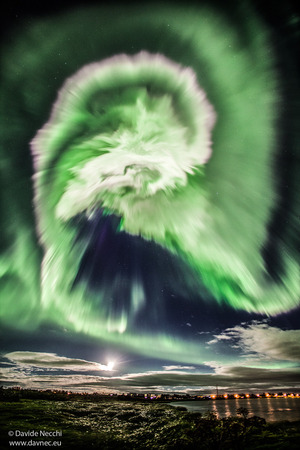
Actually, no, just an aurora. But what an aurora. To wit:

Captured in 2015, this aurora was noted by Icelanders for its great brightness and quick development. The aurora resulted from a solar storm, with high energy particles bursting out from the Sun and through a crack in Earth’s protective magnetosphere a few days later. Although a spiral pattern can be discerned, creative humans might imagine the complex glow as an atmospheric apparition of any number of common icons. In the foreground of the featured image is the Ölfusá River while the lights illuminate a bridge in Selfoss City. Just beyond the low clouds is a nearly full Moon. The liveliness of the Sun — and likely the resulting auroras on Earth — is slowly increasing as the Sun emerges from a Solar minimum, a historically quiet period in its 11-year cycle.

(Image: Davide Necchi)

apod

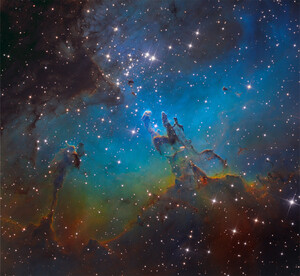
Behold: M16, aka, the Eagle nebula – just two million years old and surrounded by natal clouds of dust and glowing gas. To wit:

This beautifully detailed image of the region adopts the colourful Hubble palette and includes cosmic sculptures made famous in Hubble Space Telescope close-ups of the star-forming complex. Described as elephant trunks or Pillars of Creation, dense, dusty columns rising near the centre are light-years in length but are gravitationally contracting to form stars. Energetic radiation from the cluster stars erodes material near the tips, eventually exposing the embedded new stars. Extending from the ridge of bright emission left of centre is another dusty star-forming column known as the Fairy of Eagle Nebula. M16 lies about 7,000 light-years away, an easy target for binoculars or small telescopes in a nebula rich part of the sky toward the split constellation Serpens Cauda (the tail of the snake).

(Image: Martin Pugh)

apod

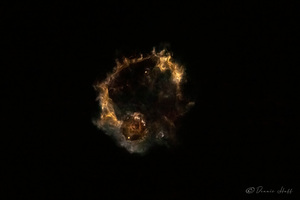
Behold: what looks like but isn’t  the Hubble Space Telescope’s latest view of a distant galactic nebula. Something much closer to home. To wit:

…this illuminated cloud of gas and dust dazzled early morning spacecoast skygazers on August 29. The snapshot was taken at 3:17am from Space View Park in Titusville, Florida. That’s about 3 minutes after the launch of a SpaceX Falcon 9 rocket on the CRS-23 mission to resupply the International Space Station. It captures drifting plumes and exhaust from the separated first and second stage of the rocket rising through still dark skies. The lower bright dot is the second stage continuing on to low Earth orbit. The upper one is the rocket’s first stage performing a boostback burn. Of course the first stage booster returned to make the first landing on the latest autonomous drone ship to arrive in the Atlantic, A Short Fall of Gravitas.

(Image: Dennis Huff)

apod

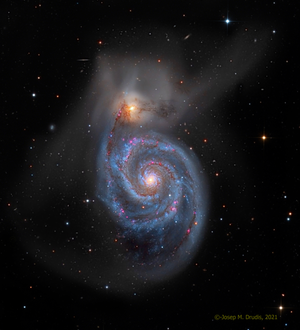
Behold: M51, aka the Whirlpool galaxy – a twofer in the constellation of the Hunting Dogs. ‘Where’s that?’, sez you. To wit:

Find the Big Dipper and follow the handle away from the dipper’s bowl until you get to the last bright star. Then, just slide your telescope a little south and west and you’ll come upon this stunning pair of interacting galaxies, the 51st entry in Charles Messier’s famous catalog. Perhaps the original spiral nebula, the large galaxy with well defined spiral structure is also cataloged as NGC 5194. Its spiral arms and dust lanes clearly sweep in front of its companion galaxy (top), NGC 5195. The pair are about 31 million light-years distant and officially lie within the angular boundaries of the small constellation Canes Venatici. Though M51 looks faint and fuzzy to the eye, deep images like this one reveal its striking colours and galactic tidal debris.

(Image: Josep Drudis)

apod

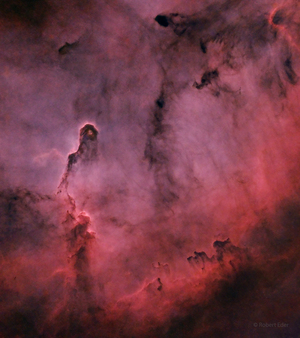
Behold: the Elephant’s Trunk Nebula winding said pareidoliac proboscis through the young star cluster complex IC 1396 in the constellation of Cepheus. To wit:

Also known as vdB 142, seen on the left the cosmic elephant’s trunk is over 20 light-years long. Removed by digital processing, no visible stars are in this detailed telescopic close-up view highlighting the bright swept-back ridges that outline pockets of cool interstellar dust and gas. But the dark, tendril-shaped clouds contain the raw material for star formation and hide protostars within. Nearly 3,000 light-years distant, the relatively faint IC 1396 complex covers a large region on the sky, spanning over 5 degrees. This starless rendition spans a 1 degree wide field of view though, about the angular size of 2 full moons. Of course the dark shapes below and right, marching toward the winding Elephant’s Trunk, are known to some as The Caravan.

(ImageRobert Eder)

apod

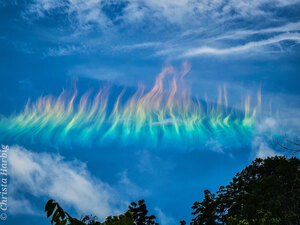
Behold: rare and eye-candiful prismatic refractions through ice crystals in a distant cirrus cloud formation. To wit:

Known informally as a fire rainbow for its flame-like appearance, a circumhorizon arc appears parallel to the horizon. For a circumhorizontal arc to be visible, the Sun must be at least 58 degrees high in a sky where cirrus clouds present below — in this case cirrus fibrates. The numerous, flat, hexagonal ice-crystals that compose the cirrus cloud must be aligned horizontally to properly refract sunlight in a collectively similar manner. Therefore, circumhorizontal arcs are somewhat unusual to see. The featured fire rainbow was photographed earlier this month near North Fork Mountain in West Virginia, USA.

(Image: Christa Harbig)

apod

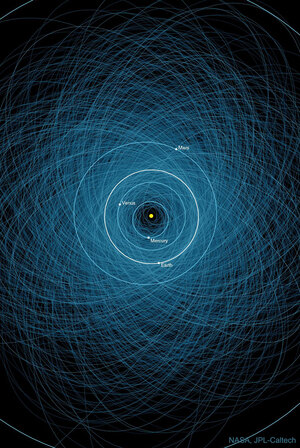
Asteroids.

It’s all fun and games until one of them strikes your planet and causes a mass extinction event. We’re lucky that doesn’t happen more often. To wit:

Pictured here are the orbits of the over 1,000 known Potentially Hazardous Asteroids (PHAs). These documented tumbling boulders of rock and ice are over 140 meters across and will pass within 7.5 million kilometers of Earth — about 20 times the distance to the Moon. Although none of them will strike the Earth in the next 100 years — not all PHAs have been discovered, and past 100 years, many orbits become hard to predict. Were an asteroid of this size to impact the Earth, it could raise dangerous tsunamis, for example. To investigate Earth-saving strategies, NASA’s Double Asteroid Redirection Test (DART) is planned for launch later this year. Of course rocks and ice bits of much smaller size strike the Earth every day, usually pose no danger and sometimes create memorable fireball and meteor displays.

(Image: NASA, JPL-Caltech)

apod

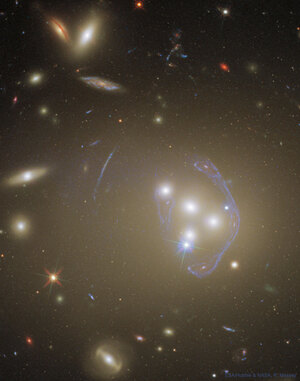
Behold: three galaxies in a row. Very similar to one another. Right – that’s what they want you to think. To wit

Toward the right of the featured Hubble image of the massive galaxy cluster Abell 3827 is what appears to be a most unusual galaxy — curved and with three centres. A detailed analysis, however, finds that these are three images of the same background galaxy — and that there are at least four more images. Light we see from the single background blue galaxy takes multiple paths through the complex gravity of the cluster, just like a single distant light can take multiple paths through the stem of a wine glass. Studying how clusters like Abell 3827 and their component galaxies deflect distant light gives information about how mass and dark matter are distributed. Abell 3827 is so distant, having a redshift of 0.1, that the light we see from it left about 1.3 billion years ago — before dinosaurs roamed the Earth. Therefore, the cluster’s central galaxies have now surely all coalesced — in a feast of galactic cannibalism — into one huge galaxy near the cluster’s centre.

(Image: ESA/Hubble & NASA, R. Massey)

apod

Behold: a composite of three moonless nights recorded last week while Earth was sweeping through the dusty trail of comet Swift-Tuttle. To wit:

One long exposure, untracked for the foreground, and the many star tracking captures of Perseid shower meteors were taken from the village of Magyaregres, Hungary. Each aligned against the background stars, the meteor trails all point back to the annual shower’s radiant in the constellation Perseus heroically standing above this rural horizon. Of course the comet dust particles are traveling along trajectories parallel to each other. The radiant effect is due only to perspective, as the parallel tracks appear to converge in the distance against the starry sky.

(Image: Balint Lengyel)

apod