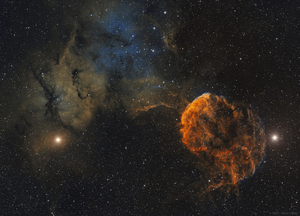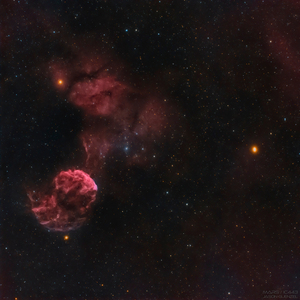
Behold: the normally faint and elusive Jellyfish nebula, aka IC 443, captured in an alluring scene with Mars to the right. To wit:
In the telescopic field of view, two bright yellowish stars, Mu and Eta Geminorum, stand just below and above the Jellyfish Nebula at the left. Cool red giants, they lie at the foot of the celestial twin. The Jellyfish Nebula itself floats below and left of centre, a bright arcing ridge of emission with dangling tentacles. In fact, the cosmic jellyfish is part of bubble-shaped supernova remnant IC 443, the expanding debris cloud from a massive star that exploded. Light from that explosion first reached planet Earth over 30,000 years ago. Like its cousin in astrophysical waters the Crab Nebula supernova remnant, the Jellyfish Nebula is known to harbour a neutron star, the remnant of the collapsed stellar core. Composed on April 30, this telescopic snapshot also captures Mars. Now wandering through early evening skies, the Red Planet also shines with a yellowish glow on the right hand side of the field of view. Of course, the Jellyfish Nebula is about 5,000 light-years away, while Mars is currently almost 18 light-minutes from Earth.
(Image: Jason Guenzel)