



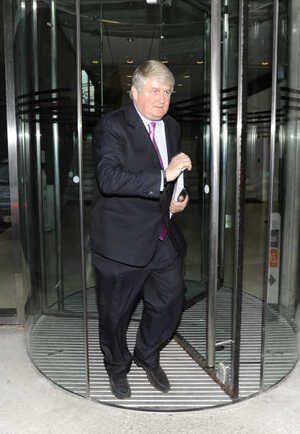

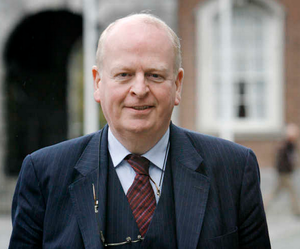
From top: Denis O’Brien, Independent TD Catherine Murphy Former Attorney General, Justice Minister and Tánaiste Michael McDowell,
Further to the ‘thing‘.
Tomorrow RTÉ and several newspapers, including the Irish Times and the Sunday Business Post, are expected go before the High Court seeking clarification on whether or not they can publish what Independent TD Catherine Murphy said in the Dáil last Thursday, in light of a interlocutory injunction awarded to Denis O’Brien – against RTÉ – on May 21.
Ahead of this, Cathal MacCoille spoke to former Attorney General Michael McDowell on Morning Ireland this morning.
Cathal MacCoille: “Good morning.”
Michael McDowell: “Good morning, Cathal.”
MacCoille: “This question that, this statement made that the Oireachtas has, to use a word not in the Constitution, has absolute privilege. Two obvious questions for every lay person listening to you, does it have absolute privilege? And should it have?”
McDowell: “Well it’s not very, very clear from the wording of the Constitution to the extent of which that privilege applies to repetition in different circumstances. Yes, the words of parliamentarians are privileged wherever their published but that doesn’t absolutely mean, and I think you have to be clear about this, that a parliamentarian can say anything they like and anybody else, in any circumstance, repeat what they said with absolute impunity. I don’t think that that extreme view is a tenable one.
But I think we’re dealing here with a very different situation. Firstly, can I just go back to what was said before the ad break there. I mean [Labour Party TD] Pat Rabbitte is correct, in one sense, when he said that no court has ruled that the newspapers cannot carry Catherine Murphy’s speech of what she said in the Dáil about Denis O’Brien and his borrowings.
No court has even attempted to deal with that issue, thus far. But a court order made between in proceedings between RTÉ and Denis O’Brien,seemed to have the potential to prevent RTE from revealing the same information that they were concerned to keep confidential, from whatever source RTÉ found it, including Catherine Murphy.
That’s the argument that Denis O’Brien’s lawyers made and it seems to me that where Pat Rabbitte says we are collectively leaping ahead of ourselves on this issue; there’s a different point to be made. Denis O’Brien’s lawyers have contacted all the media to impress upon them that it would be unlawful to publish material, including Catherine Murphy’s speech. And, I mean, Denis O’Brien’s lawyers went, for instance, to Broadsheet.ie, which is an independent news online service and threatened them and requested them to take down their coverage of her speech by seven o’clock last Friday.
So it’s Denis O’Brien who believes that this order has this effect. It’s his lawyers who are effectively issuing threats to media organisations not to cover speeches, her speech, and that is the crux of the issue at the moment. I wrote on Saturday, in the Irish Times, that media organisations had a choice. They could either take their own advice and publish what she said, or else go to the high court, which RTÉ and the Irish Times are doing and get clarification as to whether the threat that is made by Denis O’Brien’s lawyers is a valid threat, or not. And I noted that the Sunday Times yesterday published Catherine Murphy’s speech or a large portion of it and they took their own advice.
And the issue now is, was that publication by the Sunday Times, or the publication on Broadsheet, or whatever, was that a contempt of court? And the only person who can decide that, obviously a judge is the only person who can decide that, but it can only be done on a complaint made by Denis O’Brien in essence, that it amounts to a contempt of court and what RTE and the Irish Times are doing is they’re going in to seek clarification of the scope of the order that was made by the High Court in favour of Denis O’Brien against RTÉ..”
MacCoille: “Yes, essentially the position we are in now is one where most of the Irish media have acted on the basis of editorial caution, on legal advice, so therefore the position will become serious, surely, only when a court decides that, yes, Oireachtas privilege is restricted to include, for example, Catherine Murphy’s statements last week which we cannot report, again on legal advice and only on legal advice now.”
McDowell: “The reason that RTÉ and the Irish Times are taking that position, that cautious position, is because of a direct threat to them by Denis O’Brien’s lawyers, of the kind that was made to Broadsheet, saying, ‘you may not do this, it would be a contempt of court if you do it’. And I mean, let’s remember that at the heart of this is the, I believe, overweening ambition of Denis O’Brien to use the courts in this way to silence the media in covering affairs relating to himself. That’s the thing. I mean this…”
MacCoille: “His lawyers are entitled to point out what they wish about a court injunction…”
McDowell: “Oh they can and RTÉ…”
MacCoille: “…of an interlocutory injunction which they have obtained. Are you saying…”
McDowell: “They are entitled to do that, yes, Cathal, but on the other hand, it’s up to media organisations, RTÉ has taken one cautious view, the Sunday Times has taken a less cautious view. Is the Sunday Times in contempt of court? I very much doubt it.”
MacCoille: “In your view, should Oireachtas privilege overrule considerations which, for example, in Denis O’Brien’s case, of the privacy of its financial affairs?”
McDowell: “In virtually every case I believe that is the case. That is the starting point that Oireachtas, the privilege which is attached to utterances in the Oireachtas wherever published should trump the private interests of someone like Denis O’Brien in relation to business borrowings from a bank, yes I do believe that.”
MacCoille: “In terms of the likelihood and it’s obviously a very experienced and learned view in your case but it is only a view, when you say we’re in dangerous territory, do you believe it’s likely that we’ll be out of that dangerous territory and that Oireachtas privilege will be asserted and accepted by the courts when they, either in the High Court or the Supreme Court, issue rulings.”
McDowell: “Well I think there’s two things quite possible to happen. Firstly, I think the High Court might say, the High Court judge to whom this is brought before, [inaudible], ‘neither I nor the High Court has ever made an order in relation to Catherine Murphy’s speech and, therefore, the threats made by Mr O’Brien’s lawyers…’ ”
MacCoille: “Can I just interrupt you there? Because we’ve had this clarified, as you’ve been speaking. RTE did not get any letter from Denis O’Brien’s lawyers, it was simply acting on the basis of what it understood the injunction to mean.”
McDowell: “Well then that’s fine but I know that Broadsheet.ie, which went ahead and published her speech, did get such threats so RTÉ obviously are operating on the basis of their own internal legal advice and that’s fine. But the Sunday Times took a different view so…”
MacCoille: “But back to what you think, given our Constitution, do you think…
Talk over each other
MacCoille: “Do you think that the likelihood is that the freedom of a TD to speak will be accepted by the courts?”
McDowell: “I think the first thing is that the courts will probably say that the order they already made did not extend, and had no application to the situation of whether or not to cover Catherine Murphy’s speech. I’d say that will be the first position that the courts are likely to make. They haven’t ruled on that issue and their order did not deal with that particular scenario. The second thing I think a court will do is to look, and probably somebody will draw this to the attention of the court, to the reality that the speech is now in the public domain. Her speech is in the public domain and that it would be absurd and futile to order some media in Ireland not to report it or to lay down for them a rubric that would amount to contempt of court – when others are free to do it with impunity. So, I think that, on both counts, it’s quite likely that the media will not be under any court-ordered silence in relation to Catherine Murphy’s speech whenever this matter does come before the courts.”
MacCoille: “Right and just the final point, the obvious point that’s been raised by a number of people in relation to the Mary Lou McDonald case, where her colleagues on the Committee of Procedure and Privileges found that she had abused Dáil privilege but there was no effective sanction, isn’t that a fair point?”
McDowell: “Well, the first thing is that, in relation to sanctions, the Oireachtas has been fairly lax in putting serious sanctions on its members and it has never actually evolved a code of sanctions which are effective, that’s true. But, on the other hand, let’s remember, this is an important point of principle and an important point of public interest. If Denis O’Brien is correct in saying that his financial affairs are, and we can see from the Sunday Times, it’s a kind of order that those financial affairs, the size of his borrowings, etc. If he is correct in saying that this is an entirely private matter, and could not legitimately concern parliamentarians, then we have a very strange situation indeed. I believe that there was a clear public interest in what Catherine Murphy said in the sense, not of public curiosity but of public interest because it is an issue which is important in the context of the various other dealings of IBRC and it’s liquidator. And the last point Cathal, I’d like to make is, if Denis O’Brien believes he’s bringing these proceedings, and making these threats to independent news channels and the like, as a matter of principle, is this a principle that all news organisations – of which he has a commercial interest – are going to abide by in the future. Is it really the case that if INM – the Irish Independent, the Evening Herald, or whatever – find themselves with confidential information about me, you or anybody else, that he’s going to say, ‘oh no, we don’t publish those things’, or is this a case of the rich and the powerful using their legal muscle to attempt to do something which is completely incompatible with a functioning democracy. That’s my view.”
Listen back in full here
Previously: [REDACTED]’s 1.25 Interest Rate
Mark Stedman/Photocall Ireland
Meanwhile…
I personally don’t believe @broadsheet_ie was contacted because it would appear no one else was. Even Catherine Murphy hadn’t been yesterday
— Noel Dolan (@cybernoelie) June 1, 2015

A Letter received via email from Owen O’Sullivan, head of litigation at William Fry Solicitors at 6.27pm on Thursday, May 28.
This led to the following email exchange.
6.52pm, Broadsheet: “Apologies for the delay. I am John from broadsheet. I am trying to locate our legal person but I think it may be for the High and Supreme Court to decide. Article 15.12 allows all Dáil statements “wherever published” to be privileged.”
7.28pm, Fry: “Thanks for responding. All I’ll say in reply is that there is an injunction in place of which you are on notice, the terms of which are very wide and cover what could be reported about what was said in the Dail by Catherine Murphy. I await a response to the request for a confirmation regarding the article.”
7.40pm, Broadsheet: “Thank you. Just two more things. Does the High Court ruling supersede Dáil privilege? Also Catherine Murphy has stated (this evening) that the information came from sources other than the court proceedings which you mentioned.”
7.55pm, Fry: “That is for your own legal advisors.”
8pm, Broadsheet: “Fair enough. Do you have a copy of the terms of the injunction?”
8.25pm Fry: “No – but RTÉ reported on it extensively and within its terms so their reports are probably a good source for it…”
Friday 11.05am: Hosting Ireland (broadsheet’s web providers): “We have received a letter from Denis O’Brien’s solicitor William Fry regarding content on your site breaching a high court injunction. ‘As you are hosted on our network we can become responsible if we do not act on this. We request you please remove this content as soon as possible and confirm.”
11.20: Broadsheet to Hosting Ireland: “Apologies for all this. The speech is protected “wherever published” by Dail privilege in the constitution. Mr O’Brien’s solicitors say the High Court ruling supersedes the constitution but the judge never revealed the terms of the injunction.”
All correspondence concluded.
Large tay.
(Photocall Ireland)

