


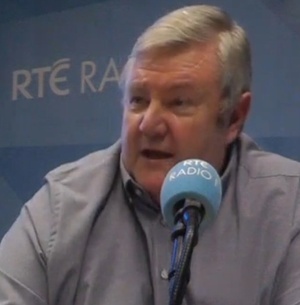
From top: Sinn Fein’s Northern Ireland leader Michelle O’Neill (left) and Sinn Fein President Gerry Adams during a press conference at Parliament Buildings, Belfast, this week; Derek Mooney
Amid all the analysis and commentary on Brexit, might I suggest you check out the Beerg Brexit Blog written by an old friend of mine, Tom Hayes.
Originally from Dublin, but now based in the North of France, Tom is one of the most experienced and skilled employer relations negotiators in Europe, something reflected in his Brexit Blog.
Whereas most look at the hard politics of Brexit, especially from the British side, and I tend to look at it solely through the prism of how it effects relations on this island, Tom looks at the process as a negotiator.
While you are never in any doubt, reading any of his blog posts, that Tom thinks that Brexit is a massive folly, each week he examines developments and tests them for how the progress, or hamper, a negotiated outcome that would serve the interests of both sides.
Of course, Brussels is not the only place hosting a painstakingly slow and complex negotiation between two intractable sides – closer to home we have the seemingly never-ending negotiation/talks process between the DUP and Sinn Féin, co-chaired by the two governments.
Taking Tom’s analytical approach, it is probably more accurate to describe what has been going on in Belfast as a talks process rather than a negotiation, as neither side – and it is important to stress that the blame attaches to both parties in this, not just one – has signalled any real interest in reaching an outcome.
In one of his early blog posts Tom Hayes identifies the 10 key “rules” for negotiations. I place “rules” in parentheses as they are not so much “rules”, as they are the basic key essential ingredients for a negotiation to get up and running.
In the same way that a leader without followers is just some taking a walk, a negotiation without these key components is just a chat, and a not too friendly one at that.
Rather than boring you to death and risking repetitive strain injury trying to type all ten on an iPad, I will focus on just two or three and consider the extent to which they are absent from the current SF/DUP talks.
The first two are:
Have clear, precise objectives. Know what you want to achieve out of the discussions.
Establish what the Harvard Negotiating Project calls the Best Alternative to a Negotiated Agreement (BATNA). In other words, work out what is the best you can do if the other side person tells you to go and f… sorry, to go and get lost.
Are we seeing any hints of the first of these from either side? While both sides say they want a return of the Northern Ireland Executive and the Assembly, there is little hard evidence that they do.
As for the second, the best alternatives to a negotiated settlement, well it seems that both sides are satisfied with the current alternative.
Now that the DUP has its confidence and supply agreement with the Tories, not to mention £2 billion for their pet projects, they are not that bothered whether Stormont returns or not. They have power, albeit without the trappings of ministerial offices or chauffeured Skodas.
On the other side, the handful of decision makers at the top of Sinn Féin have also concluded that the status quo is an option as the collapse of the Executive and Assembly has been good for business. It has not only stemmed the decline in their vote that they had experienced in the previous Assembly elections, it has partially reversed it.
So, they weaponise very real and legitimate concerns about the Irish language and parity of esteem to beyond a point where the other side can ever deliver. Thus, breaking not one but two rules of negotiations:
Manage stakeholder expectations by not promising to overdeliver.
Manage the expectations of the other party before you begin talking.
Worse still they catalogue and herald all their own failures in government and all the times the DUP out manoeuvred them in Gerry Adams’ Felon’s Club speech last January.
The history of the past twenty years shows us that the default Sinn Féin position in any fraught situation is to throw the balls up in the air.
Where other political organisations try to avoid crises, Sinn Féin thrives on them. That’s great for opposition, but lousy for government. That’s not just my opinion, while the folks around Gerry may feel they are having a good crisis, many local representatives are beginning to think otherwise – and no amount of spiking will stop that Storey.
But still the dance goes on.
The DUP knows that Sinn Féin is its best weapon in squeezing the UUP and increasing its own vote share, while conversely the DUP does more to drive nationalists to the polls to vote Sinn Féin than Sinn Féin itself.
The two big parties know each other all too well and see the current crisis as mutually beneficial, in the short term. Neither side is particularly mindful right now of the medium to long term the damage this stasis is doing to politics or the economy.
Why should they? The voters in Northern Ireland have been happy over the last few elections to reward them both.
Nationalists fed up with the intransigence and petty bigotry of the DUP have turned out to vote Sinn Féin while Unionists frustrated by the antics of Sinn Féin and fearful that Sinn Féin may become the biggest party abandoned their own moderate views and backed Arlene Foster’s DUP in even greater numbers.
The result is an impasse, but it is a time limited one.
Northern Ireland politics greatest success, and I use the word success here incorrectly, has been in insulating itself against the harsher realities of the outside world or even the consequences of its own inactions.
It is not that life in the Six Counties is some nirvana, it clearly isn’t, but it has developed a strange comfort in its own divisions, bizarre certainties and insularity.
It continues its tribal battles as if nothing anywhere else matters.
For years, the rest of the real world paid attention to what happened there, but somehow never intruded or impacted apart from sending peace envoys.
Brexit is about to change all that. Some harsh economic realities are about to hit those old certainties hard and the North’s politics will not be shielded from them.
In the meantime, the DUP and Sinn Féin talk aimlessly while the British prepare for the introduction of some form of Direct Rule from Westminster.
Hard to believe that is just short of a year since those two parties were jointly telling everyone ‘Our two parties are now in an Executive facing in the same direction… We are in this for the long haul.’
Not much of a haul.
Derek Mooney is a communications and public affairs consultant. He previously served as a Ministerial Adviser to the Fianna Fáil-led government 2004 – 2010. His column appears here every Tuesday morning. Follow Derek on Twitter: @dsmooney
Is RTE Lol-ing At Its dao tao tieng anh doanh nghiep platforms alarge enough to offer you the knowledge and expertise we’ve gained servicing the Corporate and trung tam tieng anh tphcm Government sectors, yet small enough to care. .
Is RTE Lol-ing At Its Own Since opening our doors in 2003, has delivered thousands of web and digital experiences, across a multitude of phu kien trang tri sinh nhat platforms alarge enough to offer you the knowledge and expertise we’ve gained top10perfumesformen servicing the Corporate and website Government sectors, yet small enough to care. .