Tag Archives: Orion Nebula

Behold: the full 24 light year wide expanse of the Orion nebula.

And yet, as spectacular as this image appears, it’s a mere thumbnail of the real thing – a giant 2.5 gigapixel photomosaic composed of 12,816 individual photos created over the past five years by amateur astronomer Matt Harbison.

Explore the mahoossive full sized zoomable mosaic here.

MORE: This Insane 2.5 Gigapixel Image of the Orion Constellation Took Five Years To Complete (Petapixel)

Behold:  the glowing gas of the Orion nebula as it envelopes hot young stars at the edge of an immense interstellar molecular cloud. Like the Oscars in space or something. To wit:

Many of the filamentary structures visible in the featured image are actually shock waves – fronts where fast moving material encounters slow moving gas. The Orion Nebula spans about 40 light years and is located about 1500 light years away in the same spiral arm of our Galaxy as the Sun. The Great Nebula in Orion can be found with the unaided eye just below and to the left of the easily identifiable belt of three stars in the popular constellation Orion. The image shows the nebula in three colors specifically emitted by hydrogen, oxygen, and sulfur gas. The whole Orion Nebula cloud complex, which includes the Horsehead Nebula, will slowly disperse over the next 100,000 years.

(Image: César Blanco González)

apod

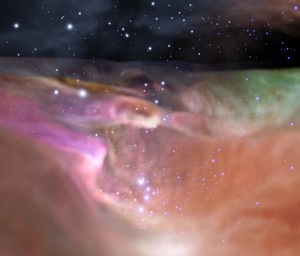
Behold: Messier 42, the Orion Nebula, or rather a visualisation of it based on astronomical data and movie rendering techniques. To wit:

Up close and personal with a famous stellar nursery normally seen from 1,500 light-years away, the digitally modeled frame transitions from a visible light representation based on Hubble data on the left to infrared data from the Spitzer Space Telescope on the right. The perspective at the center looks along a valley over a light-year wide, in the wall of the region’s giant molecular cloud. Orion’s valley ends in a cavity carved by the energetic winds and radiation of the massive central stars of the Trapezium star cluster. The single frame (top) is part of a multiwavelength, three-dimensional video that lets the viewer experience an immersive, three minute flight through the Great Nebula of Orion.

Any excuse…

(Visualization: NASA, ESA, F. Summers, G. Bacon, Z. Levay, J. DePasquale, L. Frattare, M. Robberto, M. Gennaro (STScI) and R. Hurt (Caltech/IPAC)

apod

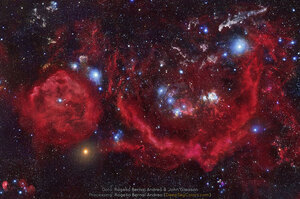
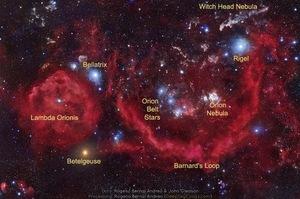
Behold: one of the best known and most recognisable constellations in the night sky: Orion. But shown in considerably more detail than the human eye – or any one telescope – can detect. To wit:

This is a more full Orion than you can see — an Orion only revealed with long exposure digital camera imaging and post-processing. Here the coolred giantBetelgeuse takes on a strong orange tint as the brightest star at the lower left. Orion’s hot blue stars are numerous, with supergiantRigel balancing Betelgeuse on the upper right, and Bellatrix at the upper left. Lined up in Orion’s belt are three stars all about1,500 light-years away, born from the constellation’s well-studied interstellar clouds. To the right of Orion’s belt is a bright but fuzzy patch that might also look familiar — the stellar nursery known as Orion’s Nebula. Finally, just barely visible to the unaided eye but quite striking here is Barnard’s Loop — a huge gaseous emission nebula surrounding Orion’s Belt and Nebula discovered over 100 years ago by the pioneering Orion photographer E. E. Barnard.

Full size image here.

(ImageJohn Gleason & Rogelio Bernal Andreo)

apod

This is how the Orion Nebula appeared to astronomers at the turn of the 20th century when advances in astrophotography opened up new vistas for science. To wit:

… his stunning image of the star-forming Orion Nebula was captured in 1901 by American astronomer and telescope designer George Ritchey. The original glass photographic plate, sensitive to green and blue wavelengths, has been digitised and light-to-dark inverted to produce a positive image. His hand written notes indicate a 50 minute long exposure that ended at dawn and a reflecting telescope aperture of 24 inches masked to 18 inches to improve the sharpness of the recorded image. Ritchey’s plates from over a hundred years ago preserve astronomical data and can still be used for exploring astrophysical processes.

(ImageGeorge Ritchey, Yerkes Observatory – Digitization Project: W. Cerny, R. Kron, Y. Liang, J. Lin, M. Martinez, E. Medina, B. Moss, B. Ogonor, M. Ransom, J. Sanchez (Univ. of Chicago)

apod