



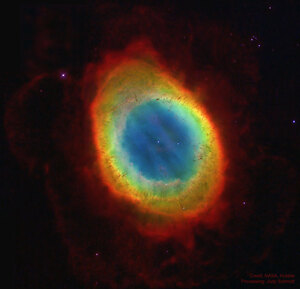
Behold M57, aka, the Ring nebula – about one light-year across and 2,500 light-years away – the most famous celestial circle outside the rings of Saturn.
Its classic appearance is understood to be due to our own perspective, though. The recent mapping of the expanding nebula’s 3-D structure, based in part on this clear Hubble image, indicates that the nebula is a relatively dense, donut-like ring wrapped around the middle of a (American) football-shaped cloud of glowing gas. The view from planet Earth looks down the long axis of the football, face-on to the ring. Of course, in this well-studied example of a planetary nebula, the glowing material does not come from planets. Instead, the gaseous shroud represents outer layers expelled from the dying, once sun-like star, now a tiny pinprick of light seen at the nebula’s centre. Intense ultraviolet light from the hot central star ionises atoms in the gas.

(Image: NASA, ESA, Hubble Legacy Archive; Processing: Judy Schmidt)