



From top: Oxfam warning 2014; Michael Taft
The recovery is benefiting one tiny group above all others.
Michael Taft writes:
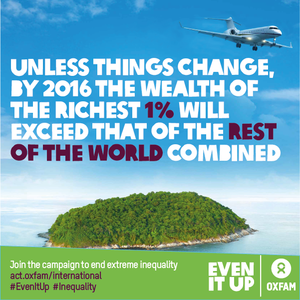
The One Percenters are back in the news with an Oxfam study showing that the world’s richest 1 percent owns more wealth than all the rest of the planet put together.
So what about our own One percent? How are they doing? Let’s have a look at how that 1 percent and other top earners have been getting along in the crisis.
What follows is based on the EU’s Survey of Income and Living Conditions measurement of income. It is a different concept from what Oxfam used: wealth. Wealth ownership refers to assets – real estate (buildings, land) and financial property (shares, bonds, cash, equities, pension pots, etc.). Income refers to the annual flow, whether it is employee or self-employed earnings, investment income, pensions, etc.
Income is only one measure of economic power and influence in the economy. Profits levels, the relative strength of labour and capital, degree of financialisation, place in the production process, social status, ownership of assets – it could be argued that income is the result, not the cause, of unequal power relationships in the economy.
But it’s an informative measurement and can reveal something of what is happening around us or, in this case, above us.
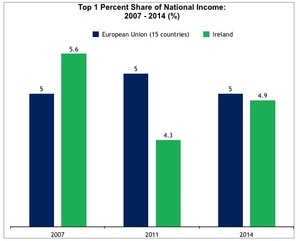
Prior to the crash the top 1 percent held nearly six percent of the share of national income, above the EU-15 average. This fell to 2011 – primarily due to losses in capital and self-employment income arising from property and speculative losses in the crash.
However, since 2011 (and the current government), things are on the mend with the 1 percent trending upwards. Still a ways to go to pre-crash levels but with a little time and a few tax cuts, normal business should be be resumed.
There are other ‘tops’ we can look at.
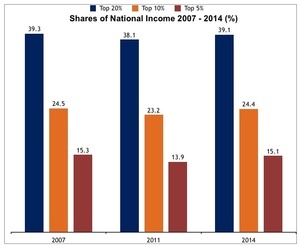
All the top percentages are experiencing a recovery and are returning to pre-crash levels.
Of course, the situation at the bottom is still pretty bottom.
The lowest 20 percent have only an 8.3 percent share (compared to 39.1 percent at the top)
The lowest 10 percent have only 3.2 percent share (compared to 24.4 percent at the top)
The lowest 5 percent have only a 1.1 percent share (compared to 15.1 at the top)
And the lowest 1 percent? It is so low that it is represented in the Eurostat tables as 0.0 percent.
There are many who would see these figures and the first thing they reach for is the tax axe. There’s something to that. Redistribute €250 million from high income groups to low income groups and watch consumer spending, business turnover and GDP rise.
But there is far more to inequality than just income. If there is affordable childcare, I may be able to take up a job or increase my working hours; otherwise I can’t afford the private fees. If I get sick, I may have to wait in a queue because I can’t afford queue-jumping insurance or private health fees. If public transport fees fall, I have more to spend. Public services are vital – not only in order that people can have access to services they might not otherwise, but that access doesn’t leave a further hole in the pocket.
There is also labour power. Giving people in the workplace stronger rights (right to collective bargain, part-time workers’ right to extra hours, statutory Sunday premium and overtime pay, extension of statutory collective bargaining) pushes up wages, especially the low-waged, and bridges the gap between the highest and the lowest by raising the floor.
Then there’s freedom of economic information to allow for a social monitoring of widening gaps. Full business accounts disclosure, including executive remuneration; and the gap between executive and average pay in the firm will allow society, consumers and investors to monitor enterprise performance and take decisions accordingly.
There are many strategies we can pursue to produce more egalitarian outcomes. Failure to do so will facilitate the acquisition of more power and resources at the top.
So, how’s the ol’ One percent doing? They went through a bit of a rocky patch but they’re back on the mend. Unless we take steps.
Michael Taft is Research with Unite the Union. His column will appear here every Tuesday. He is author of the political economy blog, Unite’s Notes on the Front. Follow Michael on Twitter: @notesonthefront


