



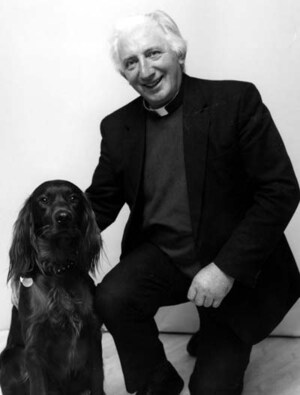
 Monsignor Denis O’Callaghan and friend
We’ll look after the Setter.
Cloyne cleric Monsignor Denis O’Callaghan appeared on RTE R1’s News at One today doorstepped by the station’s Southern Correspondent Paschal Sheehy.
It was a radio ‘moment’ and essential listening for those who think the church elders might finally have ‘got it’.
Do note the audible gasp from the Paschinator at the Monsignor’s utter lack of remorse and general foulness. How he didn’t make a citizen’s arrest on the spot is beyond us.
Listen here
Thanks Colin O’Mahoney
Transcript
O’Callaghan: “I’m terribly sorry, myself certainly, for anything I have done or not done that in fact would have added to their distress. My biggest concern.”
Sheehy: “Why didn’t you implement the church’s guidelines, child protection guidelines?”
O’Callaghan: “Well in fact you see the point about them was, my concern was, first of all, I suppose my statement has made it very clear, that the HSE is a concerned agency, and they really had – at that stage now was much earlier on – at that stage they didn’t have any interest in in in taking care of historic cases. They had ongoing situations. So I suppose that was their biggest concern. And I appreciate that.”
Sheehy: “But you had a job to do to implement the church’s child protection guidelines and you didn’t do that.”
O’Callaghan: “Yes and I regret, I regret that now.”
Sheehy: “Why didn’t you do that?”
O’Callaghan: “Why didn’t I do it? Because at the time, consulting with the HSE, way back, and that was the, that was the result I got.”
Sheehy: “But, your, the guidelines stipulated that the em, allegations were to be reported to the civil authorities. You didn’t do that.”
O’Callaghan: “I reported to the Garda, and –“
Sheehy: “Not in all cases.”
O’Callaghan: “Pardon?”
Sheehy: “Not in all cases.”
O’Callaghan: “Well no, if you, if you, if you read the report now you’ll find in fact where I didn’t report, you know, if you like immediately – it was more immediately than anything else – that there was always a reason for that.”
Sheehy: “Why? What was the reason?”
O’Callaghan: “The reason – well, if you had a man in hospital? and you know if he’s, if he’s, over Christmas for example, didn’t want to be [indistinct] before Christmas. I mean, there is a certain amount of sensitivity and discretion in all these matters, and I saw, that’s how I saw my position.”
Sheehy: “Do you accept that you failed the victims of clerical child sex abuse in the diocese of Cloyne?”
O’Callaghan: “In what way?”
Sheehy: “By not implementing the guidelines, which was the job that you were given to do.”
O’Callaghan: “I implemented the guidelines within that level of discretion that I was using myself.”
Sheehy: “And do you accept that you failed these people or do you believe you failed them at all?”
O’Callaghan: “My main concern with the people coming, who were, the accusers – let’s call them survivors, call them the victims, whatever you like to call them – and my main concern was to do what I could for them now, with counselling and every help I could give and also in fact, and then seeing where I was going to go from there.”
Sheehy: “And what about bringing the perpetrators to justice?”
O’Callaghan: “That was part of my concern. I was in no – I was absolutely under no em, illusion that I was dealing with people, dealing with people who, in fact, you know, allegedly criminals. And that was a matter for the Garda.”
Sheehy: “But you, you didn’t report it to the Garda in very many instances.”
O’Callaghan: “I – there was, there was a delay in certain situations but in fact they were all reported.”
Sheehy: “What do you say to victims of abuse who are suffering still now in the diocese of Cloyne and who believe that you failed them?”
O’Callaghan: “I am so sorry that is so. Because when I met them, and when I dealt with them in every way, I was extremely concerned about – as a priest – the pastoral care that I owed to people who suffered. And anyone who is suffering. And that was my basic concern, that it wasn’t just a matter of handing over to other people, to other agencies, but my major concern as a priest was to do what I could for them. I met them again and again and again. I think that’s omitted in the, in the report, even in the… By the way i’ve given a statement too. You’ve gotten to see that have you?”
Sheehy: “Yes I have.”
O’Callaghan: “That’s it. And that was my major concern.”
Sheehy: “Do you accept – do you accept that you failed the victims?”
O’Callaghan: “Ah well I accept, I mean in hindsight, if I’d gone back to the very beginning and even [indistinct] all the confusion, and not the confusion but the problems with [indistinct], I’d have done everything by the book. And no doubt about that. Whether or not –“
Sheehy: “And why didn’t you?”
O’Callaghan: “Because, as I’ve explained already, I was dealing with indiv– with persons – dealing with, with, with the accusers – but number one, they were my first concern. Absolutely my first concern. And they were my first concern always. Absolutely. Now maybe times, I may look back and say I should have done something better there or not. But I mean that’s human nature.”
Sheehy: “Do you have regrets? Do you feel guilt about that now?”
O’Callaghan: “Oh, I do of course. Oh I do of course. I mean, any human being who wouldn’t feel, you know, guilty, about all I suppose the distress involved and so many people? My own bishop as well? I mean, that certainly is something, you know, that you do have regrets about. And if I hadn’t regrets, I wouldn’t be honest and human. Course you have major regrets. Major regrets. Absolutely major regrets. Of course I do. So OK then?”
Sheehy: “How do you feel about Bishop John Magee now?”
O’Callaghan: “He is a good friend of mine and always has been good friend of mine. I’m very concerned, and concerned and, and sorry about him. I really am. I really am. He’s still – he was still – he was the man who appointed me, you know, I suppose, to the post of delegate. And later on in fact, when, when, when I saw in fact first of all I was coming close to the age of – I was well beyond the age of retirement, and it was maybe a long history building up, I was the one also who asked him for a replacement of me as delegate.”
Sheehy: “Do you know where he is now?”
O’Callaghan: “NO idea. And what’s more, I didn’t even want to know.”
Sheehy: “Why?”
O’Callaghan: “He is entitled to his privacy.”