



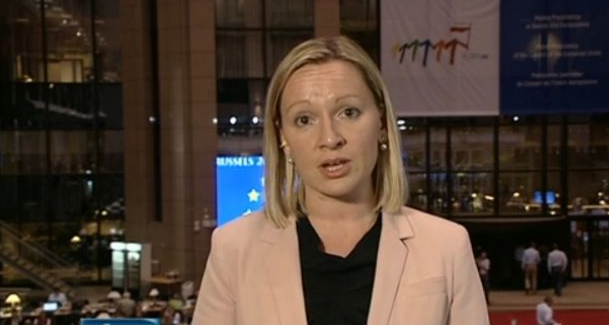
 Minister of State for European Affairs Lucinda Creighton, above, joined Marian Finucane yesterday on RTE R1 and a panel that included Martin Mansergh, former FF junior minister; Peter Brown, Founder of the Irish Institute of Financial Trading; James Morrissey, PR man for Denis O’Brien; Brendan Keenan, Economics Editor at Independent Newspapers and Helene Conway, recently elected to the French Senate and Director at the Dept of Languages, DIT.
The subject was the future of the Euro.
James Morrisey: “I think that the biggest concern, and I will defer to the economists around the table, I would look at this through people. And you mentioned earlier on ordinary people being worried about what will happen to them. I think politicians are worried about what’s going to happen to them. I mean democracy is being eroded in a way that I’ve never seen in my lifetime. The bureaucrats are taking over Europe, whether we like it or not. And the problem, this problem is bigger than our government. And it’s bigger than all other governments. And I don’t see any solutions and I don’t see any answers. And, with respect to Lucinda, the people who voted for her, I think it’s possible, that at some stage, in the not-too-distant future she may just have to say to people: “I can’t do anything about this.” I think it’s not beyond the bounds of possibility that some morning Enda Kenny or Eamon Gilmore are going to say: “There is nothing we can do about this”.
Marian Finucane: “Well they do say that, they blame Fianna Fail and they blame the Troika.”
Morrisey: “Look it, you can blame everybody, that doesn’t come up, that doesn’t come up with solutions. The original notion of setting up a common market was a very good idea. I just wonder whether the people of this country have so much in common with the people, with all other member states, that they want to be told what to do, how to do it, when to do it, in relation to taxation, restaurant, hygiene regulations, all of those things. And I just think that the Euro project has been taken far too far. And it is simply impossible to get everybody to agree. The analogy as I see it is the patient is dying, the family have been brought in to the hospital ward. And some members of the family are being told “You’re not wanted here, we will decide what is going to happen next”. That is wrong. When I hear that France and Germany are hatching some great plan and I don’t see how politicians across Europe, including in this country, are not saying “where the heck do you think you’re going to take us, without telling us you’re in our great plan”. That is simply unacceptable. And the biggest price that will be paid for this will be democracy.”
Martin Mansergh: “With respect, I mean, that’s based on a very speculative article. For nearly 40 years, successive governments have taken the view that it’s in the best interests of this country not just to be in the European Union but if there is an inner core and an outer core, to be there in the inner core.”
Marian Finucane: “Well maybe we were wrong.”
Martin Mansergh: “Well I don’t think we were wrong, I think we were right. And I would actually applaud the Government this week if I think the small measure to sustainability is to do a revise capital programme with various projects dropped. I think that helps. The other thing is we’re seeing an awful lot of this through the filter of commentators particularly in London and America. And as you know some of our papers, including some you’re quoting from, are owned by people who are deeply, deeply Eurosceptic. I buy…”
Marian Finucane: “Listen Martin, we can’t go down the conspiracy theory route. I mean there is a problem.”
Mansergh: “I’m not in the least denying the problem but the question is how we look at, how we look at the, at the problem. And I think we do have to pay closer…”
Finucane: “But do you take James’ point…”
Mansergh: “..I, I, I buy several times a week French and German newspapers so that I can get information from independent sources that are not sort of fundamentally Eurosceptic. And I think there’s far too much at stake for it to be…”
Finucane: “But can I cut across you? And take apart what James was saying there. I mean Sarkozy and Merkel got rid of Papandreou, more or less.”
Lucinda Creighton: “He got rid of himself.”
Mansergh: “Yes.”
Creighton: “He got rid of himself. His actions…”
Finucane: “But he was summoned..he was summoned to Cannes.”
Creighton: “His actions last week were absolutely 100% of his own volition, without consultation or without reference to any other political leader in Europe. And I have to say, you talk about, you know, a lack of respect for other member states.”
Finucane: “Yeah.”
Creighton: “Em, well. Any member state in the Eurozone who acts now in a unilateral fashion, without any reference to the impact it will have on the other member states, is acting in an incredibly irresponsible fashion.”
Finucane: “Unless you’re from France or Germany.”
Creighton: “No, no, no, all of them, all of them. I talk about every single member state, including France and Germany.”
Finucane: “But Sarkozy is there today saying it’s the only way forward. I mean, who gave him the authority to do that?”
Creighton: “Well I presume every political leader is entitled to have a view on it. I, I, I share the view that if we want to solve this crisis, if we want to underpin our currency, so that Irish deposits, Irish bank accounts are secured, so that Irish people’s savings are secured, so that this State can continue to fund its social welfare obligations, to fund its pension obligations, etc, etc…”
Finucane: “Yes, you wanted to come in there…”
Creighton: “If we work in unison with other Europe states to try to solve this crisis, that is the best way forward. And I mean, I really, I have to say, I just..I don’t… It’s really simplistic to say that bureaucrats are taking over the European project. I mean at the end of the day the buck stops with every….I mean we have three institutions effectively working in parallel, you have the European Commission.”
Finucane: “Which has gone AWOL.”
Creighton: “Where you have 27 commissioners, who are nominated respectively by each government. So every member state is represented equally. It’s effectively like a second chamber, or Senate. Every member state is represented equally there. It doesn’t matter if you’re France, it doesn’t matter if you’re Malta, you have the same representation. You then have the European Parliament…”
Finucane: “But at the moment… Sorry Lucinda, that’s the structure, and we’re aware of the structure. And one wonders if Delors were there, would the Commission assert itself more.”
Creighton: “Well I agree. And there is a very legitimate question about how the Commission has played its role in all of this. I think it’s disappointing that the Commission hasn’t been far more active. But I just want to make that point. You then have the European Parliament, which has a balanced representation where small member states are overrepresented and the large member states are underrepresented and I think that’s an important dynamic and the European Parliament, I think, if you look at the statements that have emerged from it, if you look at the active debate that has gone on there, it’s a thoroughly democratic institution. It’s directly elected by the people and there you see great leadership from many of the members of the European Parliament who have demonstrated far more foresight. And the third leg of that is the heads of state and government. And I think that’s actually where we have seen…And these are people who have been elected by their parliaments, some of them directly by the people, some of them directly by their parliaments They are representatives of all of us by every member state. And they have failed to act over the past two years to deal with this crisis. That has been the weakest link.”
Finucane: “Ok, Brendan, you wanted to come in.”
Brendan Keenan: “I, I, I think…”
Creighton: “It has nothing to do with bureaucrats, it has to do with politicians who haven’t actually stepped up to the plate and taken, and shown, and shown leadership and shown responsibility.”
Morrisey: “I didn’t vote for Nicolas Sarkozy.”
Creighton: “And the French didn’t vote for Bertie Ahern, Brian Cowen or Enda Kenny.”
Brendan Keenan: “What we’re seeing with the role of France and Germany is the big missing bit of the architecture that has got to be built. France and Germany are doing what the President of the United States and the President of France does in a federal system. They administer and they propose and their parliaments and congresses discuss it. There is no such structure in Europe. Nobody can act quickly and make urgent proposals in an emergency. So France and Germany are doing what has to be done that nobody else can do. But if we’re gonna make this thing last we have to find a way to construct, what I would call a Presidency, maybe be elected, maybe not, but somebody who, if you like, runs the administration, and then proposes to all the member states what needs to be done.”
Finucane: “But isn’t that was [José Manuel] Barroso [president of the European Commission] is supposed to do?”
Keenan: “The Commission doesn’t actually have that. It has 27, as Lucinda says. So, this goes back to the question of the inner and outer. The one thing we do know is that if the Euro survives, it’s going to be a political union. And that’s going to be one of the things that it’s going to have to have – an executive body. And members states then, in effect, become the congress. Now the American founding fathers worked all this out in theory 200 years ago and it has lasted 200 years We see the emergency creating ad-hoc a very similar structure to the way the United States government works, with France and Germany being the White House, but that is unacceptable in the long run. But if they didn’t do it, there’s nobody else who can do it at the moment.”
Finucane: “Right. You were trying to come in there, Helene.”
Helene Conway,: “Well yeah, I actually have a different opinion of the way Papandreou behaved. I thought Nicolas Sarkozy had no right to treat him this way as a person. To keep him waiting for two hours outside the door and then tell him what he had to do. I think whether you’re a big state or a small state, one has to have respect for others…”
Creighton: “I agree with you on that.”
Conway: “But at the same time I thought Papandreou was in an impasse. He had..in his position, you know, the right against him..everything that he did, he had the people on the streets, what was he to do? I think he showed an incredible amount of political courage, to call a bluff, and to say ‘well, look, do you want to be in or out?’ And then you can actually go back.”
Finucane: “Yeah. It’s called democracy.”
Conway: “It’s called democracy. This is called democracy. This is calling on the people to actually say and decide for themselves where they want to be and what they want to do. So I think he was actually right…”
[Talk over each other]
Creighton: “There’s no, there’s no…”
Conway: “Now I know that impact then at the other level, if you like, the federal level, was different but for himself, as a leader, I really don’t see what other option he had, and I think he was right to do it.”
Creighton: “I’ve no problem with any leader holding a referendum. I do have a very big problem with leaders who come in good faith to a summit of 27 heads of state in government, effectively sign up to a binding agreement, on behalf of their state and on behalf of their people, presumably with a mandate, he was elected to office, to try to solve this crisis and to try to bring Greece back onto a sustainable path.”
Finucane: “But his people weren’t…I mean why is it considered an offence…”
Creighton: “I just want to finish my point.”
Finucane: “Why is it considered an offence to consult with your people?”
Creighton: “But I’m just trying to finish my point. My point is this. If you want to get a mandate from your people, whether it’s a parliamentary mandate or a mandate from your people, through referendum do so before you go and sign up to that international agreement. Do so in advance of going in good faith where you sign up to a deal with your partners around a table. Don’t do it retrospectively.”
Morrisey: “But we’re losing faith and confidence in our politicians. Go back to the famous bank guarantee when the most important decision, financial decision, ever taken in the history of this State, was decided by a Taoiseach and a minister for finance, who rang a couple of fellas around, their colleagues, in their beds asleep, ‘would you tell us you’re supporting this?’ Goodness me, for something as important as that. But I think politics and politicians are being debased by an awful lot of this because I honestly think, and again I say this with respect to you Lucinda, I don’t think you or your colleagues know what the solution is to this problem. Now you’re not alone. But that scares the living daylights out of an awful lot of people who read the papers and who are listening to radio stations on an ongoing basis. And it’s spooky and I think the consequences of all of this will be much more emotional for an awful lot of people, than they will be economic. I think they’ll be psychological, I think we’re in an awful state because whatever way Europe is constructed there is no cohesion and scant leadership.”
Creighton: And it’s my job to try to restore cohesion..
[Philip Boucher Hayes joins the discussion He’s just returned from Athens, where he said society is beginning to disintegrate]
Philip Boucher Hayes: “It’s not just a case of one or two shops on a street being closed down, but every single shop on a street being closed down. I challenged myself after a while how many city blocks could I walk before I would find with a single shop that was open. The streets are crawling with junkies and prostitutes. There are, in open daylight, there are cardboard boxes on pretty much every street corner, with people living in them. There are right-wing skinhead gangs roaming certain parts of the city at night. It is a pretty scary place to be. The crime figures have soared. They’re not massively ahead of other European cities but at the moment, armed robberies, kidnappings, burglaries on every single level. What has happened over the course of 6 to 12 months is really frightening and a salutary tale.”
Later
Marian Finucane: “Couple of callers in. ‘Eamon Gilmore was asked three times during the week by Brian Dobson ‘do we, Ireland, have a contingency plan, if the Euro collapsed?’ Each time he astutely avoided answering the question’…”
Creighton: “I answered it myself in the Dail this week. Our plan A, B, C, D, etc, is to save our currency. We have one currency, no other currency and we have an obligation to save the currency that we have. And that is what we are doing. That is our plan and that is our contingency plan.”
Finucane: “Is there a war cabinet saying ‘what if?'”
Creighton: “Yes we have an economic council, which is comprised of the Taoiseach, the Tanaiste, the Minister for Finance, and the Minister for Public Expenditure and Reform. And they meet at least twice a week at this stage and in advance of the Budget, probably even more frequently and they discuss both the European dimension and the domestic decisions that have to be made.”
Finucane: “And are they addressing the question of ‘what if?'”
Creighton: “Of course they are. Of course they are. But they’re dealing with the fact that we have one currency and one currency only and we are not contemplating the prospect of the currency not existing. And we can’t. If you start speculating the break-up.”
Finucane: “Lucinda, sorry…”
Creighton: “Of the Euro, we may as well just…”
Finucane: “Lucinda, we had a real problem that grew over the years with both ministers and departments of finance, that not enough people asked ‘what if?'”
Creighton: “We have plenty of people asking ‘what if?’ and Michael Noonan has an excellent team around him which he has enhanced over the last number of months. So I have every confidence in what he and his department are doing. But the bottom line is that we have one interest in this and our interest is to ensure that when people get up in the morning that they can go to an ATM, that they can withdraw their cash, they can withdraw their Social Protection welfare money, or they can go and receive the pension benefits to which they are entitled. And if we start talking about undermining our own currency we really, we really would not be behaving in a irresponsible fashion.”