



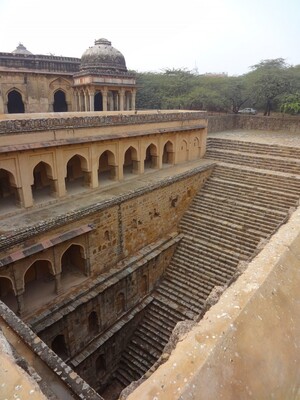
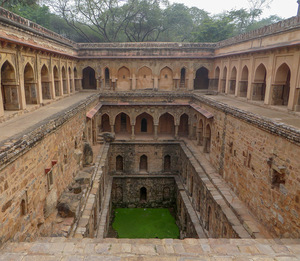

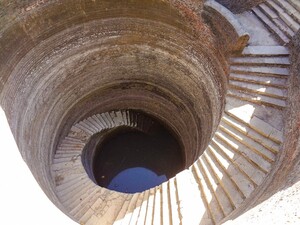


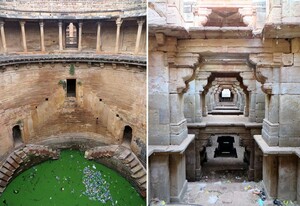

Indian stepwells or kalyani date back to the 2nd century AD when trenches were strengthened with stone to create underground temples close to the water table. By the middle ages, they had evolved into an elaborate architectural style, underpinned by advanced engineering.
Lately with a drop in India’s water table caused by unregulated pumping, many of the kalyani have run dry, caved in or become illegal dumps.
Journalist Victoria Lautman, who has been documenting the disappearance of these engineering and art treasures for the last seven years, explains:
Construction of stepwells involved not just the sinking of a typical deep cylinder from which water could be hauled, but the careful placement of an adjacent, stone-lined “trench” that, once a long staircase and side ledges were embedded, allowed access to the ever-fluctuating water level which flowed through an opening in the well cylinder. In dry seasons, every step—which could number over a hundred—had to be negotiated to reach the bottom story. But during rainy seasons, a parallel function kicked in and the trench transformed into a large cistern, filling to capacity and submerging the steps sometimes to the surface. This ingenious system for water preservation continued for a millennium.
MORE: India’s Forgotten Stepwells (Arch Daily)
Perhaps some images of the Temple of Bel, Syria might be fitting – given that photos are all that is left. ISIS scum.
Amazing what they built by hand back then.
Theres so much more to india than the taj mahal, places you wouldnt imagine could have escaped some sort of exposure.
Seen one of these tanks at a place called daulatabad, the whole complex almost defies description.
Very temple of doom.