



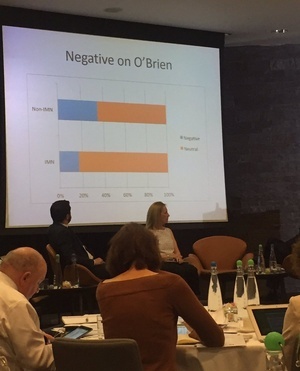

From top: A visual from the Newsocracy Conference in Limerick last Friday; Anne Marie Mcnally
Journalism as we know it and as it should be is in extreme danger in this country.
Anne Marie McNally writes
On Friday last I spoke at a conference in Dublin hosted by MEP Nessa Childers. The title of the event was ‘Newsocracy- Safeguarding Journalism and Exploring owner Influence’ and the theme was (obviously!) the relationship between media ownership and unbiased Journalism.
The panel was made up of representatives from media outlets and other agencies including Facebook, the Broadcasting Authority of Ireland, the National union of Journalists, academics from the field of communications, and journalists from various backgrounds.
By a country mile the overwhelming message from the speakers was that Journalism as we know it and as it should be is in extreme danger in this country.
Possibly the most worrying part of the day came when Professor Roddy Flynn from DCU’s School of Communications presented the findings of a research piece which examined the treatment of four of the biggest news stories of recent times across various media outlets.
Two of those stories centred around your favourite redacted personality with a penchant for litigation.One was the reporting of the Moriarty Tribunal findings and the other was the Siteserv/IBRC and Catherine Murphy story.
The results were interesting to put it mildly.
In relation to the Moriarty Report, a study of 140 articles published about the Tribunal in Independent News and Media (INM) titles and a further 227 in non-INM titles between March 23 and April 2, 2011, showed that, in general, INM titles were more likely to focus on Michael Lowry than on Denis O’Brien with the difference being reported as ‘statistically significant.’
Similarly in relation to the reporting of the Siteserv/ Catherine Murphy story, the study found that the frames used to report the story differed significantly between INM tiles and non-INM titles with the former tending to frame the story in the ‘abuse of privilege and right to individual privacy’ context while others chose the ‘public good’ frame more regularly.
Given that the circulation figures for INM titles far outstrip all others this is a worrying, if not surprising, reality in our news media and surely has repercussions for the democratic process if media is to truly be considered the Fourtht Estate of any healthy democracy.
We, of course, are also aware of the campaigns waged by INM titles on perceived ‘political rivals’ including Sinn Féin and Lucinda Creighton in recent times representing yet another worrying departure in news media in this country.
After Professor Flynn had dropped that particular nugget of academic proof on the difference in reporting based on ownership into the conference, the tone continued apace.
Daniel McConnell, the Political Editor of the Irish Examiner and former Irish Independent Political Correspondent, delivered a speech entitled ‘No Country for Brave Men’ which was a fascinating insider’s insight into the politics of newsrooms and the changing landscape of Journalism as a profession.
Daniel spoke about precarious working conditions for young graduates entering the profession and how even the type of reporting we receive on specialist subject such as the Courts, has become dumbed down by virtue of the fact that new entrants are very rarely trained into specialities and are more often than not just stuck on a beat that’s available rather than tailored to any particular skill set.
Gemma O’Doherty followed up in her now trademark fashion of burning the establishment to the ground in what was a cutting and incisive speech on the often toxic relationship between our National Broadcaster, politics and the issue of looming litigation and/or influence.
I had gone along to speak on the importance of Social Media in political campaigns and had always intended to make the point that despite my being an evangelist for Social Media, I still very much value and understand the importance of using the medium in harmony with traditional media.
I pointed out that during the so-called ‘constitutional crisis’ caused by Catherine Murphy’s speech it was only this online outlet, Broadsheet.ie, which stood by and held firm in the belief that Article 15:12 of the Constitution protected them to report the utterances of a national legislator in the national Parliament while every other (more adequately resourced) media outlet in the country cowered in the face of threats from the redacted one on high.
I know, having been in the maelstrom of that particular crisis, that it was not journalists who were the problem, it was overly-cautious legal teams wielding control over media outlets.
On that basis I’ll end this piece in the same way I ended Friday’s speech – it is not brave journalists we need – we have them – it is brave media outlets prepared to give voice to those journalists.
Anne Marie McNally is a founding member of the Social Democrats. Follow Anne Marie on Twitter: @amomcnally
Circle jerk
indeed, the graph shown only makes sense if there is an accepted level of negativity to O’Brien in the media
what is shown there could be construed as balance, some of the commentary around siteserve/water etc was hysterical
Such as?
Do you have a quota of sarcastic put downs to post every day or are you just a dislikeable person?
I’m sure you’re gonna tell me
All true I think . I suppose the question is why do we not have such brave media outlets?
Is it that demand is limited and people would be unwilling to buy papers of record in a manner that would make it profitable? Irish Times sales figures vs the rest could illustrate this.
Then there is also the litigious nature of the world today which leads to a situation of risk aversion.
Not too sure what the solutions are here, anything put forward at the conference Anne Marie?
Do something about that 2009 Defamation Act for a start, there is no balance in it towards the public good and it is way too favoured towards plaintiffs. Plus we could dump the blasphemy thing while we’re there
The Indo, for instance, cultivates a working environment where only the biddable survive. Anyone with a pair – and I include women here – leaves or is forced out. Most of the rest of the newspapers are similar to a greater or lesser extent as far as I can see.
If you’re in the know, I’d be interested to hear you elaborate further on the Indo working environment.
Ha! The fourth estate died long ago. http://www.belfasttelegraph.co.uk/news/world-news/google-working-closely-with-hillary-clinton-presidential-campaign-julian-assange-34780998.html
Remember when people used to leak information to prove bad things were happening. I’m glad we bypassed all that messy documentation business.
“Then there is also the litigious nature of the world today which leads to a situation of risk aversion.”
– I think that this is the crux of the issue, unfortunately. Media outlets, which have ever-dwindling resources due to falling sales, are terrified of writing anything that may lead to a few days down in the courts. Against this backdrop, Broadsheet’s recent coverage of the stories referred to in the original piece is especially admirable.
Yes. It’s incongruous to argue that legal teams have control over media outlets and then call for braver media outlets. If the legal teams are actually in control then you need braver legal teams, or to acknowledge that the media outlets are not actually controlled by legal teams but by the fear of huge financial penalties. You are asking most Irish media outlets to take a chance on flushing themselves and their staff down the cr*pper. With (some) respect, that’s a risk worth taking by outlets like BS, And all of that is not to say there aren’t plenty of incredibly craven individuals working in the Irish media.
Also, is it true that newspapers have some level of insurance against being sued for libel but that this is limited, eg only to a certain level of compensation? I could be completely wrong about this, but I thought that they had limited liability, which makes their legal teams very jittery.
Insurance policies like that are definitely available. Obviously there will be a limit and presumably they are expensive. Juries still set the award in defamation cases, although there are better guidelines now. But it’s not so much the awards, it’s the actual legal fees involved in running a case that are the problem. This leads to a tendency to settle, which then encourages people to lob in solicitor’s letters. The internet and the demise of traditional media is going to have a bigger effect here than any futile attempts to lower legal fees.
We haven’t had real journalists in many years. They have been singled out for phasing out in the West in general and replaced with establishment mouthpieces and other forms of tannoy.
I don’t think there is much point in criticising privately owned media outlets when the national broadcaster now runs from the threat of legal action. The Rory O’Neill case and subsequent pay outs was a new low because what he said was glaringly obvious. If RTE would not stand up to such bullies then what hope is there for the rest?
“We haven’t had real journalists in many years.”
Are you sure?
By “real” they mean every journalists doesn’t write exactly what I want them to say.
A journalist: https://youtu.be/izWwrL9JBHo
Funny how none of the INM so-called journos used the hashtag / commented on any of the #newocracy conference.
Funny that…
If I am mistaken, plse do correct me.
#newsocracy
Ooops
Ding dong, denny, calling, careful now.
wouldn’t worry about Dinny for now, he is too busy licking the wounds of his failed IPO for Digicel while Cable & Wireless are stepping up their operations to take him out of the Caribbean
Sunday Times was the only newspaper to report Catherine Murphy’s speech despite the DOB threats.