



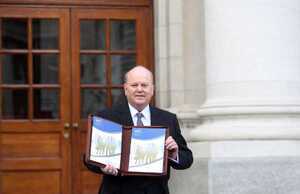

From top: Michael Noonan presents Budget 2016; Michael Taft
Overall high spending may not tell us much about the efficiency of a public service, but low spending can tell us a lot about why our public services compare so poorly with other countries.
Michael Taft writes:
Budget day and everyone will be looking for the favourite detail (tax cut, pension increase) while the Government attempts to mould the good news angle.
And throughout all this the media will be forced, through time and news cycle constraints, to report headline numbers and instant commentary. Deeper analysis will come later and by then we will all have moved on.
One of my favourite budget details is the general level of expenditure on public services, or government consumption.In the past government ministers have expressed the aspiration to have first class public services – everything from health to education to police and fire services and all the rest.
However, we are so under-funded compared to other countries, it is hard to see how this will be achieved anytime soon.
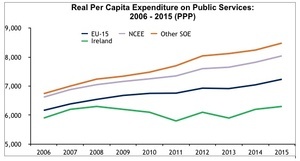
We trail behind the mean averages of EU-15 countries and our two peer groups: Northern and Central European economies, or NCEE (this excludes the poorer Mediterranean countries) and other small open economies (Other SOE – Austria, Belgium, Denmark, Finland and Sweden).
To show how far behind we are, this is how much we would have to increase spending on public services:
To reach the EU-15 average: €4.9 billion
To reach the average of Northern and Central European economies: €9.1 billion
To reach the average of other small open economies: €11.4 billion
A €9 billion increase just to reach average of Northern and Central European economies – that is a big, big number. Even with a government determined to provide the range and quality of public services enjoyed in countries on the continent, it would take a long time to realise that.
So what should we expect today?
We will get a lot of piecemeal announcements (x amount for health, y amount for education and so forth) and a few ‘sweeties’. But you will have to go towards the bottom of the budgetary outlook document, past pages of tables and numbers, to find the expenditure on public services.
But here’s one bottom line: spending on public services would have to increase by €450 million just to keep pace with inflation. Even if spending exceeds that, it may only be enough to keep pace with inflation plus demographic pressures (rising elderly and school-going population).
It will be tight – with tax cuts, increases in social protection (both in rates and increased pensioner numbers) and investment to be financed out of the same relatively small pot.
There is the legitimate complaint that spending levels is no guarantee of quality. Inefficient spending can waste a lot of outlay.
For instance, the Netherlands has experienced a substantial long-term increase in health expenditure due to the extra costs from privatising their health insurance system. This was the model that our last Government sought and failed to introduce, thankfully.
In Ireland, there is a lot of data to suggest we spend more on health than most other EU countries even though we benefit from a much lower elderly demographic (this will change over the next decade).
We spend one percent more than the average of Northern and Central European economies; we should be spending less – though the claim that we over-spend is sometimes greatly exaggerated.
Are there inefficiencies in the health system? Yes. Is it due to the high level of private profit in our public health system?
Our spending on hospital services is low but spending on outpatient services is very high – this might suggest perverse private incentives. Is it because of our geographical density which requires more spending on physical structures and staff than more highly dense countries? Is it due to weak management structures? We need a more sophisticated evidence-based debate on this issue.
One thing is certain – overall high spending may not tell us much about the efficiency of a public service, but low spending can tell us a lot about why our public services compare so poorly with other countries.
While we shouldn’t expect any big increases in public services today given the fiscal constraints and the demand on other expenditure, we should expect that the Government will announce that it intends to close the gap with the European average over the next 5/7/10 years; that is determined to provide the same quality and range of public services that our fellow European citizens enjoy.
Or is that expecting too much?
Michael Taft is Research Officer with Unite the Union. His column appears here every Tuesday. He is author of the political economy blog, Unite’s Notes on the Front. Follow Michael on Twitter: @notesonthefront


Mabe if we didn’t have the highest rate of households in which not a single person works in the entire EU (an eye-watering 23%) we might have more to spend on public services.
This is an important point.
Ireland spends quite well on transfers – particularly to those of working age.
All else equal this leaves less to spend on services.
Great post Michael.
Current government spending is split into two bits: transfers, and direct spending on all sorts of services.
Transfers gets lots of attention on days like this because people can tangibly see how much better/worse off they are in cash terms due to policy changes.
The other part – services – is much more important, particularly in the long run. Health, education and security are all provided in kind by the government and it is much harder to link the inputs (spending) with the outputs. In the presence of supply constraints simply throwing money at a policy will just produce inflation.
The (mooted) big increase in childcare subsidies will be interesting. This is a big move by the state into procuring services in an area it has traditionally ignored.
Sorry to highjack this post, but since we’re talking about The Fine Print (and as Mr Taft coincidentally mentioned “a few sweeties”), did anyone else notice when Broadsheet promised to give away €100 of chocolate, got 60-odd replies, and then deleted the post a few days later?
Did I miss what happened there or did Admin just scoff it themselves and hope nobody would remember? Suuuper dodge.
https://web.archive.org/web/20161001145906/https://www.broadsheet.ie/2016/09/30/could-you-eat-e100-of-lindt-chocolate/
And my signed Angry Bird prize that never came :-(
Oh no, prior dodgy form! How disappointing. I think they’re breaching consumer rights in both instances. What did they say when you told them you didn’t get it?
“Government will announce that it intends to close the gap with the European average over the next 5/7/10 years”
Given the make up of this government, that it exists on avoiding independent hissy fits and with grace & favour of FF, no long term plans can be made. It will exist for at most 3 budgets, this is no. 1.
All it can do is tread water.
One of the details I’ll be looking for is the raising of limits on amount that can be inherited without taxation.
Inequality is perpetuated by inheriting wealth, as demonstrated by Piketty.
Why & by how much it would be upped significantly at this time will be interested to note.
So where’s our tax going?
it gets turned into gravy.
lovely, lovely gravy