



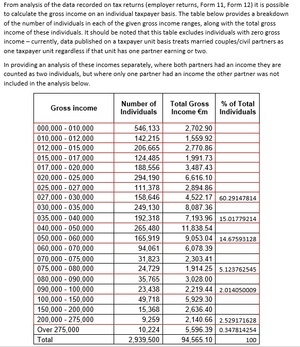
60% of taxpayers earn less than or equal to €30K gross in Ireland.
The Revenue Commissioner have, for the first time, published Ireland’s gross income statistics.
How do they look?
Ronan Emmet writes:
The table (above) provides a breakdown of the number of individuals in each of the given gross income ranges, along with the total gross income of these individuals. It should be noted that this table excludes individuals with zero gross income.
Considering the average price for a house in Dublin is now standing at €375,000, 60% of taxpayers earn less than or equal to €30K gross in Ireland. Homeownership is out of the question for a lot of these people.
The Government’s failure to adequately address the supply issue in terms of available social housing coupled with rents spiralling upwards, we have the makings of a perfect storm. 10,000 homeless is only the start in terms of what’s to come in my opinion.
Individualised Gross Incomes (Revenue Commissioners)
Dublin salaries should be weighted, so employees can afford to live there.
in the private sector they probably are effectively weighted – you’d get paid less for the equivalent job down t’country (this is why Eir want to move some of their call centres to Sligo).
they’re not weighted effectively enough.
I agree there is a problem, but pushing up wages will surely just push up house prices and rents up?
I’m not trying to be cheeky but why is that? Economics and numbers based stuff is absolutely NOT my strong suit.
I’m learning as I go, but people are generally getting their salary x 3.5 as a mortgage to bid on houses.
If a house is for sale in a area of highest demand, they will take the highest bidder, usually whoever has the highest salary.
If everyone gets more money, they can get more of a mortgage. The house still goes to the highest bidder, just now the bid is higher.
It’s hard to explain, but that’s my understanding!
Thank you! That’s very helpful. And not too difficult to understand for those numerically challenged folks like me :)
Thanks Col. I’m also not good at numbers. So I understand what you’re saying but personally it’s still annoying when x3.5 my fairly decent wage is still not enough to buy anything in Dublin. :D
I feel your pain Starina (same boat).
But, as far as I understand it, there are only 2 solutions to our problem:
1.Build enough supply to match demand.
2. Kill or deport enough people to reduce demand.
Well, I’m a big fan of eating the rich, soooooo…
It’s the extra layer of cream that makes them so tasty…
Why should they?
And a pint is €6…go figure
That’s probably why so many pubs are going out of business.
https://www.independent.ie/breaking-news/irish-news/worrying-two-pubs-a-week-have-closed-in-ireland-since-2005-new-figures-reveal-37240753.html
7.70 in Temple Bar! yeesh!
Fascinating.
Of course, this includes everyone working part time (students working for the summer or part-time) and retired but enjoying a private pension or other income stream. It excludes income from social welfare, money earned abroad and excludes wealth.
It also creates confusion. A married couple with two incomes of 45k each are likely to be treated as two tax payers but a married couple with one income of 90k will be treated as one tax payer. However if one spouse earns 10k and the other 80k, it is possible they will be counted as one tax case or as two – thereby meaning the family has one person who is doing well and another who isn’t.
It also means that a 50 year old farmer who has sold 50 acres in Meath for 12m to a property developer in the 90s and has that sitting on account, has another 100 acres that he is leasing is probably only ‘earning’ less than 20k according to his self assement and is doing very poorly according to this facile analysis.
What would be worthwhile is looking at full-total incomes of family units for people who are not looking to purchase housing either because they already own their own home, are still in education, are not yet at the stage of life where they want to own a house or are in retirement.
This tell us nothing bar some people can always look at any set of numbers and see the impending collapse of the futures market for oranges.
“This tell us nothing bar some people can always look at any set of numbers and see the impending collapse of the futures market for oranges.”
New to Broadsheet I see…
@The sound of music
well said
Average house price is not much use here.
These numbers seems to include pensioners.
according to CSO “In Census 2016, 94.7 per cent of usually resident persons aged 65 years and older, 577,171, were enumerated in private households”.
I don’t know for sure, but I would imaging that most of these pensioners living in private households don’t have a mortgage. I would also imaging that pensioners are on the lower end of the Gross Income.
“…….Considering the average price for a house in Dublin is now standing at €375,000, 60% of taxpayers earn less than or equal to €30K gross in Ireland. Homeownership is out of the question for a lot of these people….”
Classic misuse of statistics. There is no breakdown of earnings in DUBLIN which is likely higher than for Ireland overall (given the overweighting of tax receipts from Dublin) yet the 60% figure for Ireland as a whole is used to draw conclusions about affordability in Dublin.
this is nonsense without adjusting for part time workers and pensioners, who should make up a large part of the lower income cohort. sloppy analysis.
Hang on a minute according to those numbers
40% of the population have no income, 25% of which would be accounted for by minors so there are 650,000 umempmoyed or retired people on the island?
20% of the population or 900,000 people are on under 15k per year .
546,000 people are on under 10k per year?
That makes no sense.
1. As far as I can tell this excludes and Social Payments, i.e. State Pension, Jobseekers, Careers, etc.
2. These numbers count individuals that are (paid) working. But a couple where one works and the other is a homemaker is counted as 1.
In 2016 there were 1,220K under 18s; 2,870K 18-65-year-olds; and 580K 66+ year-olds.
Total number of people in the table…………2.9m in 2016
but the CSO states there was only 2.05m employed in 2016. Of which only 1.6m were full time.
So there’s 0.4m part-time workers included above and another 0.9m “Other” (pensioners, people who worked at some stage during the year but not the full year (students at x-mas), etc)
Whatever about the use of the statistics and their interpretation, there is a massive problem coming down the line.
Who is going to be able to live and work in the city apart from the very well off and those in social housing?
Is that the case currently in London? (that’s a genuine question, not some snarky retort)
Ask an economist or money expert how the living in cities can be solved without increasing wages and he or she can offer no solution
In simple language its like blowing up a balloon
Eventually it will burst
Sadly for this country the balloon is about to burst
We had the solution when we had the crash an opportunity to rebalance housing
Sadly the choice was to repeat the mistakes of the past and go for property pushed beyond the pocket of the average wage earner and to make it worse even renting is now becoming beyond the reach of the average worker
Examine the difference between renting in Berlin and renting in Dublin where in Berlin rents are half of what they are here
You must mean council housing?
Actually its not just housing
Google cost of living Berlin which is the powerhouse economy capital and compare it to Dublin
The results will show how much trouble we are facing especially after brexit
Not just rent but food utilities every aspect of life
We are heading for a bust, this time there is nothing left and it will be like the crash in greece
Why should they be weighted ?