



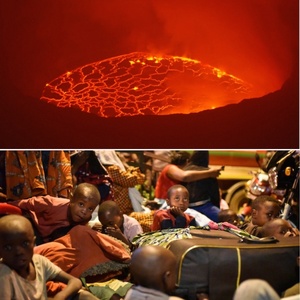
Some 400,000 people have evacuated Goma, one of the Democratic Republic of the Congo’s largest cities, after the Mount Nyiragongo volcano (top) erupted last week
Slightly Bemused writes:
It is with a certain amount of dismay and concern that I have been watching the news around the eruption of Mount Nyiragongo near Goma, in the Democratic Republic of the Congo. Hundreds of thousands of people are displaced and now are dependent on assistance from others.
International aid agencies are trying to respond as best they can, but they are hampered by many factors. The flow of lava has effectively cut the town in two, separating one side from the emergency supplies available on the other. Crucial infrastructure, such as the town’s main water supply, have been affected.
In some cases, carefully prepared compounds with supplies for displaced people, mainly aimed at those displaced by the ongoing insecurity of the region, have been either cut off or, in some cases, engulfed. Yet still people try to assist.
First and foremost, as is always the case, are the locals themselves. Many of the townsfolk of Goma have fled to the town of Sake (pronounced like the Japanese drink) 23km away. There they have been welcomed by the people of that town, and are being given shelter in halls, churches, schools, and wherever else they can be put up. The people of Sake have had their own troubles and know what it is like to be forced to leave everything suddenly and flee. Thus they are welcoming to those others so ill-affected.
In here too are the local organisations. Many set up to assist their own people, they quickly move and mobilise volunteers and what resources they have to try to provide food and clean water. Assisted by international agencies, they are the true front line for agency response. The international agencies often have the resources, but not the penetration into the community, even after all these years, that local organisations have.
Consider, if you will, what would happen here, who would respond. Assume that the government and their emergency systems are not available. The full resources of the State cannot be brought to bear, so it is only those locally based who could respond.
You might think of such local volunteer organisations as the Red Cross, Order of Malta, John’s Ambulance, any locally based Civil Defence teams. But also you would have the invaluable support of the local ICA, Mens Sheds, Parish Centres, perhaps local scout troops and, in a way clearly shown through this pandemic, the likes of sports clubs such as the GAA, soccer and rugby clubs.
They may not all have ‘experience’ in such responses, but what they do have is a readily available cohort of people they can contact who know the area, who know the people and who are willing to help.
Often dismissively referred to as Community Based Organisations, they are truly the heart of the communities in which they live, and they come together quickly to support those in need. And so it is in Sake, and across the border on the other side into Rwanda and the town of Gisenyi. Ideologies are set aside and communities move to assist those in need.
I first arrived in Goma in the immediate aftermath of the previous eruption in 2002, arriving the morning after into Gisenyi to cross the border and assist the local response. My role was logistics, so warehouses and roads were my main priority, as my colleagues worked to provide medical support, shelter and basic sanitary supplies, and distribute the food the trucks I managed brought to them.
Much will be the same today, but I fear that this could be even worse. While Goma was cut in half then, there was really only one major, slow eruption. Today, there are ongoing tremors and concerns for additional eruptions, which causes additional fear and indeed panic amongst the population.
Goma has also grown since then, with a major influx of townsfolk from more rural areas fleeing the fighting further north arriving to the relative sanctuary of the town. Yet, while sadly 38 people have so far lost their lives at this time, it is so much better than the unprepared population of the early 2000s where hundreds died. Admittedly, many of those were people who ran back to try to save their goods or, in some cases, to loot. This has so far been avoided.
When I arrived, it was still cooling, but a German-led roadbuilding team who had been improving the connection with Sake to the west had already moved in and risked their lives and vehicles to forge a road across the still cooling lava to reconnect west and east Goma. The teams were mainly people from the town, so it was their families, their friends, and their community they looked to help. It is the very improvements they later finished on the road to Sake that allowed people this time to move so quickly to relative safety.
To highlight the dangers then, and still now, I walked across that roadway at one point – foolish youth that I was. The fumes were searing, and the heat still in the road bed partly melted the soles of my boots, permanently embedding small bits of lava grit into them. I had to take the boots off to enter any room, especially ones with wooden floors, thereafter.
And I was left coughing for a week. Those fumes pose as great, if not greater threat to the people still in the town as the lava itself. I was there but a short while, those permanently living there risked long term breathing difficulties.
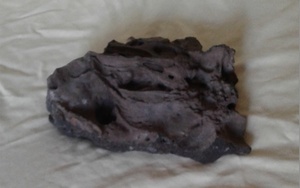
As I write this, I cannot help but raise my eyes to a piece of black rock (above) on my mantelpiece. Dusty now, you can still see the whorls and solidified wavelets where the lava froze. While definitely a keepsake and a talking point, it also serves to remind me just how precarious the lives of so many on this planet are, subject to the whims of nature.
But I am also reminded of the surprising good that can arise in some of these situations. There was a school, with buildings on four sides and a central area intended for children to play. The gateway was the only break in this, but every day it flooded when the rains happened, washing out the makeshift shelters of the people who had come there for safety.
The people, mainly women, got together and made a barrier of sandbags across the gate to stop the inrush of water, while the men worked to dig drainage points to let what did get in flow out quicker.
I arrived one day with the truck with food and rations for them to find them preparing a feast and dancing as that day, for the first time, their shelters had not become inundated. They celebrated this small victory with song and dance, and hope for the future.
Little Slightly was not yet a year old, but I got her a piece too, and mounted hers on a small wooden plinth, with the words “Goma, 29 January 2002” on the side. This got her in trouble one time. She was about 6 years old, and doing geography in school. Her teacher told her that rocks were all ancient, millions of years old. A certain little lady objected, saying she had a rock that was younger than she was. She was quickly told she was wrong and to be quiet.
The next day I got a call from her very irate mother, who had been summoned to the school. My little darling had marched into the classroom, silently plonked her mounted piece of Goma lava, with it’s inscription, on her teacher’s table, and gone and plonked herself into her seat. While a valid point, this was not the way to win a teacher’s heart. Mother was summoned, later father was called and berated, and father could not control himself and fell off his seat laughing. This did not really help matters, but it did brighten up my day.
So as I look at this token of destruction on my mantelpiece, and think of all those affected, and those trying to help them in Goma today, I cannot help but smile at the thought of people celebrating the simplest of things like dry shelters, and a little girl standing up for what she knew to be true.
Slightly Bemused‘s column usually appears here every Wednesday.
Getty/Slightly Bemused



yeah you’re back ! You’d be a great man for a chat over a pint Slightly.
Go little slightly !
So glad to see you back SB! Sincerely hope you’re doing well.
Really enjoyed this one. I’ve been following the news coverage of this story, and it was so interesting to read about your experiences. The anecdote about Little Slightly was lovely. I hope she’s also doing well :)
Good morning millie. I was reading these comments on my tablet, and it is awkward when responding. Just keeping up with its autocorrect suggestions is not exactly fun!”
Thank you also for you best wishes. Glad to say the little one is fine. She has gone camping. In Texas. Her greatest danger I think is getting sunburned, as she has inherited a certain amount of her father’s pale-to-lobster gene :-)
Great read, glad I took the time. Reminds me of how good this site can be when it wants to.
Fair play to your daughter as well, she was right and your responding with humour was the best reply.
+1000 Squillion
I don’t have anything intelligent to add other than I really enjoy these pieces and I hope that Broadsheet doesn’t judge the popularity of articles on the basis of the number of comments underneath.
+1
I really love SB’s anecdotes. They’re a wonderful piece of escapism.
Thanks guys. Glad you enjoy these.
Janet, I am glad to say I am well. My doctor even smiled at my progress – or at least I think he did. Hard to tell with the masks.
I am incredibly proud of Little Slightly. She is very much her own person. Not long before this, I had received another irate late night call (her mother did not care for the 8 hour time difference). At my regular call, Little S told me she had learned the “Prayer to the Flag” (Pledge of Allegiance) and asked me if I had said it in school. I told her no, as I was Irish, and we did not say that. Apparently, the next day she refused to say it with the class because “I am Irish”. This also did not go down well with her mother, who refused to accept my assurances that I had not told the little one not to say it – it was totally her own choice. Now I did have, and still do, my opinion on the matter of getting children to make such a pledge, but I did not want to impose that on her. Seems it was the Irishness that actually was the issue :-)
I would say a chip off the old block, which might be appropriate in this case. Her piece used be a part of mine, and connected along the darker lined edge in the picture. I would say it was a deliberate, meaningful gesture, but actually I just dropped the larger piece and it broke. The fellow who mounted hers chose the one best suited for it.
she sounds as if she can stand up for herself, I like that :)
Wonderful enjoyable writing Slightly, I’m looking forward to more :)
+ 1