



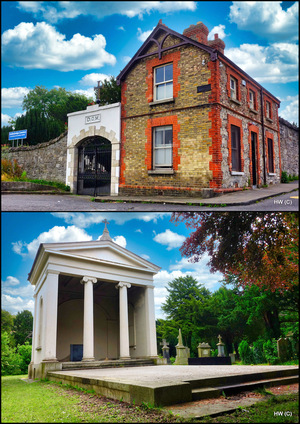


From top: Goldenbridge cemetery entrance, mortuary and graveyard
Goldenbridge Cemetery, Inchicore.
Harry writes:
Perhaps it’s my inner Goth but walking around an old cemetery can be dreamily romantic, and Dublin’s historic Goldenbridge Cemetery, hiding away in plain sight in Inchicore beside the Grand Canal, is one of Dublin’s more memorable ones. It may of course be bitter-sweet seeing it’s a place of memorial, but it’s also a destination to honour the dead.
Nature lovers will appreciate this two-acre garden sanctuary dotted with beautiful mature Yew trees, a fine silver birch tree and various plants. Garden cemeteries like Goldenbridge were designed to be not only a burial ground but a contemplative place to enjoy outdoor recreation before there were many public parks.
Today visitors may enjoy the design, architecture, and the garden layout where you will find striking monuments, graves, and a fine neo-classical Mortuary Chapel completed in 1829 for the sum of £230, similar to the chapel in Paris’s iconic Père-Lachaise Cemetery.
Beneath this chapel are vaults originally built to house night watchmen and their Cuban bloodhounds to protect the graves against body snatchers. Back then it was a lucrative business to steal corpses and sell them to Trinity College, the Royal College of Physicians and the Royal College of Surgeons and also to foreign markets.
The chapel was designed with an interior staircase leading to the roof so the watchmen could view the surrounding area, the cemetery’s high walls and railings were completed before any burials took place to further deter body snatchers and reassure relatives who were burying their loved ones that they would be protected.
For those interested in history Goldenbridge has a lot to offer. Established in 1829, following the passing of the ‘Act of Easement of Burial Bills’ in 1824, this was the first Roman Catholic cemetery to be opened following Catholic Emancipation in 1829, pre-dating Prospect Cemetery in Glasnevin by three years.
Before the passing of the bill Catholics in Ireland had to go to the clergy of the established church, the Church of Ireland, to arrange burial, and they had to pay for that permission. no prayers could be recited except those from the book of Common Prayer. Many Catholics around the country secretly buried their dead at night in sacred places like monastic grounds etc. but in Dublin the law was strictly enforced against Catholics.
There were three principal cemeteries used by Catholics in Dublin. St James in James St, Bully’s Acre in Kilmainham, (after a six-month cholera epidemic in 1832 the already congested Bully’s Acre received 3,200 victims of cholera and shortly afterwards was closed by order of the government) and St Kevin’s in Camden Row, Dublin.
In 1823 a confrontation ensued at a funeral in St Kevin’s graveyard, the Catholic Archdeacon of Dublin Michael Blake, was officiating at a funeral of a well-respected Dublin citizen and his funeral drew a large attendance. Archdeacon Blake was ordered to cease reciting his prayers for the dead by a Protestant Sexton.
This rebuke caused a major outcry amongst Catholics in Ireland catching the attention of the “The Emancipator” Daniel O’Connell and he campaigned to change this situation.
O’Connell conducted many “monster” meetings with crowds of 40,000 in attendance and skilfully used the St Kevin incident to pressurise the authorities to grant Catholic Emancipation. The Roman Catholic Relief Act 1829, also known as the Catholic Emancipation Act 1829, was passed by the Parliament of the United Kingdom in 1829.
At the same time O’Connell and his supporters, the Catholic Association, sought land for a new cemetery where members of every religion and none could be buried and conduct whatever ceremony they wished without harassment or insult. In one of O’Connell’s great speeches, he said: “We wish to live on terms of amity and affection with our brother Protestant fellow-countrymen. We earnestly desire to be united with them in our lives, and not to be separated from them in death”.
In 1828 the Catholic Association purchased two acres of land on the south side of Dublin in Inchicore, two miles from the city for the then princely sum of £600 from Mathais O’Kelly. The first Trustees were Dr Coleman the Archbishop of Dublin, Rev Dean Lube P.P., Daniel O’Connell, Nicholas Mahon and Christopher Fitzsimon. The concentration of Goldenbridge took place on the 15th Oct 1829 just six months after the passing of the Act of Catholic Emancipation.
Eighteen-year-old Margaret Lowry was the first to be buried there and in the next two years 12,000 burials took place with an average of 20 funerals a day, six days a week. It was a popular cemetery as it charged less than half of the fees charged by St James cemetery.
After Prospect cemetery in Glasnevin opened the funerals at Goldenbridge reduced to an average of 500 a year. Goldenbridge was finally forced to close by the British Army in Ireland. The cemetery was bounded on three sides by the adjacent British Richmond Barracks, during the 1860’s British officers lodged a complaint asserting that water seeping from the cemetery was contaminating the Grand Canal, the canal provided drinking water for the soldiers and their families who lived in and around the barracks. An investigation was carried out proving the cemetery had safe drainage.
The real reason for the military objection was that troops frequently ended up drinking and fraternising with mourners after funerals. In addition, the military complained of the noise and commotion of rowdy funeral processions passing the barracks, supposedly disrupting military activity. A hearing was held and the Lord Chancellor of Ireland, Thomas O’Hagan, ordered the closure of the graveyard in 1869. He restricted any future burials to those who had acquired rights of burial by purchase or had relatives already buried there.
Despite being adjacent to the barracks, few soldiers are buried in the cemetery, but sadly at a time when death was high in infancy, 200 of their children rest in Goldenbridge amply illustrated by many of the grave stones displaying their young age when they passed away.
Many notable people are interred in Goldenbridge including Patrick O’Kelly (above), one of the leaders of the 1798 United Irishmen, William Sheehy, a member of the Fenian Brotherhood, Andrew Clinch, rugby union player who played on the 1896 British Lions tour to South Africa.
Two of the more famous graves are of W. T. Cosgrave (above right), the first Taoiseach of the Irish Free State in the 1920s and his son Liam, who was Taoiseach in the 1970s. In the south east corner of the graveyard, there are communal mass graves from both the Famine period of 1845-49 and of the cholera epidemic of 1867, hundreds if not thousands are buried in that dark corner.
After the cemetery was closed it slowly fell into a state of disrepair with totally overgrown weeds and vegetation. For 150 years the gates of Goldenbridge were locked to the public and visits were permitted by appointment only.
In the years leading up to the centenary of the 1916 Rising many commemorative restoration projects were carried out in Ireland. Richmond barracks was restored as a museum and the cemetery was also restored. As part of the restoration project, the vegetation was cut back, many graves and monuments were cleaned and restored, while excellent work was carried out on the Mortuary chapel leading to Goldenbridge being reopened to the public in 2017.
So, if you decide to visit, be on the watch for a weathered stone plaque mounted on a wall, displaying in Latin, “Memento Mori”, in English, “Remember your Mortality”, a piece of sound advice to get your priorities right, I hope it will inspire a visitor’s zest for life.


Harry’s Dublin appears here every Friday.
All pics by Harry Warren


Cracker stuff again, Harry, love these. Requests allowed for places outside Dublin?
Harry’s Ireland has a ring to it????
Thanks very much Papi, I am sure I will find something to write about beyond Dublin :)
Cheers, Harry, love your stuff. Been trying to remember where a colony of Venetians were put during religious persecution times, Waterford or Wexford I think, and they established a huge glass industry in an old fort. The Elizabethan fort in Cork also has a great history.
You might be thinking of this?
https://woollydays.wordpress.com/2016/06/27/the-story-of-new-geneva-barracks/
Fantastic stuff Harry but then that is par for the course with you.
I was aware of this place but have never had any reason to venture inside but looking at the pictures I think its somewhere to visit soon!
Thanks again for another great post, much appreciated.
Thanks very much ian-oG, often the over looked places have so much to offer, I believe they have guided tours as well in the cemetery…
I don’t know what I am waiting for the most on Fridays, the music competition or Harry’s Dublin?
Excellent stuff anyhow, I am looking forward paying a visit to Goldenbridge.
Great stuff as usual Harry! There is a tiny typo which had me confused for a second, I think it should say ‘consecration’ not ‘concentration’ of the cemetery!
Thanks H, I am sure the professional Broadsheet proof reader was otherwise engaged before uploading the piece :)
Excellent as always Harry. Thank you for these articles.
I pass this particular cemetery, an amazing place.
I pass this particular cemetery REGULARILY!!!
Thanks perricrisptayto, it’s well worth a visit.
Great to see the photos in the body of the article – much easier to track. Good work Harry!
From your suggestion, Zaccone!
Another great piece. I’ll need to stay mobile well into my 100’s to get to visit all. You’re wonderful at sharing Dublin with us. Thank you.
Thanks Marbe, hopefully they will have invented a flying zimmer frame by then :)