



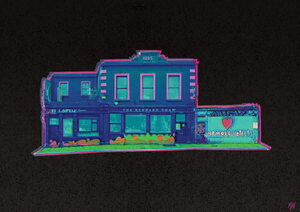
The Geebag by Homebound
SPLUTTER!
The secret place!
*thud*
Mark at Jam Art Prints, writes:
We’ve two new beautifully screen printed Geebags to win by HomeBound this week.
The word gee is thought to originate from Síle na Gig carvings on churches and cathedrals around Ireland. To enter this competition to win TWO bags, let us know of some interesting word origins that you know of…
Lines MUST close at 3.45pm EXTENDED until Midnight!
The Jam Art Prints competition runs here every second Thursday.
Sponsored Link

Does the Irish language count?
I’m left-handed and the term in Irish as many of you will know is “ciotóg.” I was interested to learn that the etymology of the word is derived from the feline. All kittens are initially left-pawed and when broken down into its constituent bits “Ciot” + “Óg” = “young cat” or kitten !
So if you call me a ciotóg you may also call me kitten and i won’t scratch your eyes out !
that’s pretty cool
I like kittens..
Slogan comes from the Irish for war cry.
Nazi isn’t short for Nationalsozialistische Deutsche Arbeiterpartei. It’s a pre-existing term for a country bumpkin that plays on the rural Catholic preponderance for Ignatius of Loyola. Anti Nazi’s just borrowed it.
Tanks (land based Ironclads) are tanks thanks to Churchill (in part). They code name for the top secret development project was supposed to be Water Containers for Russia. Churchill said the military would shorten it to WCs for Russia and changed Container to tanks. The Russians changed sides and the military did indeed shorten it. To tanks.
Slogan is indeed said to derive from ‘sluagh ghairm’ – the (battle) cry of a host/assembly of warriors
Ceolan was popular when I was a kid:
It described any feckless, away-with-the -birds youngster.
Ceo-lán….full of fog.
splutter indeed!
http://www.etymonline.com/word/pussy
“soft, warm furry thing”…?
the Vikings: never not at it…!
:-)
purely as an F.Y.I. / background / research, sort of thing:
https://www.youtube.com/watch?v=BB-J6QeAraw
not to be confused with yak-butter…
if you’re sitting-down for your tea.
:-)
More Irish for ye:
“So long” is thought to derive from “slán”
And bóthar (road) literally gets it name from “cow crossing”(bó + thar)
They should do a range of these bags. They could have ‘ball’, ‘colostomy’, scum’, ‘sh*te’, ‘w**k’ etc. I wouldn’t buy one but good luck to them
‘gee-eyed’ is probably the best irish expression ever.
As is ‘gee-hair’ when used as a unit of measurement.
A Fás carpentry instructor actually used the term, methodically and not in jest, in his class.
That instructor spent two deades there.
Fiche blian ag fás.
Gheobhaidh mé mo cóta.
Now, for a very modern one.
It started off as “Fcuk U Joe Biden”
It’s turned into “Let’s go Brandon”
and is further transforming into “Let’s go…anything” to mean you know what!
Brilliant
Gee, comes from the Gaelic, gaoth, pronounced gee funnily enough. It’s the word for wind, in this case – as the wind that might blow through a little bush. And, because our ancestors were ahead of their time, not only can gaoth mean to blow, but is also used as a word to describe wise, sagacious, shrewd and intelligent. And while on the topic of sexy things, Jazz from the Gaelic teas meaning bursting with sexual passion and energy… we can explain bailepitmeauve another time..
Except for G** B** is a term of patriarchal, sexist abuse, expropriating the female body to enhance existing power structures. And it’s rude. Everybody knows that. Even Bodger. In fact I have been put in moderation because I have called Facebook employees a bunch of big, lettuce-headed, blow-in, numpty GBs.
Anyway, where’s the bag with the word BALL on it?
lol
some of my best friends are geebags
It’s wall to wall gee here today… I look forward to meeting your gee bag friends…. any takers on fine coming from the Gaelic faighne. Seems to make a lot more sense to me than coming from the French, to end. That’s just fine. What a fine head of hair you have. That’s very fine on my lips. We’ll have a fine time together, you and me… meanwhile, and I digress, but our English overloads thought it quaint we addressed them as sor, yes sor, of course sor, straight away sor.. not aware that a sor is a louse…
a fine time indeed
Surely “guy bagues”?
While I’m at it there’s an awful lot of very descriptive words for plants in the Irish language.
I was shooting the breeze with a pal of mine from the Donegal Gaeltacht years ago and for whatever reason Viagra entered the conversation. He told me that up in Donegal they didn’t need to go to the chemist shop to get it all they had to do was head for the ditches and hedgerows to locate what is called locally (apologies for any misspellings) “magairlí medihreach” – translates as “merry balls” or as we decided to call it “jolly bollocks.”
“In 1881 the Folk-Lore Record said: `The early purple orchis, Orchis mescula, is called mogra myra, and is supposed to be most efficient as a love potion’. The compound noun may be translated as `jolly little testicle’.
https://www.irishtimes.com/news/the-words-we-use-1.1106838
Now, stick that in yer pipe and smoke it.
Ha, my granny recommended the swooshing application of a bunch of nettles to the buttocks and testicals of any unperforming male.. the result is as immediate as it is effective.. and, yes, but by accident, in answer to your next question..
:-)
The well used term slipolupis…derived from the terror felt when being chased around a kitchen table by a hungry wolf
You robbed that off a Gary Larson cartoon and got it wrong you big doofus!
https://phobia.wikia.org/wiki/Luposlipaphobia
Ah, The Far Side: Often copied, seldom bettered.
Gary Larson also coined the word “Thagomizer” – the four spikes on the Stegosaurus’s tail.
…after the late Thag Simmons
https://en.wikipedia.org/wiki/Thagomizer
I’ll get slippers
…spice is the term given to a seed or bark, root or fruit usually used to flavour food but also used as a medicine, in cosmetics and perfume or in rituals…stick it on a bag and carry it round Dublin it takes on a totally new meaning!
oh it was ok me hours to get that ! duh me
speaking of spice bags
Diarrhoea comes from the Greek “dia” meaning through and “rhein” meaning flow.
for the year(s) that are in it
The word “quarantine” has its origins in the Black Death of the 14th century. From the Italian words “quaranta giorni”, or “forty days”, in reference to the fact that ships were put into isolation on nearby islands for a forty-day period so that those on board could allow for symptoms to develop.
haha. We have been quaranting health people for the last 700 years
yeah but after forty days the gigs up ;)
sticking to the theme
The word “robot” comes from the Czech word “robota,” meaning “forced labor”
As I understand it Tory comes from a 17th century term for Irish bandits – also known as Rapparees – who would have plagued the land owning class back in the day.
By the early 18th century it had been adopted as a slang term for the political gathering in the British House of Commons that eventually evolved into the Conservative and Unionist Party.
Little has changed, says you.
your average little gurrier of Dublin comes perhaps from French guerrier ‘warrior’ …
… and ‘beserk’ is a Viking word which denotes a particularly ferocious type of fighting; also, Viking is derived from the behaviour of Norse seafarers who would go viking, i.e. raiding, pillaging.
Jaysus – they’re all coming back to me now as Meatloaf was inspired to sing when the two of us last hung out and indulged ourselves in entertainment like this.
In Dublin, you’re in the chipper, the nostrils funneling the delectation of odours to your olfactory neuron and you might hear someone local ask for a “one and one” – fish ‘n’ chips says you and you’d be right says I.
Where does it come from? Well, apparently back in the day there was a concentration of immigrants to Ireland from a specific region in Italy. They used to have carts about the city selling seafood, chips and the like. People would be offered and often asked for “uno et uno” or “uno di questa, uno di quella” – one of this and one of the other or … you’ve guessed it “one and one” as it became.
Stick that in yer deep fat fryer and batther the bejaysus out of it !
don’t mind if I do !
While we’re in chipper-land, where did a ‘single’ of chips come from?
Beyond the Pale comes to mind. Where I live the last remnants of the triple ramparts of The Pale still give a small wake-up call that you are leaving the safe environs for the wild lands. While pales did exist before, the term ‘beyond the pale’ comes from that period of English occupation of Ireland, when it stretched from Drogheda to Bray.
Interestingly, two other words come from the same period. Culchie arguably comes from the Irish ‘coilte’, or wood, about people who lived not in towns, but outside the Pale, in the woods. Jackeen has some credence in coming from when queen Victoria visited Dublin, and they all waved Union Jacks to welcome her, inside the Pale.
As with all words, a true etymologist will do research, but sometimes the folk myths are more fun :-)
Down the whest, culchie used to be associated with people from Kiltimagh, you can hear the connection. I always felt it was to specific to the place…but you never know?
I have heard the same about Kiltimagh. In fact, I find it the more interesting one :-)
Shampoo, himself tells me it’s hindi and means ‘to massage’ derived from the Sanskrit root chapati (चपति), the word initially referred to any type of pressing, kneading, or soothing, extended to mean ‘wash the hair’ and as an aside if you can’t make a round chapati you’ll never get a fella ;)
Hooligan owes its literal existence and meaning to an extended family of Co. Carlow travellers who moved to England in the 19thC, it subsequently became synonymous with bad behaviour.
Holohan did you say ?
Hahaha
And Vandals were a Germanic tribe who migrated across Europe to North Africa and the Mediterranean before plundering Rome.
“Light yourself a candle
Don’t wear sandals
Try to avoid the scandals
Don’t want to be a bum
You better chew gum
The pump don’t work
‘Cause the vandals took the handles”
The Irish for jellyfish – smugairle róin = ‘seal snot’
Alas, our forebears who did the naming evidently had no scholars of Scyphozoa or Cubozoa among their ranks. You can imagine the scene:
“Cad é sin ar na rámha, a dhadaí?”
“Smugairle róin, a mhic.”
Gobs***e – a term used for an idiot who talks incessantly. From the Irish word ‘gob’ for beak, ie.mouth.
The name Carroll comes from Caérbheal which was predominantly a Gaelic Connaught name – in Seangaeilge it means ‘crooked mouth’, as in someone who speaks out of both sides of their mouth; also, Connaught is the only province which Vikings didn’t re-name from Gaelic – Laighin, Mumhain and Ulaidh were all renamed phonetically with an ‘er’.
Nice one.
Scottish equivalent is Campbell or “cam” + “béal” though not sure about Cameron – tough nuts with broken noses or fodder for the bullies?
Sawel mountain, in the Sperrins, carries an ancient Irish name that translates into a description that presumably wouldn’t pass the censor here but you can check it out for yourselves.
Samhail Phite Méabha.
That’s Méabh of Connacht being remembered there.
Quite apposite in a thread about gee bags
It’s fitte in Norwegian too.
From the Latin, pit, meaning hole.
Common knowledge, however, I’m going with it.
Sandwich – from the 4th Earl of Sandwich who was too enthralled to forsake his gambling table for the dinner table, and, so, had his meat brought to him between two pieces of bread.
I’m sure he was impeccable dressed.
Impeccably, even.
let’s get on to the fun stuff food, the ancient Romans thought that the shellfish mussels looked like little mice hence the name mussels from the Latin noun, musculus which means “little mouse”
Báirín breac = ‘speckled loaf’ = barmbrack
And ‘orecchiette’, the pasta named by Italians literally meaning ‘little ears’.
cute
Not sure if that sounds any more appetising than vermicelli – ‘little worms’
now I’m hungry
speaking of cake
Mutterkuchen – placenta
Translating literally as “mothering-cake”
The full medical name for a placenta is “placenta uterina”, which translates from the Latin as “uterine cake”.
For the Romans a “placenta” was a type of flat cake, and the organ was called a placenta due to its apparently similar shape.
ah ze germans,
a little off topic but too funny not to share,
you know who you are,
Innerer Schweinehund (inner pig-dog)
If you never sort out your cupboards or are always too lazy to go to the gym, it’s the fault of your innerer Schweinehund or inner pig-dog. This is your disorganized inner voice (who is, in your defense, fully accountable).
I love German words, they’re like lego bits stuck together to make words that are very functional in their descriptions.
Also Churchill rather wonderfully described the English and the Germans as “a common people divided by a common language.”
This is the best thread in ages. I don’t even want to win the bag now (I really really want to win the bag)
I’m loving this thread too,
in school I thought I was crap at language, I learned German easily because well it makes sense and struggled with Irish although I did honors but struggled because the language was taught as dead and then I moved to France and learned in a year, by ear, by magic it came by full immersion and all these lights went off in my head for other languages too, a year in Nepal I got that too, no books , no grammer just watching mouths and making connections and learning the rythme and music and way of thinking of a language,
I love how you can think a thought and dream a dream in one language that does not literally translate to another,
you realise what a bastard English is,as my spelling gets worse in every language but my comprehension more as I explore,
I wish language was taught differently in school.
do you know I’m going to stop blaming my bad spelling on learning more languages and accept it’s my lack of pendantic thought that allows the mind to do the gymnastics to start with … delighted with new excuse
The thinking and dreaming in another language is an incredible experience and surprisingly natural.
@Janet
Clearly you are not crap at languages! I wonder why you thought that for a time?
Did someone in “authority” tell you so? (there is no such thing as authority). Total immersion is the ideal but of course not always possible. I loved languages in school including Irish but we had a different problem – six or seven different teachers of varying skills and abilities over the five years in secondary school.
Didn’t help and meant I had to learn, by heart, seven essays for the Honours Irish exam so I could flip the title and deploy one of the seven to fit. That’s no way to develop a love of language but it endured thankfully. I was probably the only kid in first year of secondary school who was disappointed that Latin was pulled. I had been looking forward to learning it to unlock other languages.
Anyway … I have no idea now how languages are taught but I would hope it has improved since my day.
Language, etymology, linguistics etc. is endlessly fascinating. It unlocks so much understanding, generates such depth of thought and connection to the world around us now and back through millennia. All a bit overwhelming really, the potential it brims with and also how it restricts us, copper-fastens and doubles-down on a way of thinking and like you say how other languages provide such unique and valuable insights allowing us to view something we once thought immovable in a new way.
Right – feck this, everyone down the pub .. eh, oh. Forgot. Everyone down the park?
I’ll bring the cans and we will unlock the tower of Babel, great comment !
to answer your question, no I don’t think anyone told me, I just assumed I was bad because I found all the other subjects much easier, gosh the size of my teenage ego lol,
I know now that for languages I’m an aural learner, stick it in a song and I’ll never forget it or even better get a sexy pair of brown eyes to whisper it to me over a glass of wine and the words are all mine.
The greatest gift of language for me is the elasticity of thought, the new worlds that open to you, the new humor and sensuality :).
**sidles closer to Janet**
**purses lips**
**coos, purrs – “Wo ist das Tourismusbüro?”
Das ist mir Wurst
one for me
pygocole :)
pygocole ”which designates“ an individual particularly smitten by the buttocks ”. One can also speak of “pygophile”. The word is formed from pugê, “buttock”, and cole, “who worships”
See also ‘callipygian’
now we are talking
Let’s hear it for Aphrodite Kallipygos/Venus Callipyge. Some act to follow…
looks over shoulder…done :)
I know it’s off-topic, but, the words ‘womb’, and, ‘tomb’ always fascinated me.
No etymological connection.
How is that possible?
You are not alone :
http://www.songlyrics.com/nomeansno/body-bag-lyrics/
Great tune.
I hope you are not a mortician by trade.
Grotesque.
Back in the days when women wore tight corsets and when they laughed, their bladder tended to be squeezed, and suddenly they would have a little leak, sounding like a little stream which gave the verb “to laugh/ rigoler. Sometimes it was actually more like a pond, from where “to laugh a lot/ se marrer” came from ;)
Has to be an ancestor of PMSL ;)
haha which I am now, damn you ineffective kegels
Juggernaut or Jagannāth comes from the Sanskrit word Jagannātha, meaning “lord of the world.” So now
I’m learning Hindi at the moment, it’s a head melt, I had some Urdu from my time in Nepal and I keep getting mixed up
as an aside I was very high up in the mountains once ( this one’s for Jonny ;) ) and I could see the words coming out of my mouth and I had this ” moment” where I could see the connection to Irish in Urdu, it really spurred on my love of language knowing we are all connected like that.
Gujarati ‘bangalo’, from Hindi ‘bangla’ [= Bengalese]. referring to a low, thatched house [in the Bengal style]
Gives us bungalow.
my Dad like that one
he’s living in a bungalow he says
there’s no one upstairs
And now we have Christmas Pyjamas coming from both Urdu and Hindi as it’s roots are from the Persian words pāy, meaning “leg” and jāma, meaning “garment.”
reading a great book at the moment about the neanderthal called Kindred at the beginning it explains the word,
The word “Neanderthaler” comes from the cave in the valley “Neanderthal”.
The word “Neanderthal” comes from the word Tal=valley in old spelling and the name of Neander, a composer of church hymns who lived near this valley.
The name “Neander” was the Greek version of the Neander’s original name “Neumann” (neu (german) =new ( english) = neo (Greek), mann (german) = man (english) = andr- (Greek) )
So, the word Neanderthaler actually comes from a name meaning “new man”.
Neat huh ?
Here, Dubs, did you know that there was an alley running between Queen St and Smithfield, known as ‘Thundercut Alley’, which got its name from a brewery in Smithfield known as Thunder’s. The workers coming down from Stoneybatter would turn in to Queen Street and cut through the alley, hence the name. There’s a restaurant there now called same.
is there a hotel on it yet ;)
Well, Mark at Jam Art Prints, I bet you’re sorry you asked about Gee bags now!
I like gee bags…
At the risk of starting a gender discriminatory war, one of the fun ones I like is man. From, as mentioned above, the old German, or maybe Saxon, mann, meaning person. So you had mann – person, here mann – male person, and wo mann – female person.
In English over the years the ‘herre’ bit got dropped, and the wo was made part of the word woman. But the roots are still there.
A good friend used use that in training and loved the confusion when he used ‘her’, as it sounded, to refer to the men :-)
excellent :)
I saved this for last (closing-gate panic)
Torschlusspanik is the feeling of panic as time runs out.
Schluchtenscheisser:
Used by Germans for their beloved Austrian neighbours, stands for someone taking his dumps in canyons (since Austria is very mountainous)
Found the above definition online, but, I always thought it had something to do with the Austrian mispronunciation of German words?
Perhaps someone knows better?
“Avocado” is a modification of the Spanish word aguacate, which derives from the Nahuatl (Aztec) word āhuacatl, which means “testicle.” Possibly reflecting the shape of an avocado, as well as its reputation for being an aphrodisiac.
And finally, for literature fans, the mystery of the ‘slut’
https://www.theguardian.com/books/2021/oct/11/solved-the-mystery-of-the-slut-scrawled-on-the-grapes-of-wrath-manuscript
Sticking with gee a little longer. Khaki comes from India via the Gaelic caci, which is literally sh1t, and used by Irish soldiers to describe the colour of their khaki uniforms. I’m just wondering if another Irish word translated over in relation to clarified butter.. something not made in Ireland, but prevalent across the sub continent… different but familiar.. and likely very tasty…
I wonder what they called bog butter
Delicious… (I wish)
I wonder what they called that auld nipple sucking of kings, delicious too ?
For some the bog butter made me think of nipples and the bog bodies that had them sliced off.
Wasn’t what I thought you were thinking when you mentioned bog butter after my clarified gee butter joke.. but, do you what.. I’m just going to go with you on this one…
Cú, as someone who speaks Greek, the origins of Kaka/Caca is colloquial [slang] for Skata, hence the study of scatology and its inferences!
P.S. If you’re ever in Greece don’t ask for a serviette (with your knife and fork) as a serviette is a sanitary towel – I’d stick with napkin!
P.P.S. One more thing, when in a restaurant (even though they sound VERY similar), don’t ever get *bread* and *penis* mixed up unless you intend to eat both with your meal :)
Have you ever eaten gee?