

Author Archives: Eamonn Kelly

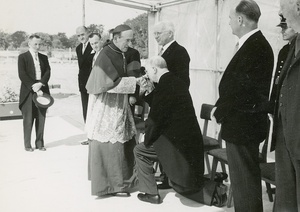
From top: President de Valera kissing the ring of Rev. Dr. John Charles McQuaid Archbishop of Dublin, 1968; Eamonn Kelly

US Democrat congresswoman Alexandria Ocasio-Cortez recently said that many people had a simplistic view of Martin Luther-King, believing that he merely asked for civil rights and got them. Job done.

She was appealing to people to make their own power, aware, no doubt, that she was being put in that isolated position of being the voice for many, and, as so often happens, being the target for so many more. But also recognizing that one voice is not enough, that democracy only moves when the mass of people decide to move it.

For most people, social protest, in the here and now, as opposed to way back in the comfortable romantic past, seems messy and unpleasant and even unreasonable. Which of course it is. That was the point Ocasio-Cortez was making.

But, in reality, Martin Luther King Jr was not only shot dead. Whoever shot him, and that’s still an ongoing debate, shot him in the mouth. Which speaks volumes. If you’ll forgive the grim pun.

Here in Ireland we don’t really do freedom of speech. It seems to be considered impolite, or a bit low. People who do speak out tend to be regarded as trouble-makers, with an unreasonable propensity for “taking issue”.

Though from the perspective of those who do speak out, issue is not taken nearly often enough in Ireland.

To the outspoken, the general Irish public fit perfectly the prejudicial description of “sheeple”; an obedient, malleable flock that the powerful shoo this way and that and patronise with occasional explanatory tit-bits and flatteries, the disrespect barely hidden behind a thin veneer of smiling contempt.

The powerful in Ireland now occupy the place that used to be filled by Archbishop McQuaid, where all are expected to kneel and kiss the holy ring; (“ring” in whatever sense you choose to understand the term.) Everyone competes to occupy this powerful space, in fractals or Russian dolls of the same power struggle from the great to the small.

All the way down the pyramid the perceived “nobodies” at each level are expected to genuflect accordingly to their perceived betters.

Austerity was an amazing phenomenon in this regard. Everyone noticed. We were the talk and wonderment of Europe. The Irish were so, so quiet. So obedient. Is it any wonder that the occasional free-speaker might sound “unreasonable” or annoyingly loud?

Even a whispered No in such a servile environment sounds startlingly loud, and perhaps even insane. There can be no truth only the truth of the elite.

To present a varying narrative is to be “difficult” and un-cooperative. Not a team player. Everyone who speaks out in this vacuum sounds like Bob Geldof at his most belligerent.

“Oh look, it’s your man/woman again, taking issue with something. Boy, does that joker have personal problems.”

In this regard, everyone is complicit in guarding the pyramid. Power is always correct, and the individual is always wrong.

The Authoritarian Irish

Is it fair to generalise and state that the Irish are authoritarian in character? It’s a question you don’t hear bandied around much. But if it were found to be true it shouldn’t come as a surprise to anyone really, given the twin oppressions of Empire and Church lurking in the psychological background.

If you wanted to make an authoritarian population you couldn’t have picked better ingredients than the combined insanities of the British Empire and the Catholic Church foisted on an unsuspecting peasant people.

But you can be certain that there are many who would absolutely deny this proposition out of hand. While there is often talk about the authoritarian church, there is rarely much discussion about the authoritarian Us.

We just don’t go there, and yet, we’re so quiet under pressure. Fintan O’Toole wrote that the Irish could conceivably hunker down for a thousand years and take all the punishment that authority could fling at them, and simply endure, with barely a peep of protest. Endurance is what we’re about.

And we are so disturbingly quiet when a minority is targeted or is hurting, like the way homeless people have been used by this government as bait to invigorate the property market. We look quietly on, glad it’s not us, until suddenly, it is us, and then we look out of our hotel window and realize no one in Ireland cares what happened to us.

The economy is recovering, that’s the main thing. Most people are “happy”. Not all. But most. The silent majority are happyish. It’s enough. We will endure.

And somehow, we fortunate ones always manage to spin a story to explain away the social casualties as the architects of their own sorry condition. That they brought it on themselves through fecklessness. This harsh judgement itself yet another social injustice piled upon those at the bottom of the obedient, enduring heap.

Adorno has a term to describe a society’s mood or character. He calls it a society’s “phenomenon”. Ireland’s phenomenon seems like a parent/child relationship. You meet this same interactional character at every level.

The nanny state someone once called it. The state is the parent and the citizens are the children and they help the state best by being obedient and by always “complying”; this is the state’s favourite new word.

The children have to strive to be the best children in the world, even if many of them have been denied by mammy state the UN right to shelter. Hush now children don’t you cry…Be quiet and be “good”. Ssh, daddy is on the phone to the vultures.

Permission to Speak

The idea of needing permission to speak is dealt with in detail in Foucault’s analysis of the Greek word parrhesia, which referred to the duty or allowance for a citizen to express criticism or opinion concerning the democracy.

There were parameters as to who could speak and who couldn’t. Slaves, for instance, had no right to speak. (In our time these might be corporate or public service employees, but not taxi-drivers.)

Generally, those who were allowed to express an opinion had letters after their name, as we would understand it, or occupied socially accepted positions allowing them to express an opinion, such as politicians and journalists or, in our world, RTE people.

In our time and place it is recognized that democratic freedom of speech and expression are their own permissions. They come with the democratic bundle. Particularly so in a republic.

A republic without freedom of speech is like a pub with no beer. Nevertheless, it is still generally believed that freedom of speech is restricted to elites and that anyone else indulging in outspokenness or, God forbid, criticism of the great and the good, is simply a trouble-maker or a crazy person.

Restrictions on who and who couldn’t opine began to broaden in the 20th century to include famous people, until we ended up with what Clive James called “common fame” and everyone’s opinion was sought on various topics, most notably pop stars and footballers, proving that most pop stars and footballers don’t know much beyond pop and football.

The internet blew the entire idea of restrictions on opining wide open and suddenly everybody could express an opinion, no matter how crazy or ludicrous.

But what became clear very quickly was that while everyone now had an opportunity to be heard, very few had actually anything worthwhile to say, and soon the internet deteriorated into something like an ongoing slanging match in a kindergarten.

Club-wielding trolls ruled cyberspace with practised insult until eventually, horrifyingly, one of them lurched unimpeded straight into the White House and parked his fat arse in the president’s chair.

So, the game has changed utterly and has created a situation where if you now feel you have something worthwhile to offer, the democracy actually needs your contribution. Which is what Ocasio-Cortez meant when she said build your own power.

All the arts of power-politics and media are currently employed in attempting to sway the crowd to move this way or that, because democracy still depends on the majority vote and politics is ultimately reactive.

In our country, for instance, Fine Gael and Varadkar will only abandon or amend the ideology of privatisation that is causing so much pain to so many Irish people, when they feel pressure from the majority.

If the majority don’t object, even in the face of 10,000 people sacrificed to homelessness to feed the privatisation ideology; that majority silence is as good as a vote of confidence in the privatisation policies being pursued by the Fine Gael party.

Fine Gael are always accusing the left of being driven by “ideology”, while they, presumably are driven by “common-sense”; when it is clear to anyone with even half a brain that privatisation is also an ideology.

This kind of evasion is similar to the type of intellectual con that emanates from Fox News, and is, I suppose, to borrow Adorno’s term, the chief “phenomenon” of neo-liberalism. A kind of huckster/grifter political style, to put it kindly.

Even so, people are wary of causing a fuss by protesting, especially here in Ireland where quiet obedience, instilled by the brothers and the nuns, is still seen as a virtue. Many are fearful that if they do protest, they may inadvertently trigger a revolution, with perfectly good cars left burning in the streets.

This is what psychologists call “catastrophising”. The system however is unlikely to break or unravel from the effect of people’s dissent.

The system will more likely strengthen from the bit of stress as the political class re-align to accommodate people’s stated wishes. Because democracy is ultimately a kind of controlled mob rule.

And neither does dissent have to be some elaborately staged protest with organisers and whatnot and rock bands setting fire to guitars.

An email to local elected representatives expressing disagreement with, for instance, a housing policy that results in mass homelessness, and advising that in the absence of visible action to rectify this insult to decency a vote against the candidate is guaranteed at the earliest opportunity, is bound to get a politician’s attention.

Especially if streams of such reminders came flooding in regularly from all directions on various issues where political complacency was short-changing citizens.

As Alexandria Ocasio-Cortez has recognised, even a thousand personalised modest objections to government policy by voters would be a louder shout than any argument she alone could make.

Democracy has chores. It’s not all shopping and fucking you know.

Eamonn Kelly is a freelance journalist, His column appears here monthly.

Pic: UCD Digital Archive
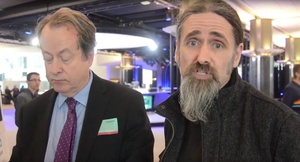
From top: Master of the High Court Ed Honohan (left) in Brussels with and Luke ‘Ming’ Flanagan MEP; Bryan Wall

The 2016/17 amendment to section 110, the SPV (Special Purpose Vehicle) instrument that serves vulture funds so well, appears to have been written by the same people who would be the leading beneficiaries of the amendment.

Master of the High Court Edmund Honohan, when trying to woo Ming the Merciless (Luke Flanagan MEP) and some guests in Brussels recently, in the hope of getting the EU Commission to investigate anomalies in Ireland’s tax laws on a state aid angle, admitted that the whole thing is a complex mess and spent an hour trying to explain the mess.

I spent two hours trying to understand the mess he was explaining.

One of the problems with trying to understand the mess is that the language used by our representatives seems to be deliberately designed to fog everything, and succeeds admirably.

The mess is either a deliberately designed mess, even a sophisticated mess, or it is an unintentional mess. It is either genius or incompetence. Not even Honohan can be certain.

Honohan contrasts the language of Ireland’s legalese with EU legalese. EU legalese is designed to be simple, working towards clarity, this is its main concern; while Irish legalese seems designed to achieve the exact opposite.

This might well be a strategy to wear everyone down so that they won’t even bother trying to unravel the language knots and won’t discover things like the amendment of section 110 being written by those it favoured, who appear to have created a kind of club where you need €10million to join, and if you join you can be re-classified as a charity, making you tax free on property transactions.

Or the wording of a related amendment to the same instrument that allows the person making tax returns to define what is understood by “normal accounting practises”. Which seems to mean, you tell us what you think you owe us by your criteria and we’ll accept that.

The taoiseach says the amendment to section 110 was a way to get the economy moving via the property market. David McWilliams says that the same end could have been achieved via the credit unions. That there was no need to invite in vulture funds.

The section 110 instrument was once a relatively standardised securitisation instrument, designed to manage taxation in response to 24-hour banking made possible by the internet. It was nothing sinister.

But it went from being an innocent finance tool, to being a kind of rogue SPV as a result of the 2016 amendment. Honohan described the amended SPV as a kind of genetically modified SPV.

Prior to its metamorphosis, the section 110 SPV dealt only with abstract calculations in cyberspace. Now it was suddenly let loose in the real world, making drastic changes in physical reality, resulting in people being dumped from their homes and into hotels, enriching hoteliers, with the hotel bills being underwritten by the tax-payer, among whom no investment corporations exist; while the properties were re-rented or re-sold at enormous profit to investment corporations.

“We remind all States,” said a recent UN report, “that while gold is a commodity, housing is not, it’s a human right.”

The taoiseach – the same man who declared to the Dáil that there is no such thing as a free house and who was recently corrected by the UN who declared that housing is a right – described the new window created in the 110 SPV as a “loophole” and promised to close it next Autumn. It has to wait for the Finance Act time of year to be closed.

It seems a major leakage of public money into the stratosphere is not enough to declare an emergency gathering to close the window. This in the same week that another Fine Gael minister talked about imposing fines for wasting water.

In the meantime, the loophole will continue to be exploited by the investment corporations/vulture funds, and whoever else happens to be in €+10m club, until the government gets it together to close the window..

They have lots to do in the meantime while lost revenue gurgles down the drain. They can be overseeing the Brexit mess with superior attitude; they can think about calling an election; they can take a summer recess; maybe attend a few summer schools; maybe some summer sporting events; maybe a high-profile pop concert for maximum feel-good PR exposure; take their hols…

The window in the 110 SPV isn’t actually a loophole. It was designed. The taoiseach said so, in the same statement in which he described it as a loophole.

It’s a kind of Schrodinger’s Cat of Irish tax law. It’s a loophole, but it isn’t. It’s a tax-break, but it isn’t. You’re a charity, but you’re not. It’s whatever you want. Here, you have €10million, write the legislation yourself! We’re all winners in this fine mess we’ve gotten us into!

The “loophole” was carefully designed to attract foreign investors to make a killing in the Irish property market in order to get the banks and the economy jump-started. It worked, by the simple expedient of allowing the banks to sell off bad mortgages to tax-free vulture funds who kicked out tenants in arrears and Presto! A new property bubble on the rise and Ireland is back in business.

Sure, there was some collateral damage. Like the 10,000 homeless, the hungry private renters, the underpaid, exploited and the new Irish emigrants away into exile with stars in their eyes because they can’t afford to rent a room here.

But hey! you can’t make an omelette without breaking a few eggs and it is clear from the stats that everything is working towards back-to-normal now.

And according to all the privatised carefully rigged surveys, with carefully framed questions to elicit only positive responses, less than 5% of the public (all thought to be cranks) admit to being unhappy with the government’s performance, and will be farmed out to some private entity shortly for psychological fixing for a mere few millions more of tax-payer’s money.

Eamonn Kelly is a freelance journalist, His column appears here monthly.

Pic: YouTube


From top: Michael Moore promoting his documentary Farenheit 11/9 and protesting the poisoning of the privatised water supply in Flint, Michigan, USA last September; Eamonn Kelly

Someone I met recently dismissed privatisation as a dull non-issue, regarding it as a fait accompli and something that wasn’t really that serious in the long run.

Michael Moore’s latest documentary, Fahrenheit 11/9, is a stark reminder of what privatisation actually means as played out in the more “advanced” corporate structures of the United States, which are currently laying waste to all around them.

Privatisation in the United States is like a cancer eating up whole districts.

For instance, the so-called opioid crisis came about when pharmaceutical companies knowingly hooked people on opiate-laden painkillers in order to create a market. Like drug-pushers used to do, giving heroin to kids outside schools to create a “demand”.

With Moore’s documentary, what I imagined would be an attack on Trump is actually far more nuanced than anything so simple, turning out be as much an indictment of the Democratic Party as it is of Trump.

Or, more accurately, an indictment of the political elites of the United States, who are not unlike our own small political elites, characterised as they are by serving business, to the detriment of the people who elect them; while denigrating those who are poor in capital and in political representation.

This new breed of neo-liberal politician not only turns a blind eye to social injustice, but often actively and even knowingly, creates social injustice.

The deliberate lying that took place in the Democratic party to ensure that Hilary Clinton would get the nomination over Bernie Sanders, who actually had more support, was, according to the Moore film, morally sanctioned by the belief that a woman “deserved” to be president at last.

So, they cheated the system to promote Hilary at the expense, not only of Bernie Sanders and all his supporters, but also at the expense of the integrity of the democratic party and the integrity of the democratic process.

This deliberate deception, along with Obama’s visit to Flint, Michigan in early 2016 to address the problem of lead poisoning that came in the wake of the privatisation of the water supply, contributed to an increasing lack of faith among the electorate in the democratic process.

What happened in Flint was that after the water supply was privatised, a contract was then put out to build a new pipeline. A new pipeline wasn’t really needed, except to create a profit opportunity for a private contractor.

What this meant was that the Flint water supply, instead of being drawn from a clean lake, was instead drawn from a polluted river while the new pipeline was being built.

As well as poisoning 10,000 children with ingested lead, the river also, it turned out, was damaging components in the local General Motors car factory. Metal components. General Motors complained and were given access to the clean water supply.

The people of Flint however, were left to drink from the lead-polluted water source. The majority of these people, by the way, are African American.

A distress call was sent to the black president who arrived on Air Force one. Some people wept on seeing him. Everything would be okay now. He would stand with them surely against the Republican governor who had brought all this privatization misery and distress on the town. I was with them. I was a bit of a fan of Obama too and I totally expected some kind of happy ending.

What did Obama do? Standing at the dais to speak to and reassure the people of Flint, he asked for a glass of water. Not a bottle of water. By this time everyone in Flint was drinking bottled water. People yelled from the audience that he should drink bottled.

Obama took a sip from the glass of water brought to him. Not a big swallow, a careful sip. He minimized the issue. He said that he was sure that when he was a “kid” he might have picked at flakes of paint that contained lead, and eaten them.

He said in effect that there was no problem, and he flew away leaving behind an entire town totally disillusioned with politics and democracy and the political elite who appear to, no matter what they might say, serve business interests only and damn the ordinary people with neglect.

Weeks later, for reasons not fully explained by anyone, except one soldier who conjectured that Flint had a lot of empty and derelict buildings, the US army conducted training manoeuvres in Flint, using live ammunition, without having consulted the town of their intention to do so.

Helicopters flew low over the town firing guns. Mortars and rockets exploded into derelict buildings. The impression given was that the US government, even before Trump, was already gone rogue and was now a tool of corporate America, to the exclusion of all other considerations.

These two events, taken together, the side-lining of Bernie Sanders to promote Hilary Clinton’s presidential ambitions, and Obama’s betrayal of the people of Flint over the poisoning of their water supply, conspired to create an environment of political complacency among the electorate, combined with a more generalised anger at the political establishment, that had the effect of catapulting Trump into office, with perhaps some help from Russian hackers.

The documentary implies that Trump would never have been elected if the Democratic party hadn’t been so elitist as to alienate its own electoral base by placing feminist aspirations above democratic integrity. Cheating the democratic process in the name of a perceived good or righteous cause is still cheating.

Moore’s startling conclusion is that the Democratic party were the first to depart from democratic principles which gave rise to Trump.

Obama’s mockery of Trump’s presidential ambitions in the growing climate of political disillusion can’t have helped; while his downplaying of the polluted water supply in Flint would not have gone unnoticed by poor black communities across the country.

What Moore’s documentary showed was that the political establishment is already lost to corporate influence, as it is here and in most democratic countries, as detailed in Joeseph E. Stiglitz’s “The Price of Inequality”. In this case the price was Trump in the White House and all subsequent costs, including deliberate environmental devestation.

What Michael Moore’s disturbing documentary demonstrated was that the corporate overlords really don’t give a damn about the well-being of normal people or the environment. That there is no argument or revelation of injustice that will change their approach.

The chilling conclusion is that they know exactly what they are doing. It’s not a mistake or an oversight. They will kill to have their way. That, ultimately, is what privatisation truly means. It’s not a game. They’ll have our skins for lamp-shades if they believe there’s a market for them.

Eamonn Kelly is a freelance journalist, His column appears here monthly.

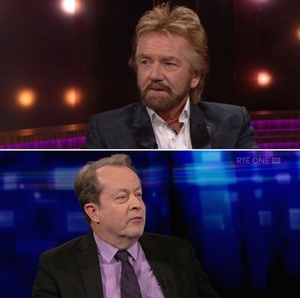
From top: Noel Edmonds on The Ray D’Arcy Show; Master of the High Court Edmund Honohan on Prime Time; Eamonn Kelly

In 2016, Edmund Honohan, Master of the High Court, offered a solution to the growing homelessness crisis in an open letter to the then environment minister, Alan Kelly, who had called for a debate about property rights as defined in the constitution.

As I understand it, there seemed to be a belief at the time that the question of property rights guarded against the government acting to acquire property in the interests of the constitutional “common good”.

Mr Honohan wrote:

“The Constitution in effect provides that the State may expropriate private property if the Oireachtas decides that to do so is for the ‘common good’. Road widening is a good example… At the moment there are long waiting lists for housing and the private rental market is unable to provide dwellings at affordable rents…Consequently, if the Oireachtas is of the view that the State should itself (or its local authorities) provide public housing ‘in the Common Good’, the State can (and probably, legally, should) decide not to wait the two/three years needed to build social housing but instead to immediately acquire houses now in private hands.”

So that’s that clarified. Honohan anticipated that the response to his suggestion would be to make it a football and kick it back to the supreme court to decide.

But it seemed the supreme court had already decided, in 2000, that “the provision of affordable housing is an objective which is ‘socially just and required by the common good’.”

So, there was no grey area. No humming and hawing, no debate required. It was quite clear. The government had constitutional leeway to provide social housing, and that any failure to do so, according to Honohan, would be a political decision.

As we know, it was decided by government to ignore this solution and to allow the homelessness crisis to fester, in a move seen by many as engineering social neglect to generate profit for certain sectors.

But legally, according to Edmund Honohan, there was no reason why those families should have been left in private hotels in the years of government inaction that have since passed.

Since then Honohan continued to be a vocal opponent on behalf of people adversely affected by the housing and mortgage crises.

The Journal
reported that in recent years, Honohan has become known for his strong views on the treatment by financial institutions of debtors in distress.

He has been particularly vocal in relation to possession cases, often engaging in…

“…heated exchanges with barristers representing lenders…He has also written a bill sponsored by Fianna Fáil TD John McGuinness, the Affordable Housing and Fair Mortgage Bill. The bill includes a number of proposals for tackling the number of households struggling with mortgage arrears…

He also recently wrote to Fianna Fáil leader Micheál Martin, reminding him that it is his job in opposition to call out the vulture funds that are buying up distressed home loans…”

In a report from June 2017, writing in a personal capacity, he outlines the significance of the effect of the growing number of repossessions.

These are coming about as a result of the banks managing to sell off accounts in arrears, many of which are the result of the sub-prime mortgage phenomenon that triggered the banking collapse. These accounts are being bought up by private agencies known as “vultures”.

Mr Honohan writes:

The crisis is not that these people are heavily in debt, it is that when they are eventually evicted…there will still be no public housing for them…”

He conjectures that many of the loans taken out during the boom were taken out for two reasons: one, the banks were pressing money on people at that time, to the extent that it was difficult not to take out a loan; and two, there was insufficient social housing for people who may, in wiser times, have gone that route if there had been sufficient social housing.

The real sting in the tail in the report is that the tax-payer will now pick up the tab for the evictions; including policing costs, legal costs, transport costs, and so on.

Again, Honohan offers legal remedies to avoid all this pain, including ways to keep people in their houses despite the debt.

He offers comparisons with other jurisdictions and solutions to similar problems found elsewhere.

It seems though that these suggestions were also ignored, and we know from the taoiseach’s recent admonition about the term “vulture funds”, along with his more general championing of privatisation, that he largely approves of the concept of private companies re-possessing homes and evicting people who will then, in the absence of a social housing programme, be accommodated in private hotels, all paid for by the tax-payer until such time as the market can deliver sufficient housing.

Put simply, the taoiseach’s privatisation programme and reluctance to provide social housing is beginning to seem more like a gamble, not unlike the banking gambles that preceded the 2008 collapse, and, is similarly, being underwritten by the tax-payer.

The taoiseach’s gamble is that the market will deliver housing, and the chips he has set down are the homeless people in the private hotels, making of the gamble something of a neo-liberal social experiment.

Let’s rephrase that again: The taoiseach’s gamble, or neo-liberal social experiment, is to be paid for entirely by the tax-payer, with further contributory costs in the form of stunted childhoods and broken families condemned to live for years in private hotels, along with further costs paid by low-income workers priced out of an increasingly restrictive private rental market, again as the consequence of a lack of social and affordable housing.

This month, Edmund Honohan, a voice for those anonymous debtors being forced from their homes, found himself at the centre of what seemed like some kind of comical trumped-up charge of vandalism.

When his requests for ventilation in the court where he works were seemingly unheard, he broke open some small windows with a hammer to freshen the air. The ventilation he had tired of requesting was then provided.

This might seem like a trivial matter, but shortly after this incident he was relieved of his duties in hearing debt cases.

Maybe it was felt he was too strongly opinionated in his opposition to the banks and the political class to offer unbiased service. Maybe he was punished for breaking windows? Or maybe he was simply politically silenced.

Who knows? No doubt that will be debated too, at length, sometime, somewhere. But David Hall of iCare Housing said that the decision was a bad day for debtors.

He added that Honohan was…

“…one of the few officials who have spoken the truth about banks’ behaviour and has tried to help those crippled with debt”.

Around the same time, in RTE, Noel Edmonds, the UK DJ who lost a fortune to the HBOS, a subsidiary of Lloyds bank, was telling Ray D’Arcy his story.

Mr Edmonds is seeking compensation from Lloyds. His combination of public figure status and his criticism of the bank has made him into a controversial figure.

Mr Edmonds claims that a whistleblower overheard the chief executive of Lloyds say that the bank would have to “crush” Edmonds to deter any other claims for damages.

At the mention of bank trouble, the audience seemed to murmur in approval, but Ray D’Arcy, seemingly keen to control the moment, said that it was different in Ireland. No Ray, it’s different for girls; but banks, like cars and neo-liberals, tend to be the same the world over.

Mr Edmonds pushed ahead and when he talked about jailing a few bankers, the Irish audience burst into loud applause. Mr Edmonds told of how the experience of losing his home, his marriage and 300,000 GBP in savings brought him to the brink of suicide.

When Edmonds mentions being driven to the brink of suicide, D’Arcy seems to murmur doubtfully.

This is quite a common response. I suppose it is assumed that if a person had tried to commit suicide and had done it “properly”, they would have succeeded, in which case sympathy would then be extended.Continue reading →


From top: Regina Doherty on ‘The Week in Politics’ last Sunday; from left: presenter Sharon Ni Bheolain, Ms Doherty, Stephen Donnelly and Martin Kenny; Eamonn Kelly

RTÉ television do a show called ‘The Week In Politics‘. I caught some of it by accident last Sunday. Sharon Ní Bheoláin was hosting.

Like many RTÉ journalists, Sharon doesn’t do anything as obvious as engage with the actual issue. Instead she occupies that favoured neutral ground known as “objectivity”, from where she basically just interrupts people as if for the heck of it.

There seems no pattern or point to her interruptions. She seems to take special pleasure in saying, “You have ten seconds!” to respond to a really complicated proposition.

Regina Doherty, sent by Fine Gael, decided to announce on this occasion that the nurses weren’t striking for more money.

This comment threw everyone, but Regina was very sure of her ground.

Stephen Donnelly, Fianna Fáil spokesperson for Health, swung his head repeatedly in astonishment to stare in disbelief at Regina.

Next to him, Martin Kenny, of Sinn Féin, spokesperson for Agriculture, Food and the Marine, had his groundings visibly challenged.

But Regina’s claim that the nurses weren’t going on strike for more money, had at its core, a small basis in logic. In other words it wasn’t entirely insane, it was just deliberately unhelpful.

Here’s how it works. Since the nurses agreed to a pay deal a couple of years back, which will be honoured, Regina concluded that the nurses, by accepting that agreement, were already “happy” with regard to money.

So therefore they can’t be striking for more money, since they are “happy”.

It might be more accurate to say, if someone had thought to say it, that the nurses are striking for more funding, to increase staff and to have a fairer wage for all.

Regina made her absurd claim about the nurses, twice, before Stephen Donnelly politely asked Sharon for permission to speak.

He said: “This is twice Regina has said this and I really have to pull her up on it.” To which Sharon replied, “You have ten seconds”.

Then someone found a clip of Leo Varadkar talking about the nurses and the strike and the money.

We can’t afford to give the nurses more money, said Leo, neatly contradicting his minister for employment affairs and social protection, who peered through her glasses like a bewildered child in a crowded Specsavers.

We have to hold onto that money, said Leo, in case Brexit goes wrong in a few weeks time, and we also need it for housing.

But no one noticed the inconsistency. The initial absurdism was now twisted into a fresh absurdism by Leo’s assertion that the nurse’s strike is morally irresponsible given the need for housing.

Suddenly it was all over. We were right out of time. And nothing was clear. Nothing had been resolved or clarified. If anything, the issue was in worse condition that it had been before Sharon and the panel got their hands on it.

Thank you, goodnight and up yours.

Eamonn Kelly is a freelance journalist

RTÉ: The Nurses Are Not Striking For More Money. Up yours (Eamonn Kelly)

From top: Taoiseach Leo Varadkar and Minister for Employment Affairs and Social Protection Regina Doherty; Eamonn Kelly

It seems that JobPath will be wound down sooner rather than later.

The first signs of its demise began In December 2017 when a report indicated that JobPath was ineffective in its stated aim of creating employment.

Then in June 2018 the Department of Social Protection (DSP) announced via the minister that JobPath participants could now apply for Community Employment (CE) schemes.

Prior to this the JobPath rule said that CE schemes were not “real” jobs.

Whether this change was to include placements on CE as JobPath “successes” to massage the stats, or whether it was a winding down of the entire JobPath programme and the wider privatisation drive of welfare services was not yet clear.

But then in October 2018 it emerged that 11,000 people who had completed the JobPath programme were re-referred for another go. The figure was later revised up to 15,000.

Questions were raised. Did this mean that Seetec/Turas Nua would receive another payment for the same “customers”?

The Oireachtas public accounts committee looked into the matter and Yes, was the eventual confirmation. Seetec/Turas Nua would be paid twice for unsuccessfully “processing” the same individuals.

Then, in December 2018, that quiet time when everyone’s mind is on Christmas, the taoiseach said in an interview that JobPath may be wrapped up.

He claimed that it had done its job, that there was now almost full employment, full employment that is of people who can’t afford to rent rooms.

But it was clear that JobPath had not done its job. In November 2018 The Comptroller and Auditor General, Seamus McCarthy, told the Oireachtas Public Accounts Committee that only 7% of jobseekers who found work while engaged with JobPath were still in employment after 12 months.

But even that measly success rate is open to question.

There are numerous anecdotal reports of people finding jobs without the aid of JobPath, whose employers are then contacted by Seetec/Turas Nua employees to claim credit for the creation of the job in order to charge a fee from the DSP.

The current minister for social protection Regina Doherty reiterated a claim to the public accounts committee that she routinely makes, saying that JobPath is, (or “JobsPath” as she calls it, revealing a perplexing apparent lack of familiarity with her own paperwork) the most successful job activation scheme in the history of the State.

What she fails to mention, and what no one ever pulls her up on, surprisingly, is that JobPath is, strictly speaking, the only Employment activation programme in the history of the state.

“Unlike most OECD countries, Ireland has not yet developed full labour activation policy, but is under increasing pressure to do so.”

So says a paper published in 2010, “The politics of Irish labour activation: 1980 to 2010” by Mary P. Murphy from the Department of Sociology, NUl Maynooth:

According to this paper, JobPath was one of three available models for employment activation in Ireland:

“The Danish model of flexicurity (derived from the two words flexibility and security) aims to enable flexible transitions between work and unemployment: periods of unemployment are cushioned by generous welfare schemes and workers, while unemployed, remain work-active by participating in ALMPs.

The mutual obligations model promoted by the OECD (Grubb et al., 2009) recommends intensification of benefit-control activity for the unemployed and other benefit-recipient groups in a more coercive approach where moderate benefits are used to support compulsory education, training or labour market participation; intrinsic to this model is the political message it sends about the obligations of the unemployed.

The third model, active inclusion for all, is promoted by the European Commission as a holistic strategy that stresses work for those who can work and inclusion for those who cannot work. This is less work focused and avoids punitive conditionality or a narrow focus on getting people off benefits.

Rather, its three pillars focus on adequate income support, inclusive labour markets and decent public services, which strive to provide personal pathways to employment and/or social participation…”

Well, it’s clear for anyone who had even the briefest brush with JobPath that we didn’t get the Danish model. Of the three available models, the more punitive one was chosen by the Fine Gael-led coalition.

It seemed that the intention was simply to dump people off welfare at whatever cost, encouraging a new wave of emigration from Ireland while forging ahead with a ruthless privatisation programme across all public services.

Also, as Leo Varadkar’s welfare cheats campaign demonstrated, there seemed to be a clear intention to divide workers from jobseekers and to arrange a situation where one group condemned the other as dead-weights on the “economy”, as the state has come to be regarded. This in a context where the banks and so on were getting all the breaks.

The model is not unlike neo-liberal models at play elsewhere. Put bluntly, as elsewhere, the approach is basically the legalised pillaging of state resources by an exploitative elite served by an obsequious political class, and usually at the expense of poorer people.

Maybe it’s because the companies who do “punitive”, like Seetec/Turas Nua (Working Links) who had already cut their teeth in Britain tormenting the lower classes, that our government decided to take that option.

Continue reading →

From top: Ryan Tubridy interviewing Taoiseach Leo Varadkar on the Late Late Show last Friday; Eamonn Kelly

Eamonn Kelly writes:

The problem with Ryan Tubridy’s interview approach is that he appears to be given a list of questions which he rushes through as if he believes that the object of the interview is to exhaust the list of questions. Once the questions are done the interview is over. Phew. Now the quiz!

The problem with this is that all the questions are taken as having equal weight and substance; there is no room to improvise – though Tubridy is far from being Robin Williams in terms of improvisation – and worst of all perhaps, there is no time afforded to the interviewee.

A few weeks back, even Mary Robinson, that paragon of patience, got a bit tetchy with Mr Tubridy’s interruptions; because, quite simply, they demonstrated that he wasn’t listening.

He was looking at his list, desperate to get to the end, so that he could do his more comfortable act of taunting the poor people of Ireland with baskets of bank-notes for a stupid money-drooling quiz.

Gay Byrne, like Michael Parkinson, knew that once you had them talking you let them at it. Mr Tubridy, on the other hand, seems to regard interviewees as obstacles between him and the completion of his list of questions.

The interview last Friday with Leo Varadkar should have been about one question and one question only: the 10,000 homeless people, parked in hotels at the taxpayer’s expense, as sacrifices to the market, in the hope of getting private investors to build houses to save Fine Gael having to go against its right-wing ideological principles by embarking on a believable social housing programme.

Mr Tubridy quoted Micheál Martin as saying that there was an upper middle-class resistance to building local authority housing.

Mr Varadkar looked pained, puzzled and bewildered at this one, denying there was any class prejudice in Ireland. Sure wasn’t he from Blanchardstown and now he’s taoiseach. Case closed. This, by the way, doesn’t count as evidence, since it is merely anecdotal.

Mr Tubridy wasn’t about to launch into a discussion on Ireland’s non-existent class structures, not with a quiz no more than ten minutes off; so, the exploration of alleged class prejudice in Ireland ended with Mr Varadkar implying with a look that maybe Micheál Martin was delusional.

Continue reading →

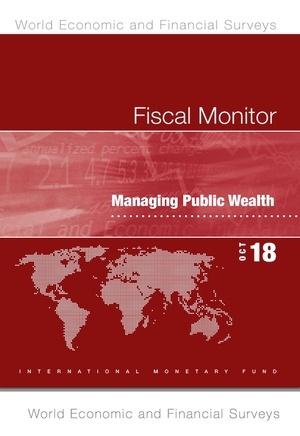
From top: The International Monetary Fund (IMF) October 2018 fiscal report; Eamonn Kelly

There are a couple of startling contradictions to Fine Gael fiscal policy contained in the Executive Summary of the IMF’s latest fiscal monitoring report: “Managing Public Wealth”.

The first is that, according to IMF economists and measurements gleaned from their global survey, privatisation of public properties is always a sure-fire loss-maker.

Contrast this with Fine Gael’s eagerness to privatise everything as the main plank of fiscal management.

The IMF conclusion was arrived at by using a different approach than that normally used in order to measure a nation’s wealth.

Rather than simply looking at income versus outgoings, the new approach uses a balance-sheet method, taking assets into account; publicly owned bodies and natural resources.

The problem identified by the IMF under the old approach was that it invited governments to focus on debt rather than taking a wider assessment of a nation’s wealth.

The report says:

“Balance sheet strength is not an end in itself, but rather a tool to support the objectives of public policy. The long-term aim of government is not to maximize net worth, but to provide goods and services to its citizens and possibly to create a buffer against uncertainty about the future. Current net worth should be seen in this context.”

Notice that in this assessment, the citizenry in and of themselves are also considered to have a net worth value.

Contrast this with the results of privatisation policy as they have impacted on health and welfare in Ireland during austerity. The casualties speak for themselves.

There may be a visible and measurable short-term gain in privatising public utilities for instance, creating the kind of figure-happy stats that Fine Gael rush to press with, but the overall value of national assets will be naturally reduced.

It’s a bit like burning the furniture to keep the fire going and pointing at the blazing fire and exclaiming, “Are you all warm now!”

The IMF report goes on:

“Similarly, cutting back maintenance expenditure reduces the deficit and lowers debt, but also reduces the value of infrastructure assets, which could cost more in the long term.”

So, cutting public spending and services and contracting out to private concerns will, as many people have already worked out, cost more in the end.

Though again the initial figures will look “nice”. Until, that is, the private contractor settles in and nails everyone to the wall with a price hike, slyly cutting level of service while they’re at it to maximize profits. Before you know it, you’re paying dearly for minimal or even no service.

And you’re stuck with it because the cost of restoring the original public service is prohibitive.

The UK Independent, reporting on this fresh approach by the IMF, said that the UK had

“…undergone one of the most drastic privatisations of any economy since the early 1980s…incentivising departments and local authorities to sell off assets to fund day-to-day spending under the premise that such an approach is necessary to cut the deficit…”

This is a similar approach to the one Fine Gael-led governments have been taking to balancing the books.

The IMF however have now contradicted this approach, warning that focusing on debt “misses large swaths of government activity and can fall victim to illusory fiscal practices”.

… that serve two functions: one, it provides conservative government with selective short-term figures that look like positive gains; and two, it delivers future profits of public assets into private hands.

Eamonn Kelly is a freelance journalist

Illusory Fiscal Practises: The IMF Debunking of Privatization (Eamonn Kelly)

Minister for Housing Eoghan Murphy TD and Taoiseach Leo Varadkar

IN a new blog posting, Journalist Eamonn Kelly writes:

Neoliberalism is a cuckoo in the liberal democratic nest.

Once seen in this light you can then alter your approach on how to deal with neo-liberals. For instance, if the ineffectual performances in the provision of social care by the current cabinet occurred in the private sector, which they champion so loudly, all of them would be sacked.

But only an idealistic liberal democrat with a belief in rational argument would argue that the failure of this government to address the housing and health crises is due to ministerial incompetence.

A neoliberal leadership, such as the one we have in Ireland, seeks to destroy liberal democracy from the top down, using all the powers and freedoms of that liberal democracy to do so.

That the neo-liberal takes political office at all is the first deception.

That the housing crisis has worsened under Varadkar is not because the problem is “complex”, as he recently claimed, or because his minsters are incompetent as their critics claim, it is because the neoliberal philosophy that they represent, cannot allow for a public work’s programme to build social housing.

The only complex part of the Irish housing crisis is the part where the Irish people seem to be asleep to the fact that there is a neo-liberal fox in the henhouse; an unelected taoiseach who quite openly represents business and business alone and who stated in the Dáil when asked about social housing that people can’t expect a “house for nothing”.

Judge them by their works, a wise man once said.

Neo-liberalism is a very simple philosophy. It is social Darwinism. [More at link below]

Eamonn Kelly is a freelance journalist

The Exhausting Futility of Arguing With Neoliberals (Eamonn Kelly)

From top: David Mcwilliams in Saturday’s Irish Times; Eamonn Kelly

Eamonn Kelly writes;

David McWilliams’ article in Saturday’s Irish Times about how people who give out about the multi-nationals are a bit backward, a bit “old Ireland” in their outlook.

But what he failed to see is that people who criticise all the breaks the multi-nationals get are really critiquing in a deflected manner all the breaks that the Irish people don’t get when they want to start a business.

Implicit in the multi-national deals and the manner in which successive sycophantic governments clamour to please corporate America is the idea that the Irish people in and of themselves are clueless about business and dependent on someone else making jobs for us.

This despite the fact that the boast of our superior educated workforce is what the IDA always leads with as a selling point to multi-nationals.

But if you’re an Irish person wanting to start a business it is awkward to the point of being punitive in setting it up and running it. And should the business fail the system is designed to whip away the safety net of welfare at the very time you might need it.

It seems then that everyone and everything is invested in and given breaks except the Irish people. Public monies ear-marked for retraining the workforce, for instance, were handed out in the millions to two British companies who provided no retraining for the investment but only a kind of policing of unemployed people.

The message is clear from the top. The Irish people are not worth investing in but are only useful as drones for corporate America who get all the breaks to use us, basically.

I’m not suggesting that we fling out the multi-nationals. That would be stupid. But this is the kind of “stupidity” that McWilliams was suggesting lay behind critiquing the multi-national deal.

What I am suggesting is that we invest in Irish would-be entrepreneurs and local businesses with the same confidence and generosity as we have been affording to multi-nationals.

By not investing in the Irish people you create a self-fulfilling prophecy that local entrepreneurs are unable to create employment. This reinforces the old national inferiority complex that informs the present system of attracting multi-national investment.

So contrary to McWilliams’  view that people who criticise the multi-nationals are somehow “backward”, the truth is that the system engineered by Lemass for a different Irish population made up of mainly farmers and labourers, is still being run as if the people haven’t changed.

A system based on an acknowledgment of a national inferiority complex, a need for creating employment for a workforce of mainly uneducated and unskilled labour and the luring of friends in America to make jobs for us.

Everything about it is dependent. But that’s not us any more. It’s the system is backward, not the people, as McWilliams implies.

The irony of this is that David McWilliams who presents himself as the progressive face of economics appears to be arguing that we return to the “innocence” of the Lemass era and show gratitude towards the multi-nationals.

If that’s not a big-red-flag clue to a post-colonial authoritarian issue I don’t know what is.

Eamonn Kelly is a freelance writer

Corporate Tax And The Yeah But School Of Economics (David McWilliamns, Irish Times)