


Tag Archives: Company Towns

homegiving2

3

4

2

From top: Homegiving posters for Ryanair, Guinness, Apple and Tesco

Further to the debate on company towns in Ireland.

Antoine D’Alton writes:

Our mission is to persuade large and medium sized employers to build affordable homes for their employees and help make a lasting contribution towards solving our national housing crisis.

We aim to initiate a Employee Homestead Provision Bill before the Irish Parliament this year with the aim of removing unnecessary restrictions which have been placed on employees regarding employer housing provision.

We want to encourage large and medium sized employers throughout Ireland in the private and public sector to consider investing in housing projects whether it is apartment buildings or housing estates which are purpose built to serve the increasing demand for our nation’s growing workforce.

We believe that we can include large and medium sized companies in the social bargain, and encourage them to return to building homes and communities which they used to do in the past.

We maintain, that Government by itself cannot and will not solve the housing crisis on its own. We further believe that the Irish property market has been skewed in favour of speculators, property developers, financial institutions and private landlords all of whom have a vested interest in ensuring unaffordable house prices and disproportionately high rental prices prevail into the future

As it stands it has become increasingly difficult for young families and employees to find an affordable home or rental property in our cities and major towns. We understand the frustration this is causing and recognise the long-term adverse effect this will have on our economy and our nation going forward.

The current housing crisis has been caused by poor planning and ill-considered public policy. It seems our government has not learned the lessons of the financial collapse of the Irish economy in 2008 which necessitated a bailout from the European Commission, the ECB and the IMF.

We are conscious of the hardship which speculation and price gouging in the housing and rental markets is causing. We know that it is resulting in families being evicted from their homes and being unable to pay rents which are way out of sync with average household earnings.

We know that private landlords and private equity firms are basing their returns on what they assume working professionals will pay. In the city of Dublin many of those employees work for large and medium sized tech firms whose staff are effectively competing for scarce rental properties and as a consequence through higher purchasing power are displacing people who can no longer remain in those properties which have served as their homes.

Moreover, those higher rental and accelerating home prices are putting disproportionate pressures on existing employees working for large and medium sized employers.

The exorbitant costs of rents and the difficulties in finding a home is acting as a disincentive for employees coming for abroad. We know from experience that thriving companies rely on and need new personnel, without them those companies cannot grow and prosper.

We all know that Ireland provides one of the most generous tax regimes for private companies in the world at 12.5% per annum. We know that many companies who avail of that rate are not contributing their fair share to our economy nor to the common good.

In some respects their low-earning employees have no alternative but to ask the government to assist them with housing. We do not believe that the tax payer should fit the bill for the failure of profitable and well capitalised companies to provide accommodation for their employees.

We want to change the dynamics of the Irish property market, and ensure that there is home security for our growing work force in the years ahead. We know that this will have positive knock-on effects for our nation, our people and for our economy. We believe that by investing in affordable housing, large and medium sized companies will be putting down long-term roots which in turn will create long-term job security.

We appreciate that there will be people with a vested interest in not allowing our bill go forward, we know who they are and we know the damage they have inflicted on our nation in the past? If they are allowed to succeed, we know they will damage our nations future and worse the future of our children.

It is our common cause to ensure that they will not succeed in that respect.

Finally, at the most basic level, we have a very human need, one that should be affordable to all and one that is the bedrock of our society – the need and the desire to have a place we call, home. With the Employee Homestead Provision Bill, we believe we can make that a realisable objective again not just for employees of large and medium sized companies, but for all.

We need your support.

Previously: Our Kind of Town?
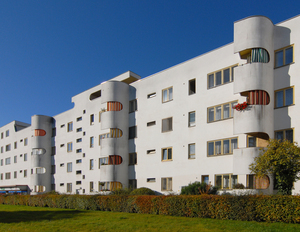
Siemenstadt Bauteil ScharunCadbury's Housing Bournville

Facebook St Anton Development

From top: Siemens housing complex, Berlin, Germany; Cadbury’s House, Bournvlle, England; the proposed Facebook’s proposed housing and leisure unit at Menlo Park, San Fransisco

What do Bourneville, Port Sunlight, Siemenstadt, Bilund and Batadorp all have in common?

They are thriving ‘company towns’.

And none is in Ireland.

Antoine D’Alton writes:

The concept of ‘Company Towns’ or purpose build accommodation for employees is not unknown to large American corporations. Indeed right up until the 1980’s, large companies in the United States were building homes and communities for their staff.

Indeed at the moment, Facebook are currently building an apartment complex in Menlo Park in San Mateo County in California. Located less than 1.5 miles from the new Facebook West Campus, the company is building a $120 million mixed-used development. Indoor facilities include a clubroom, sports lounge, coffee shop, concierge service, a market, self-service bike repair shop, leasing center, fitness center and yoga room.

Outdoor amenities include: a resort-style pool, spa, entertainment lounge, sun lawn, game lawn and Bocce Ball, social lounge, and roof deck. In an effort to shore up city support, Facebook has made a pledge that some of the units would be made available for the general public.

In 2013, Google partly funded the Franklyn Street Family Apartments in Mountainview, California, creating affordable housing for 51 families near its campus.

Now think about that for a moment, Facebook are building apartments in Menlo Park and making some available to the General Public.

If they can do it there, why can’t they do it in Dublin?

The answer is simple, there is no good reason.

Consider the following, Facebook avails of Ireland’s 12.5% Corporate Tax rate which is considerably lower than the equivalent tax rate in the United States. And while it is true large multinationals create employment opportunities, these employees are also driving up the prices for rental properties in Dublin which is having a knock-on effect to other tenants in the city.

Employees of Facebook and other large companies know they’re being overcharged in the Dublin property market, and this will be a factor which will determine whether these companies put down long term roots or invest elsewhere in the future? Put simply, if Dublin loses its attraction for prospective employees, then large employers will consider moving elsewhere.

Now here’s the solution, you offer corporations like Facebook an incentive to build apartment complexes which are mixed use.

For them, it is a legitimate investment, which will pay for itself from rents accrued from leasing units to their employees and others. After 25 years or indeed during that time-frame, they can sell the properties to their employees or tenants with a credit for rent which had already been paid.

The benefit from this is that it will free-up rental properties across the city and contribute to solving the social housing problem.

Put simply, it will increase supply in the market and also free-up accommodation in the city for other users.

The notion of Company Towns and purpose build accommodation for employees is not unknown to Ireland. In fact there are many examples of properties which were once built by employers for their staff throughout the city, whether they were constructed by Guinness, Jacobs, or indeed the railway companies etc.

Back in 1872, Edward Cecil Guinness began building houses for his employees to rent in Belview and Thomas Court, adjoining the St. James’s Gate Brewery. This housing accommodated employees on the active list of the Company. Further housing was built in Rialto in the 1880s. Guinness’s policy of providing homes continued well into the 20th Century

In the years before independence many houses along the North Circular and South Circular Roads were built to accommodate soldiers and administrative staff belonging to the garrison.

Up until the present day, the United States Army Housing Division develops, manages and leases properties throughout the world in order to accommodate soldiers and their families, and it is not alone in this regard.

The point is this, there are additional solutions to the ‘housing problem’ which have not yet been considered or even thought about. And while some people might not like the idea of living in property owned by their employer, the truth is this, you don’t have to live there if you don’t want to. But at least you have a choice.

And for those who believe that Company Towns, and Company complexes are a thing of the past, why are Facebook building the St. Anton complex?

But why stop at Facebook, what about Tesco or other large companies which are dependent on low-wage earners?

We need people to work in our shops, in our factories and our cafés. On the income they earn, it is not possible or at least very difficult for them to get a mortgage and it is becoming increasingly difficult for them to afford the rent. Consequently, the state has to subsidise housing for them. But why should this problem fall back on the state, why can’t employers play their part?

How many affordable homes and apartments have the likes of AIB and Bank of Ireland built for low and medium income families?

The answer is none.

When you think about all the damage the banks did to our nation, perhaps they owe a debt to society by building affordable homes?

Remember you can effect change for the common good and incorporate large companies into the social bargain. This is what we call corporate welfare as opposed to social welfare which ultimately falls back on the taxpayer.

Also, there is nothing to stop the Government and State agencies from going to the capital markets and building accommodation for nurses, teachers, and other frontline employees on the same principle. They have done it in other countries, so there is no reason it can’t be done in Ireland.

Let’s not forget, that both business and governments depend on ‘goodwill’ and stable markets to prosper. They also depend on ‘purchasing power’ to raise income, improve their balance sheets and keep the economy going. By building homes they can contribute to both in a variety of different ways and here’s the key incentive, they can profit from it too.

All that is required is the will to work the problem.

Pics via Antoine