Tag Archives: Cygnus

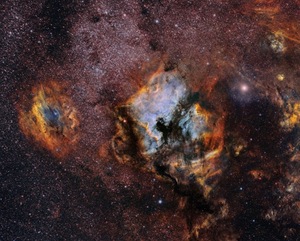
Behold: the constellation of Cygnus near the northern end of the Great Rift, or ‘Dark River’: the cosmic dust clouds that normally obscure the centre of the Milky Way from our view. To wit:

Composed over a decade with 400 hours of image data, the broad mosaic spans an impressive 28×18 degrees across the sky. Alpha star of Cygnus, bright, hot, supergiant Deneb lies at the left. Crowded with stars and luminous gas clouds Cygnus is also home to the dark, obscuring Northern Coal Sack Nebula and the star forming emission regions NGC 7000, the North America Nebula and IC 5070, the Pelican Nebula, just left and a little below Deneb. Many other nebulae and star clusters are identifiable throughout the cosmic scene. Of course, Deneb itself is also known to northern hemisphere skygazers for its place in two asterisms, marking a vertex of the Summer Triangle, the top of the Northern Cross.

(Image: J-P Metsavainio (Astro Anarchy)

apod

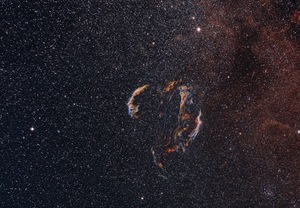
Behold: ribbons of shocked interstellar gas at the outer edge of an expanding stellar explosion that would have been clearly visible to our ancestors during the late Stone Age 20,000 years ago. To wit:

The featured image was recorded by the Hubble Space Telescope and is a closeup of the outer edge of a supernova remnant known as the Cygnus Loop or Veil Nebula. The filamentary shock front is moving toward the top of the frame at about 170 kilometres per second, while glowing in light emitted by atoms of excited hydrogen gas. The distances to stars thought to be interacting with the Cygnus Loop have recently been found by the Gaia mission to be about 2,400 light years distant. The whole Cygnus Loop spans six full Moons across the sky, corresponding to about 130 light years, and parts can be seen with a small telescope toward the constellation of the Swan (Cygnus).

(Image: ESA/Hubble & NASA, W. Blair; Acknowledgement: Leo Shatz)

apod

Behold: the spectacular skyscape of interstellar dust and glowing hydrogen gas near the northern end of the Great Rift and the constellation Cygnus the Swan.  To wit:

Composed using 22 different images and over 180 hours of image data, the widefield mosaic spans an impressive 24 degrees across the sky. Alpha star of Cygnus, bright, hot, supergiant Deneb lies near top centre. Crowded with stars and luminous gas clouds Cygnus is also home to the dark, obscuring Northern Coal Sack Nebula, extending from Deneb toward the center of the view. The reddish glow of star forming regions NGC 7000 and IC 5070, the North America Nebula and Pelican Nebulas, are just left of Deneb. The Veil Nebula is a standout below and left of centre. A supernova remnant, the Veil is some 1,400 light years away, but many other nebulae and star clusters are identifiable throughout the cosmic scene. Of course, Deneb itself is also known to northern hemisphere skygazers for its place in two asterisms — marking the top of the Northern Cross and a vertex of the Summer Triangle.

View full size here.

(Image: Alistair Symon)

apod

Behold: the painterly tableau of the constellation Cygnus (the Swan) picked out at the northern end of the Great Rift in swirling strokes of interstellar dust and glowing hydrogen gas. To wit:

Composed with three different telescopes and about 90 hours of image data the widefield mosaic spans an impressive 24 degrees across the sky. Alpha star of Cygnus, bright, hot, supergiant Deneb lies near top centre. Crowded with stars and luminous gas clouds Cygnus is also home to the dark, obscuring Northern Coal Sack Nebula, extending from Deneb toward the centre of the view. The reddish glow of star forming regions NGC 7000, the North America Nebula and IC 5070, the Pelican Nebula, are just left of Deneb. The Veil Nebula is a standout below and left of centre. A supernova remnant, the Veil is some 1,400 light years away, but many other nebulae and star clusters are identifiable throughout the cosmic scene. Of course, Deneb itself is also known to northern hemisphere skygazers for its place in two asterisms — marking the top of the Northern Cross and a vertex of the Summer Triangle.

(Image: Alistair Symon)

apod