Tag Archives: supernova

Behold: ribbons of shocked interstellar gas at the outer edge of an expanding stellar explosion that would have been clearly visible to our ancestors during the late Stone Age 20,000 years ago. To wit:

The featured image was recorded by the Hubble Space Telescope and is a closeup of the outer edge of a supernova remnant known as the Cygnus Loop or Veil Nebula. The filamentary shock front is moving toward the top of the frame at about 170 kilometres per second, while glowing in light emitted by atoms of excited hydrogen gas. The distances to stars thought to be interacting with the Cygnus Loop have recently been found by the Gaia mission to be about 2,400 light years distant. The whole Cygnus Loop spans six full Moons across the sky, corresponding to about 130 light years, and parts can be seen with a small telescope toward the constellation of the Swan (Cygnus).

(Image: ESA/Hubble & NASA, W. Blair; Acknowledgement: Leo Shatz)

apod

Like this.

Neutron stars are the collapsed cores of stars which – prior to supernova – had the mass of between 10 and 29 times our own sun. They’re only about 10km in diameter which. In cosmic terms, is very, very small indeed. To wit:

Previously these city-sized stars were too small and too far away to resolve. Recently, however, the first maps of the locations and sizes of hotspots on a neutron star’s surface have been made by carefully modeling how the rapid spin makes the star’s X-ray brightness rise and fall. Based on a leading model, an illustrative map of pulsar J0030+0451‘s hotspots is pictured, with the rest of the star’s surface filled in with a false patchy blue. J0030 spins once every 0.0049 seconds and is located about 1000 light years away. The map was computed from data taken by NASA’s Neutron star Interior Composition ExploreR (NICER) X-ray telescope attached to the International Space Station. The computed locations of these hotspots is surprising and not well understood. Because the gravitational lensing effect of neutron stars is so strong, J0300 displays more than half of its surface toward the Earth. Studying the appearance of pulsars like J0030 allows accurate estimates of the neutron star‘s mass, radius, and the internal physics that keeps the star from imploding into a black hole.

Image: NASA, NICER, GSFC‘s CI Lab

apod

Question: what could possibly shoot out a neutron star like a cannonball? Answer: a supernova. But you knew that. To wit:

About 10,000 years ago, the supernova that created the nebular remnant CTB 1 not only destroyed a massive star but blasted its newly formed neutron star core — a pulsar — out into the Milky Way Galaxy. The pulsar, spinning 8.7 times a second, was discovered using downloadable software Einstein@Home searching through data taken by NASA’s orbiting Fermi Gamma-Ray Observatory. Traveling over 1,000 kilometers per second, the pulsar PSR J0002+6216 (J0002 for short) has already left the supernova remnant CTB 1, and is even fast enough to leave our Galaxy. Pictured, the trail of the pulsar is visible extending to the lower left of the supernova remnant. The featured image is a combination of radio images from the VLA and DRAO radio observatories, as well as data archived from NASA’s orbiting IRAS infrared observatory. It is well known that supernovas can act as cannons, and even that pulsars can act as cannonballs — what is not known is how supernovas do it.

(ImageF. Schinzel et al. (NRAONSF), Canadian Galactic Plane Survey (DRAO), NASA (IRAS); Composition: Jayanne English (U. Manitoba)

apod

Behold: G292.0+1.8 – a fine young supernova 20,000 light years away toward the southern constellation Centaurus. So what are we looking at here?

Massive stars spend their brief lives furiously burning nuclear fuel. Through fusion at extreme temperatures and densities surrounding the stellar core, nuclei of light elements like Hydrogen and Helium are combined to heavier elements like Carbon, Oxygen, etc. in a progression which ends with Iron. So a supernova explosion, a massive star’s inevitable and spectacular demise, blasts back into space debris enriched in heavier elements to be incorporated into other stars and planets and people. This detailed false-colour x-ray image from the orbiting Chandra Observatory shows such a hot, expanding stellar debris cloud about 36 light-years across. […] Light from the inital supernova explosion reached Earth an estimated 1,600 years ago. Bluish colors highlight filaments of the mulitmillion degree gas which are exceptionally rich in Oxygen, Neon, and Magnesium. This enriching supernova also produced a pulsar in its aftermath, a rotating neutron star remnant of the collapsed stellar core. The stunning image was released as part of the 20th anniversary celebration of the Chandra X-ray Observatory.

(Image: NASA/CXC/SAO)

apod

screen-shot-2017-01-08-at-22-25-24 screen-shot-2017-01-08-at-22-25-34 screen-shot-2017-01-08-at-22-26-02

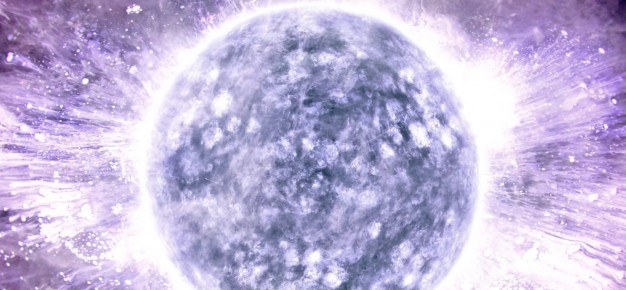
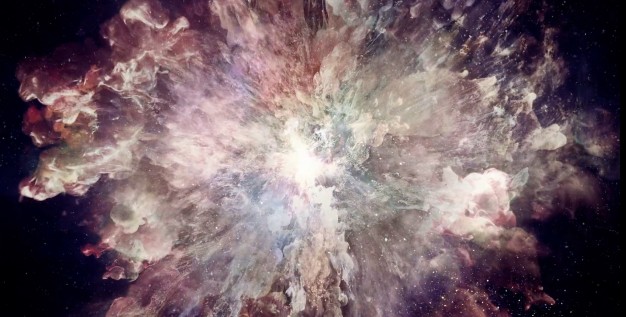
Using old school analogue visual effects like ink dispersing in an aquarium and pinholes in tissue paper to represent stars, Thomas Vanz creates a very impressive and highly plausible representation of a dying sun going supernova. To wit:

Novae is a movie about an astronomical event that occurs during the last evolutionary stages of a massive star’s life, whose dramatic and catastrophic death is marked by one final titanic explosion called supernova. By only using an aquarium, ink and water, this film is also an attempt to represent the giant with the small without any computed generated imagery.

Vanz shows how he did it here and here.

kottke