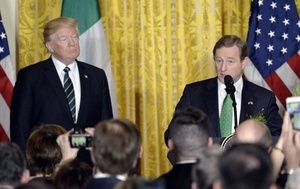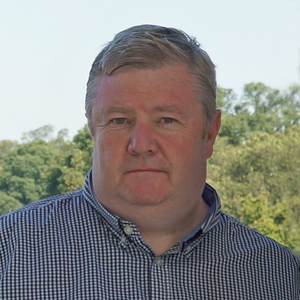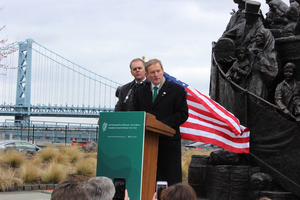



From top: Simon Coveney and leo Varadkar; Derek Mooney
Former US Defence Secretary, Donald Rumsfeld spoke not just of the events themselves but of a government’s capacity to anticipate, and thus prepare, when he offered his Rumsfeld’s Rule of known and unknown knowns…
There are known knowns. These are things we know that we know.
There are known unknowns. That is to say, there are things that we know we don’t know.
But there are also unknown unknowns. There are things we don’t know we don’t know.
The latest Irish Water fiasco falls clearly into the first category.
Not only it is clearly a known known, it a well-known known. It was specifically provided for in the Confidence and Supply Agreement hammered out in Trinity College last year between Fianna Fáil and Fine Gael.
There is no sensible or grown-up reason on earth why water charges should bring down this government. Both sides have known this was coming as both sides had agreed the timeline.
This process has been heading to an obvious conclusion from the very moment the committee was established – though why they established a committee with an even number of members that could be deadlocked is another issue.
Whether we like it or not and whether it is fair or not the simple political reality is that the complete mishandling of the whole water meter/charges process by successive Ministers since 2011 means that water charges are dead.
The 2016 general election result showed that.
Contrary to what Minister Varadkar might say across the floor of the Dáil the death knell of water charges was not struck by AAA, PBP, Sinn Féin or any other leftish anti-austerity group, but rather by Fine Gael and Labour designing and implementing a water metering and charging system that cost more to run than it raised in revenue.
To use phraseology that Minister Varadkar may grasp, not one red cent of the water charges collected was used to upgrade the water system.
It was taken up with administering the collection of water charges, charges not even based on the water meters which cost over €500million to install, and the payment of the so-called ‘water conservation grants.
While Minister Varadkar works on explaining the fiasco his government made of the implementation of water charges his colleague and leadership rival Minister Simon Coveney can attempt to come to grips with one key aspect of “new politics” that seems so far to have eluded him: namely, that Fine Gael does not have a majority in the Dáil and so it cannot tell Oireachtas committees what they may or may not decide.
The Joint Committee on the Future Funding of Domestic Water Services was established by the Dáil last November, to consider the report of the Expert Commission and to report with recommendations to both Houses of the Oireachtas.
That is what it has been doing over its twenty, or so, meetings and that is what it will, all going well, finish doing tomorrow (Tuesday, April 11).
Perhaps Minister Coveney hopes he can thwart the committee’s report and so get out of the commitment given by Fine Gael in Annex II of its Confidence and Supply Agreement with Fianna Fáil thatL
“the recommendations of the Special Oireachtas Committee will be considered and voted upon by the Oireachtas within a one month period.”
Though he was not charged with its implementation in the last government, Simon Coveney owns Irish Water as a concept and a policy more than any other politician.
He is the one who came up with it back in November 2009 in his New Era policy document which promised €18 billion in investment and 105,000 new jobs.
He not only suggested the name, but also talked about “real economies of scale”. Who knew 2009 was such an age of innocence?
Within months of its launch, Michael Noonan was distancing himself from the grand promises of New Era, telling the Newstalk Breakfast Show on July 14, 2010 that:
“Simon Coveney was the author of that particular policy document and if you look at it, the figure of 100,000 jobs doesn’t appear anywhere in it; that seems to be some kind of public relations add-on that enthusiastic people attached to it.“
Both Coveney the Minister and Coveney the putative Fine Gael leader urgently need a political win somewhere.
His promise that hotel accommodation will no longer be used to house homeless families by July of this year rings hollow with the news that he hopes to achieve it by having the Dublin Region Homeless Executive take a five year lease to convert a disused hotel on O’Connell Street.
I don’t expect the Government to fall tomorrow, but the sturm und drang of the past few days on this very basic and long known known does suggest that the capacity of this Government and its agreement with Fianna Fáil to withstand a known unknown, never mind an unknown unknown is virtually nil.
If I were a screen printer I would be ordering the plastic corriboard sheeting for posters for later this year.
Derek Mooney is a communications and public affairs consultant. He previously served as a Ministerial Adviser to the Fianna Fáil-led government 2004 – 2010. His column appears here usually every Monday. Follow Derek on Twitter: @dsmooney
Rollingnews