
Tag Archives: Harry Warren

St. Kevin’s Park, Camden Row, Dublin 8.

Harry Warren writes:

Dublin has some beautiful well-known parks but one of my favourites is the petite St. Kevin’s Park on Camden Row. It is usually bypassed by tourists but favoured by locals. St Kevin’s Park is unusual in having the ruins of a church and being a half park and half graveyard.

The grounds were redeveloped some years ago and the cemetery became todays park. It has a long history, the first mention of a church on the site dates back to the 13th century. The church ruins in the park today are a later addition built in 1750. This church was closed in 1912.

The park grounds still have some notable headstones in situ but the majority have been removed. The old headstones now line the perimeter of the park and more are around the walls of St. Kevin’s church.

Unsurprisingly the park is reputed to be haunted. Archbishop Dermot O’Hurley was buried there after being executed for treason in the 16th Century. He secretly baptised Catholics during penal times in St Kevin’s. He was eventually arrested, imprisoned and tortured and was sentenced to death. The authorities had him executed by slowly hanging him until dead. He was buried in St. Kevin’s but his grave is unknown today.

His spirit is said to be seen in the park where he performed the baptisms. During the transformation of the graveyard into today’s park, the owners of graves that could be traced were offered to have the occupants remains exhumed and buried elsewhere but many graves were unidentified and their bones still lie there today. The angry souls of these disturbed graves reputedly haunt the park.

Notable existing graves on view in the park are:

The Moore Family, relatives of Thomas Moore the poet and composer.

Hugh Leeson, brewer, and whose family gave its name to Leeson Street in Dublin

Jean Jasper Joly captain of the Irish Volunteers in 1798.

John Keogh, friend of Theobald Wolfe Tone, he once owned the land that is now Mount Jerome Cemetery in Harold’s Cross

Also, of note, the 1st Duke of Wellington of the Battle of Waterloo fame, was baptised in St Kevin’s.

During the 18th century the cemetery was a hunting ground for body snatchers, a very lucrative business. After dark a fresh grave with loose soil was sought out. A hole was quickly dug down to where the head lay . On reaching the coffin, two broad iron hooks under the lid, pulled forcibly up with the rope, broke off a sufficient portion of the lid to allow the body to be dragged out.

The body was stripped of the grave clothes, which were scrupulously buried again. The body was then put in a sack for transport and the soil was restored. The body was then sold to one of Dublin’s many medical schools, Trinity College, the Royal College of Physicians and the Royal College of Surgeons.

There is a dark history to the park as well. Tommy Powell a six-year-old child, was tragically murdered here in 1961. Broadsheet had an excellent 2017 article about the unsolved murder that you can read at this link here.

Today St. Kevin’s is a haven for wildlife. There are many species of birds including wrens, blue tits, robins, magpies, blackbirds and wood pigeons as well as mammals like hedgehogs, urban foxes, squirrels and wood mice.

Three species of bat are to be found in the park, Leisler’s bat, the common pipistrelle and the soprano pipistrelle. These bats make use of the ivy around the old church ruin as a roost. It is a lovely place to visit but perhaps for those of a nervous disposition, not after dark.

Pics by Harry Warren

Previously: Harry’s Dublin on Broadsheet

The Iveagh Gardens, Dublin 2.

Harry Warren writes:

I created this collage (above) of the same trees in the Iveagh Gardens in Dublin over a few seasons. Nature doing what it does best. The photos were taken during Summer, Autumn and now what I fear for some, is going to be a long Winter.

Because of the worldwide outbreak of COVID-19 it has been a rough year for many up to now. One can see how fractious many of the posts on Broadsheet have become but hope is on the horizon, everything comes in cycles and I do look forward to Spring blossoming when it arrives. All things come to pass and the current scenario will fade away in time. Watch out for the photo when Spring returns.

Pics by Harry Warren

From top: Palace Street, Dublin 2 (pics 1 and 2); Dean Street and Kevin Street Cross, both Dublin 8

On Dublin’s shortest streets….

…Harry Warren writes:

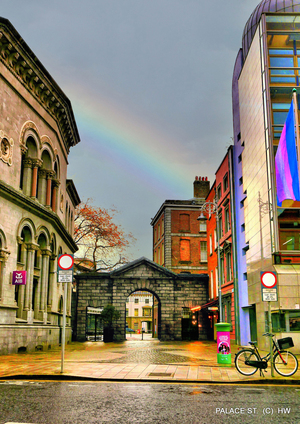
Just before one of the last lockdowns, I was happily enjoying a coffee outside of the lovely French restaurant Chez Max on Palace Street, Dublin 2. An American gent at the table beside me, in all seriousness said to his lady friend, “so what do they have to be indignant about? “Maybe the name is Olde English”, she replied”.

I couldn’t resist joining in the conversation. “Are you admiring the building? The Sick and Indigent Roomkeepers Society was a charity and its now a listed building”.  “Were they indignant because they were poor?”, he replied. Then badly paraphrasing G.B. Shaw, I offered “two nations divided by a common language”, gently advising that “indigent” now a rarely used word meant “poor”.

The penny finally dropped, we laughed and we had an enjoyable conversation about the locale and Palace Street. They were quiet taken with Palace Street and said it was the smallest street they had ever seen.

Palace Street. is one of the shortest streets in Dublin, it links Dame Street to one of the entrances to Dublin Castle. One side of the street has a fine elegantly designed building now an AIB bank. On the opposite side at number one is Chez Max and number two was the home of Dublin’s oldest charity, The Sick and Indigent Roomkeepers Society. It was founded in 1790 “for the relief of the poor without religious discrimination.”

Number three is a hideous Lego block lump of architecture, oversized, grimly designed and lacking in any finesse, popularly known as Robocop on Dame Street.

Palace Street. is one of the shortest streets in Dublin, followed by Dean Street in the Liberties [Dublin 8] but I would argue that Kevin Street Cross has to be the shortest of them all. Kevin Street Cross joins Bride Street. with New Bride Street on the way to St. Patrick’s Cathedral. Other short streets in Dublin? There is a hint in my name of my favourite one. I am sure there are more.

If any Broadsheet readers know of any shorter street or road in Dublin than Kevin Street Cross, I would love to read a comment in the Reply section.

Anyone?

Pics by Harry Warren

St Patrick’s Tower (and pear tree), Roe Lane, Dublin 8.

Harry Warren writes:

If you are strolling along Thomas St in Dublin, walking past the St. James Gate Guinness Brewery entrance, perhaps dreaming of the halcyon days pre COVID-19 of quaffing a creamy pint, have you ever noticed that odd looking tower across the road topped with a green dome and where else in Dublin would you find a pear tree outside of a private garden?

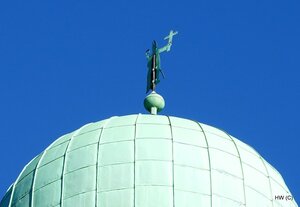
St Patrick’s tower was built in 1757 and was and arguably is, the largest smock windmill with a revolving top in Europe, today its sails are long since gone. The tower itself is 135 feet high and the width of the base is 70 feet. A smock mill is a type of windmill that resembles the shape of the smocks, the clothing originally worn by farmers in the Netherlands where these type of windmills were first erected. Why the moniker of St. Patrick’s Tower? If you look closely at the dome the wind vane on top is an effigy of St. Patrick.

The windmill was built to grind corn for the Roe Distillery that produced in excess of two million gallons of whiskey annually. The Roe family were very successful whiskey producers, by 1887 the distillery had expanded to 17 acres making it Europe’s largest distillery. Roe Whiskey was exported to the United States, Australia, Canada, as well as all over Europe.

The wealth of the Roe family became so great that they funded £250,000 (€20 Million euros in today’s money) for a major restoration of Christ Church Cathedral. Unfortunately, by the 1920’s the worldwide global whiskey market was in serious decline and by 1949 the distillery and its grounds were finally sold off to Guinness.

The pear tree? It is located at the base of the tower and in Autumn it produces a large crop of juicy pears. Perhaps someday it will be used in the manufacture of a nice pear liquor if they ever open a new distillery here again.

Today the tower is a feature of The Digital Hub in Thomas Street, the tech and media enterprise centre. There is seating in front of the tower and it is a lovely spot to enjoy a coffee in the Autumn sunshine.

Pics by Harry Warren

Meanwhile…

Oh.

The Iveagh Markets, Dublin 8.

Harry Warren writes:

A cheeky grin adorns the face of an excellent sculpture that winks at you as you walk past the Iveagh Market building in the Liberties area of Dublin 8. Beautifully detailed, the limestone carving is one of eight very individual faces of various ethnic groups that peer out upon the street at passers-by. Who or what do they represent?

There are various theories but according to Samantha L. Martin-McAuliffe, a lecturer in the School of Architecture at University College Dublin, they are described as being representations of the nationalities that traded with Ireland at the turn of the twentieth century, as noted in The Ethics of Giving and Receiving: a Study of the Iveagh Markets, Dublin.

According to the Irish Georgian Society, following the demolition of buildings in what is now St Patrick’s Park, next to St Patrick’s Cathedral, “Street traders lost their traditional market rights”

As a result, Lord Iveagh, Edward Cecil Guinness, built the iconic building of 30,000 Sq. ft on Francis St. and John Dillon St. to house their trading stalls and on completion handed it over in trust to Dublin Corporation.

The markets consisted of, “two covered markets for the sale respectively of old clothes and fish, fresh fruit and vegetables”. The building of the Iveagh Markets began in 1902 and were completed in 1906.

Like many modern building projects costs soon over ran the budget. Originally budgeted for £45,000, the final cost was about £60,000 a very substantial sum in those days. For many decades the Iveagh Markets once housed a bustling market activity of new and second-hand clothing as well as a food market selling grocery and meats.

Over the years the markets were gradually allowed to fall into disrepair by Dublin City Council. In 1997 they were closed and sold to a private developer. Disgracefully, for twenty years the market building was left to rot instead of being developed.

In January 2018, Dublin City Council repossessed the market site, now in an advanced state of dereliction but apart from securing the building no further development has happened.

Dublin and Dubliners deserve better. So, the next time you pass by look up and enjoy the sculptures and wonder at the inaction of Dublin City Council allowing an architectural gem fall into ruin.

Pics by Harry Warren

Some Neck Guitars.

4 Dean Street, Dublin 8,

Harry Warren writes:

I visited Some Neck Guitars recently to have a guitar repaired. They did an excellent professional job for a very fair price. They are doing their best to support the live music industry in Ireland, despite the assault on it due to the Corona Virus restrictions.

Some Neck Guitars is Dublin City’s first dedicated classic Vintage and Modern guitar and amp store. Apart from a very friendly and helpful staff they have an excellent range of classic guitars and amplifiers for sale. They also offer a full and comprehensive guitar set up and repair service.

Name those ‘axes’, anyone?

Pics by Harry Warren

Harry says: “I took the top photo shortly after the seats were installed some years ago and passing by yesterday, I photographed the Autumnal one with the gentlemen seated (above).”

Havel’s Place.

St Patrick’s Park, , Dublin 8.

Harry Warren writes:

Many people visit St Patrick’s park adjacent to Christchurch cathedral in Dublin and sit at two beautifully designed seats enjoying a coffee and a conversation but are completely unaware of the origin of the seats.

The seat and table are Havel’s Place, a memorial bench to Vaclav Havel, a playwright and former Czech President and above all a champion for human rights that were ceremonially unveiled in Dublin on December 10, 2013. A unique work by the famed designer Borek Sipek.

The bench, comprising a round table with a Linden Tree (The Czech National Tree) growing though its centre and coupled with two movable chairs decorated with typical Havel hearts (today the hearts are now sadly missing) enables visitors to freely discuss matters of interest, which is the main mission of the whole work, “Without free discussion there is no Democracy”.

In addition to the bench there is a small commemorative plaque, usually hidden by pebbles, mounted on the ground. In light of the ongoing Brexit discussions perhaps it’s time that Boris Johnson and Michel Barnier sat down here and had a coffee together.

Pics by Harry Warren