Tag Archives: Horsehead Nebula

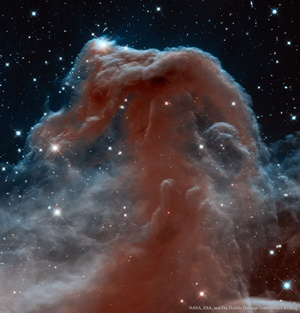
Behold: the magnificent interstellar dust cloud of the Horsehead nebula in the vast constellation of Orion. Sculpted by stellar winds and radiation into an equine pareidolia that will not last forever. To wit:

A potentially rewarding but difficult object to view personally with a small telescope, the above gorgeously detailed image was taken in 2013 in infrared light by the orbiting Hubble Space Telescope in honour of the 23rd anniversary of Hubble‘s launch. The dark molecular cloud, roughly 1,500 light years distant, is cataloged as Barnard 33 and is seen above primarily because it is backlit by the nearby massive star Sigma Orionis. The Horsehead Nebula will slowly shift its apparent shape over the next few million years and will eventually be destroyed by the high energy starlight.

Another perspective?

apod

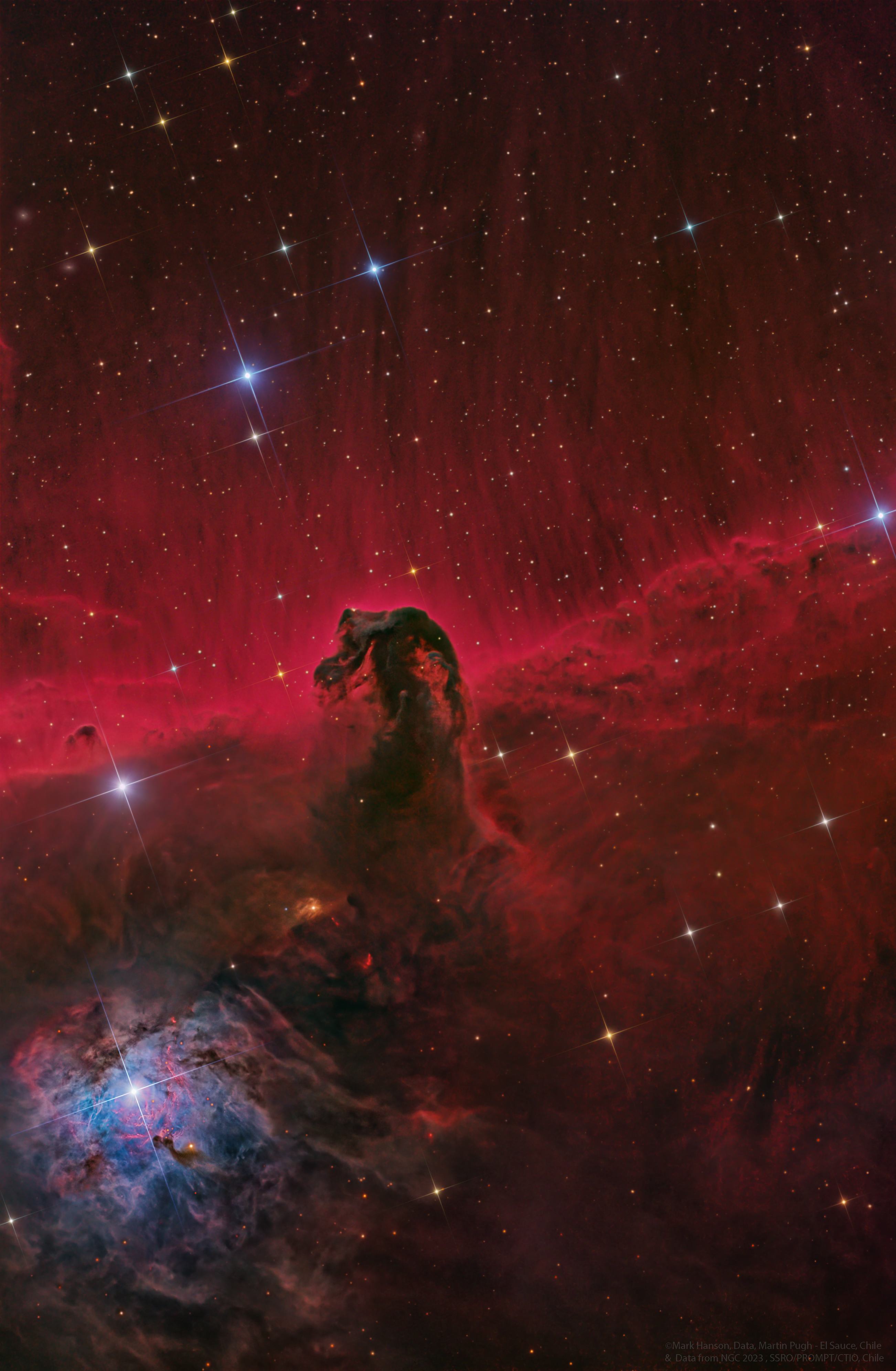
Behold: the Horsehead Nebula, just south of the easternmost star of Orion’s Belt, 1,500 light years distant. To wit:

About five light-years “tall”, the dark cloud is cataloged as Barnard 33 and is visible only because its obscuring dust is silhouetted against the glowing red emission nebula IC 434. Stars are forming within the dark cloud. Contrasting blue reflection nebula NGC 2023, surrounding a hot, young star, is at the lower left of the full image. The featured gorgeous colour image combines both narrowband and broadband images recorded using several different telescopes.

Previously: My Lovely Horse

(Image : Mark Hanson & Martin Pugh, SSRO, PROMPT, CTIO, NSF)

apod

Behold: the Horsehead Nebula – the most famous (and beloved) interstellar cloud in the sky. To wit:

It is visible as the dark indentation to the red emission nebula in the centre of the above photograph. The horse-head feature is dark because it is really an opaque dust cloud that lies in front of the bright red emission nebula. Like clouds in Earth’s atmosphere, this cosmic cloud has assumed a recognisable shape by chance. After many thousands of years, the internal motions of the cloud will surely alter its appearance. The emission nebula‘s red colour is caused by electrons recombining with protons to form hydrogen atoms. On the image left is the Flame Nebula, an orange-tinged nebula that also contains filaments of dark dust. Just to the lower left of the Horsehead nebula featured picture is a blueish reflection nebulae that preferentially reflects the blue light from nearby stars.

(Image: José Jiménez Priego)

apod