
Tag Archives: Judge Maureen Harding Clark

wyghbtf9screen-shot-2016-11-30-at-10-25-18

From top: Irish Times Health Correspondent Paul Cullen; Independents 4 Change TD Clare Daly and health correspondent at The Irish Times Paul Cullen

You may recall the publication last week of Judge Maureen Harding Clark’s report on the symphysiotomy redress scheme.

And some of the subsequent criticism of both and the report and the media coverage of the report.

Senior lecturer at Birmingham Law School, Mairéad Enright wrote:

[Judge Clark’s report] is not the independent report survivors of symphysiotomy are entitled to under human rights law. The media have read it as diminishing SOS’s claim that the non-emergency substitution of symphysiotomy for Caesarean section without consent, as practiced in Ireland, violated many women’s human rights. However, this coverage has been insufficiently critical of this report.

“…It is a mistake to think of the story of symphysiotomy as one about ‘bad doctors’. It is a story about bad systems of knowledge, and bad cultures, which corner women, induce compliance, deny their autonomy and thereby wound them. Those cases are extraordinarily difficult to litigate because the assumptions which drive the old system persist in judicial reasoning and are exacerbated by an adversarial framing.”

“Outside the courtroom, we can find the same problems. What is striking about this report is that it uses constructs from those systems and cultures – valorising reproduction however painful, stoking a suspicion of women who claim their human rights, privileging medical literature over first person testimony – to silence protest. It deserves closer, and more critical reading and discussion.”

Further to this.

Yesterday, Independent 4 Change TD Clare Daly and Anti Austerity Alliance TD Ruth Coppinger raised Judge Harding Clark’s report and the media coverage – with Ms Coppinger naming Irish Times journalist Paul Cullen.

Clare Daly: The Harding Clark report into the symphysiotomy redress scheme has been described as deeply skewed, profoundly unfair, subjective and selective, intellectually dishonest, morally bankrupt, replete with false allegations, omissions, distortions, misrepresentations and contradictions, and biased throughout. Those who said that are being soft on Judge Harding Clark whose report cannot go unchallenged or uncorrected. She goes way beyond the terms of reference of her assessor report to the Minister for Health when all she was asked to do was deal with the activities and expenditure of the scheme. Instead, she deviated into personal and unsubstantiated commentary, which is highly inappropriate in the context of outstanding litigation. Her report is riddled with false allegations, such as alleging that leading campaigners against symphysiotomy had alleged they had the procedure when they had not. That is completely and utterly untrue.”

“The only interpretation one can draw from this report is that it is a defence of the uniquely Irish practice of non-emergency symphysiotomy. It serves to diminish survivors’ claims and is a further violation of those women’s human rights. Symphysiotomy as practised in Ireland is a human rights abuse and that is the case regardless of this report. There can be no denying that the State has been culpable in this but rather than address these matters honestly, the report has served to diminish the suffering caused and undermined the experiences of the women. There is a continued suggestion that the women were lying. Nobody who met these women could ever believe that.”

“Of course, Judge Harding Clark met hardly any of them. It was a paper review with no right to appeal any of her decisions. It was her opinion and her opinion only. It is hugely traumatic for the women involved that this horrific report has been published. I believe the Minister needs to intervene to have it withdrawn. It is hostile in its tone and it smears and discredits survivors rather than dealing with a bad and deliberate policy and a poorly-administered scheme. It needs to be withdrawn and we need clarification on this matter.”

Ruth Coppinger: “I, too, have been absolutely appalled by the media coverage and the commentary of certain people in the media in the last week in response to this report. I agree that the methods of assessment were defective. I agree with Deputy Daly on the policy of Judge Harding Clark of taking oral evidence and meeting only a handful of the women involved. If she had met more, she would have seen for herself some of the injuries and limping, etc., that these women endure. Using contemporaneous radiology in one particular case, the judge stated that a 2004 X-ray did not show injuries to the women and that therefore the injury had happened afterwards. The judge went way beyond her brief, showed her own bias and showed contempt for these women. I believe it is absolutely vital that this Dáil and the Government agrees to set aside time to have a proper analysis of this report.”

There are a couple of myths that the report tries to knock down. The first is that symphysiotomy was a normal procedure practised in many countries, as argued by Paul Cullen, for example, in The Irish Times. In 1944, there were four of these operations in the national maternity hospital. In 1948, there were 43. That was because of the arrival of Dr. Alex Spain, an arch-Catholic, as head of the hospital, who refused caesarean sections and said that their result would be contraception, the mutilating operating of sterilisation and marital difficulty. It is utterly wrong to say that. They also argue that symphysiotomy was not dangerous. Clearly, it was. It was not a benign procedure. It was not used in other countries as a first resort; it was used as a last resort. This is the third whitewash report there has been. It is a disgraceful indictment of the system that it does this to women who were brutalised in Catholic Ireland of the past.”

Later

Daly: “I have to say that there has been a certain rewriting of history again. We know that the majority of survivors never accepted this redress scheme to begin with. The Minister of State is dodging the key elephant in the room, which is that this report goes one step even further from that. It is riddled with factual inaccuracies, unverifiable anecdotes and is severely damaging. It is well known that people experience trauma and upset as victims of abuse if their stories are not believed. The report is done in a manner which disbelieves the testimony of the women involved. It makes outrageous claims. We know that not one woman anywhere submitted that she had consented to or was aware of that procedure, yet the judge said that she found it very difficult to believe that is the case. There is no evidence to support her view in that situation. This is the same judge who, when awarding payments previously, told the women they were getting the money to redress their “unhappy experience”. This was deliberate butchery that was carried out on people for ideological reasons.”

“What the report shows is a deliberate undermining of the human rights campaigners and groups whose work actually led to the setting up of this scheme to begin with, bad and all as it is. I remind the Minister of State that it took a former Minister to go to court to get the Guerin report withdrawn. We know the McAleese report into the Magdalen laundries was hugely criticised and controversial. The point that is being made here is that this document cannot stand. In and of itself, it abuses the women involved. It has to be withdrawn and considered further by this House.”

Coppinger: “There has been an attempt by the Catholic right to seize on this highly flawed report to argue against the whole question of Catholic control of maternity hospitals. There is no question that this was done and motivated by a Catholic medical theology. It is also argued very patronisingly that these women did not know the difference between a caesarean section, a symphysiotomy or anything else that was happening to them.I know women were kept in ignorance but I think most women would know if they had their pelvic bones broken.”

“The scheme relied on written and radiological evidence which was extremely unfair because proving a symphysiotomy happened over 50 years ago is incredibly difficult if medical records do not exist. In that sense, the scheme militated against the older women and some younger women were able to pursue their claims successfully. The fact there were 185 unsuccessful applications does not mean that 185 symphysiotomies were not carried out. As I said, it was difficult to prove. People were also only given 20 days to apply to the scheme which is highly restrictive in the context of gathering up information.”

“There is no way that this Dáil could or should stand over this report. A debate must take place in this Chamber to question the rationale of Judge Harding Clark.”

Transcript: Oireachtas.ie

Notes on Judge Harding-Clark’s report on the symphysiotomy payment scheme (Mairead Enright, Human Rights in Ireland)

Pic: Paul Cullen

90355583

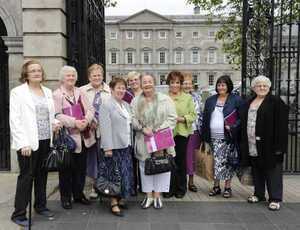
Women who had symphysiotomies and their supporters outside the Department of An Taoiseach in 2014

Further to the publication of Justice Maureen Harding Clark’s report on the symphysiotomy redress scheme last week…

And some of the subsequent reporting of the same…

Sinead Redmond, of the Association for Improvements in the Maternity Services (AIMS) writes:

The Association for Improvements in the Maternity Services (AIMS) Ireland is outraged at the suggestion that the survivors of symphysiotomy have exaggerated, or been in some way dishonest, in their claims in what has been a long and difficult struggle for them, in the pursuit of justice.

We, at AIMS Ireland, know that women are very slow to expose themselves to legal proceedings, especially when they have been traumatised in the past. The fact of the matter here is that medical records are missing.

We are very disappointed that Judge Maureen Harding-Clark has made completely unfounded accusations of dishonesty against elderly women and their supporters, based on a lack of documentation and records. At the same time, she fails to hold the hospitals and medics responsible for not keeping that documentation, as is their responsibility.

The claim that a woman’s medical record could prove or disprove that a procedure had taken place is laughable. Medical record keeping of the time was minimal, to say the least. Many women’s medical records for a birth consist of a few lines, hardly comprehensive proof.

All medical records prove is that a midwife or obstetrician wrote something once upon a time on a chart. Whether this is an accurate reflection of events is another story entirely. It is not uncommon to see issues with medical record keeping to this day.

Further, AIMS Ireland is at a loss to understand why, in an era where women not only had no access to abortion, but also had no access to contraception as well as no legal right to not be raped within marriage, women who had further pregnancies after symphysiotomy are deemed by the judge to not have been traumatised by the symphysiotomy.

Women of the time had no say over whether they became pregnant or not regardless of their state of health and wellbeing, and as of course is still the case, they had no say over whether they remained pregnant or not. Becoming pregnant was not something a woman had any say whatsoever in.

This report is a further violation of those women, who are and were entitled, in their latter years, to expect more of a state that claims, with little evidence, to be more enlightened.

Women who have experienced mistreatment know that it has happened. They are neither hysterical nor litigious as suggested by those who should know better. It is beyond belief, that those practicing medicine in today’s world, would turn to the ancient argument of the hysterical woman.

The biggest issue for AIMS Ireland today, is the establishment’s complete failure to hold a mirror to its practices both past and present. It demonstrates to women today how little value is placed in their well-being.

It further illustrates that ‘the professionals’ in this country have rights over women’s bodies which would not be given in other jurisdictions.

In media commentary this week, the point has been made that symphysiotomy is still used in poorer countries where alternatives are lacking. The key point here is “where alternatives are lacking”. This was not the case in Irish hospitals in 1965, with access to trained surgeons, surgical theatres and antibiotics.

There is no valid reason for the fact that though symphysiotomy was dropped and even banned as a procedure in other Western countries, it continued to be used in Ireland as late as the 1980’s, no matter how frequent its use was.

Points have also been made regarding the life-saving potential of symphysiotomy in specific situations. No one is questioning that.

We are questioning the medical need to perform these procedures in Irish hospitals in the years in question, when evidence showed a caesarean section was a viable alternative.

We at AIMS Ireland find it appalling that women’s experiences, trauma and injuries at the hands of what was a highly patriarchal and religious-led maternity care system, could be so lightly dismissed, and their suffering labelled as in some way “normal”.

Women should not be suffering either emotionally or physically after childbirth in Ireland.

AIMS Ireland statement on the publication of Judge Maureen Harding-Clark’s report into the surgical symphysiotomy ex-gratia payment scheme and media commentary on the same (AIMS Ireland) 

Meanwhile…

screen-shot-2016-11-28-at-17-41-12

Previously: ‘Confabulation, False Memories And Conspiracy Theories)

Related: Medical Council ‘carefully considers’ symphysiotomy report (Paul Cullen, Irish Times)

Symphysiotomy group calls for claims in redress report to be withdrawn (Gráinne Ní Aodha, The Journal)

screen-shot-2016-11-23-at-10-55-57

90264588

maureen-for-bio

From top: report by Judge Maureen Harding Clark on the ex gratia payment scheme for women who had symphysiotomies; members of the Survivors of Symphysiotomy campaign group in June 2012; and Judge Harding Clark

In 2014, the then Minister for Health Leo Varadkar commissioned Judge Maureen Harding Clark to review the Government’s ex gratia payment scheme for women who have had symphysiotomies.

Judge Harding Clark’s 274-page report was published yesterday.

The scheme involved three levels of compensation for the women who had undergone the procedure:

Category 1A: symphysiotomy only, €50,000

Category 1B: symphysiotomy with significant disability as defined in the scheme (where medically verified physical symptoms or conditions were directly attributable to symphysiotomy and which had lasted for more than three years)  €100,000

Category 1C: a particular form of symphysiotomy, with or without significant disability €100,000 – €150,000

Category P1 and P2: pubiotomy, with or without significant disability, €100,000 – €150,000

According to the terms of the scheme, pubiotomy was defined as “[involving] the sawing through of the pubic bones while symphysiotomy involves cutting through soft fibrous cartilage and does not involve bone or the use of a saw”.

Women who wished to apply for compensation could do so between November 10, 2014 and December 5, 2014 – yielding almost 600 applications (with some being made outside this time-frame) while the State expected fewer than 350.

In the end, the following payments and conclusions were made:

185 were declared ineligible for the scheme. 

Symphysiotomy was established in 403 cases (60 of which involved symphysiotomy to release the after-coming head in breech deliveries and for shoulder dystocia) and pubiotomy in 1 case – with 399 women receiving awards.

216 women received €50,000
168 received €100,000
15 received €150,000

In addition:

4 women died before any offer was made
1 woman rejected the offer to continue her action through litigation
1 woman died before the offer that was notified to her could be accepted.

From the report:

A great deal of adverse publicity surrounds the subject of symphysiotomy in Ireland. The Scheme was therefore premised on the widespread assumption that symphysiotomy was a surgical procedure which as a matter of near certainty, created lifelong suffering.

It was generally asserted that Irish obstetricians were motivated by Catholic teaching on
contraception rather than by obstetric need and that they were alone in the English-speaking world in performing symphysiotomy during the 1940s until the late 1960s.

The terms of the Surgical Symphysiotomy Payment Scheme reflected those widespread perceptions and provided for payment once a surgical symphysiotomy was proved, no matter why the surgery was performed.

No general pattern of immediate or developmental injury was seen. The evidence did not confirm that symphysiotomy inevitably leads to lifelong pain or disability or those symphysiotomy patients aged in a manner whichwas different to those of non-symphysiotomy women.

The majority of applicants who underwent symphysiotomy made a good recovery and went on to have normal pregnancies and deliveries and to lead a full life. Most applicants had at least 4 normal deliveries after the symphysiotomy.

A small number of applicants suffered from pelvic pain and a slightly larger group from urinary issues. Whether the conditions were associated with prolonged labour, the use of forceps, parity or the symphysiotomy procedure or a combination of all three was not possible at this remove to determine. It was noted that many symphysiotomy procedures were carried out after a ‘failed forceps’.

Five applicants had a documented history of incontinence associated with the symphysiotomy birth. They had suffered bladder/urethral damage or fistula at the time of symphysiotomy. The injury was identified within hours of the symphysiotomy and repaired at the first opportunity. All five  applicants were thereafter predisposed to urinary tract infections and in one case, continuing incontinence.

Pain and/or discomfort over the pubic joint during intimate relations in the first 12 months post symphysiotomy was a very common complaint. However, the vast majority of applicants became pregnant within a year of the symphysiotomy. Several applicants claimed that the symphysiotomy caused cessation of all sexual relations and the end of their reproduction. A small number claimed that their reluctance to engage in sexual intercourse led to marriage breakdown.

In many cases, applicants had seen the word episiotomy on their records and had equated that with symphysiotomy. 23 other claims involved spontaneous symphysiotomy. The rest of the claims involved incorrect assumptions that

Many applicants who did not undergo symphysiotomy provided statements of fairly harrowing memories of the operation and how their lives had been ruined, how they were unable to walk or take care of their babies, that they were incontinent, suffered prolapse of pelvic organs and had never recovered to this day.

Much more concerning was that their claims of disability were supported by medical opinion. I believe that prolonged and exhausting labour (common until the concept of managed labour was advocated in the late 1960s by Dr. Kieran O’Driscoll at the NMH) and especially, if the delivery was by forceps was attributed to symphysiotomy.

Such confabulation is understandable in the context of a difficult delivery many decades previously. Fear, pain, narcotic analgesia, exhaustion and dehydration can all contribute to confusion and memory blanks. It is therefore probable that hearing the testimony of others led many applicants who did not undergo symphysiotomy to acquire false memories and to fill in the blanks

On the Catholic Church:

Very detailed and forensic examination of available contemporaneous medical records failed to find evidence of a religious as opposed to an obstetric reason when a symphysiotomy operation was performed.

“It was introduced to permanently enlarge a narrow pelvis and thus avoid unnecessary repeat caesarean section deliveries in a country where contraception was not countenanced by the Catholic population and was in any event illegal and unavailable.”

“The evidence is that sterilisation was not performed in any of the Dublin Maternity Hospitals at that time even though the procedure was not proscribed by law as with the case of contraception. The medical indication for symphysiotomy was always provided.”

On the media:

It is obvious that the rarity of symphysiotomy means that few GPs know anything of the procedure apart from from media reports. This sometimes emotional and sensational reporting has led many highly competent doctors to believe that once a symphysiotomy is performed, pelvic instability, pain and urinary incontinence follow as a matter of course.

This probably explains why the reporting of a patient’s condition and complaints changed once the possibility of symphysiotomy was raised. So little is known, as opposed to perceived, about the sequelae of symphysiotomy that on a number of occasions, I was reprimanded by an applicant’s doctor for reporting that a radiology report received in his patient’s case indicated a completely a [sic] realigned pubic joint. This it was declared was an impossibility and a reflection of my ignorance.

Examination of records found that 30% of applicants did not undergo symphysiotomy at all and most applicants did not suffer medically verified injury which accorded either with media reports or with their narratives. This overall finding is reflected in the number of applicants (30%) who underwent symphysiotomy but did not claim any disability. My own expectation at the commencement of the Scheme that most applicants would be able to identify and establish their significant disability was not confirmed.

…After much thought, I concluded that it is very probable that the combination of a traumatic birth experience and exposure to other women’s stories has created a self convincing confabulation of personal history. Another inference is that the possibility of financial payment has influenced suggestible women and their family members into self- serving adoption and embracing of the experiences described by others or in the media and created psychosomatic conditions.

…As previously mentioned, the history of symphysiotomy in Ireland was very fully explored by Professor [Oonagh] Walsh. To a great extent, her scholarly report has been ignored by sections of the media who appear to prefer the more lurid and unfounded accounts projected by some activists and bloggers. I am therefore not sanguine that there will be any change in the manner of reporting of the subject.

On conspiracy theories:

Very considerable efforts were taken to thoroughly and fairly examine all applications. Particular difficulties arose in a number of cases where the applicants were firmly convinced that they had undergone either symphysiotomy or pubiotomy and were unwilling to accept the truth of the content of their medical records. Conspiracy theories were not uncommon. Usually the issue was set to rest following gynaecological and radiology examination; sometimes several such examinations were necessary.

Thud.

Meanwhile…

Read the report in full here

Related: Symphysiotomy: the whitewash that never was (Paul Cullen, Irish Times)

Previously: ‘Happy To Shred’

Meanwhile….

‘I want to reiterate that this was a maternity unit that was to some extent caught in a time warp. There was no badness or cover up.”

Judge Maureen Harding Clark at the end of her 2006 inquiry into events at the maternity unit in Our Lady of Lourdes Hospital, Drogheda, where Dr Michael Neary removed the wombs of 129 women over 25 years, a rate that was 20 times the national average.

Good times.

Lourdes Hospital Report 2006