
Tag Archives: Ken Foxe

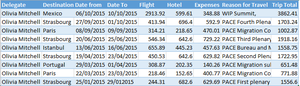
Olivia-Mitchell-Travel Terry-Leyden-Travel

Tables created by journalist and lecturer Ken Foxe showing the cost of flights, hotels and unvouched expense claims – made by former Fine Gael TD Olivia Mitchell and Fianna Fáil senator Terry Leyden – for trips they made in 2015

You may have seen an article in yesterday’s Sunday Times in which Ken Foxe reported on the expense claims made by Dáil and Seanad members for their overseas travel in 2015.

These are tax-free unvouched expenses which don’t relate to the cost of hotels or flights, as those costs are paid by the Oireachtas.

Those who made the largest claims included Fianna Fáil senator Terry Leyden, who claimed €5,852 to cover eight trips, and former Fine Gael TD Olivia Mitchell, who requested €4,399 for nine trips.

Further to this.

How can Irish politicians claim up to €260 per day in unvouched tax-free expenses when abroad?

Ken Foxe explains:

Subsistence claims on certain types of overseas travel for politicians can end up being particularly high because of a top-up scheme, which allows large daily payments dependent on the destination city.

For example, meetings of the Council of Europe in Paris are paid at a daily rate of €146 with a top-up of 80%, bringing the daily rate to €262.

The enhanced rates are designed to cover the cost of so-called “casual entertaining”, and were first introduced in the 1950s.

The existence of these top-up rates has been questioned by the Comptroller and Auditor General on two separate occasions but they have not been reformed. The scheme is unique to politicians, and is not replicated in any other part of the public service.

Sound familiar?

*Click link below to see a table of all expenses claimed by members of Dáil and Seanad for overseas trips in 2015.

How Irish politicians are able to claim up to €260 per day in unvouched tax-free expenses when abroad (No Expenses Spared, Ken Foxe)

Appointment
howlin-1024x437

From top: Information Commissioner Peter Tyndall with President Michael D Higgins and Labour’s Minister for Public Expenditure and Reform Brendan Howlin on the day of his appointment in December 2013; Mr Howlin’s introduction of ‘significant extra protection’ for politicians in the FOI Act 2014

You’ll recall Ken Foxe’s unsuccessful attempts to access copies of invoices and receipts submitted by 22 TDs and Senators, under Freedom of Information requests.

The Oireachtas refused Mr Foxe’s request claiming the documents were the politicians’ ‘private papers’.

He appealed this decision to the Information Commissioner because, in a case in 1999, the then Information Commissioner Kevin Murphy ruled that politicians’ expenses couldn’t be regarded as ‘private papers’.

However, the current Information Commissioner Peter Tyndall – who was nominated to his position by Labour TD and Minister for Public Expenditure and Reform Brendan Howlin – upheld the Oireachtas’s decision not to grant Mr Foxe access to the documents.

Mr Tyndall ruled that Section 42 (1) of the new FOI Act 2014 – introduced by Mr Howlin – contained a new provision which “affords a more significant protection for private papers of members of the Houses than previously existed”.

Further to this…

Mr Foxe, a lecturer in Dublin Institute of Technology, asked Mr Tyndall and Mr Howlin’s department several questions in relation to his decision.

The Department of Public Expenditure and Reform had no comment to make on Mr Tyndall’s findings.

However, these are Mr Foxe’s questions to Mr Tyndall and the answers he received…

Has Mr Tyndall raised concerns with the Dept of Public Expenditure with regard to what appears to have been extra provisions put in place for protection of politicians’ private papers from public scrutiny?

The Constitution provides that the sole and exclusive power of making laws for the State is vested in the Oireachtas and it is the role of the Information Commissioner, in relation to the FOI Act, to implement the legislation passed by the Oireachtas in an independent and impartial manner.

As can be seen from the recent decision in case 150073, the Commissioner considers it reasonable to conclude that receipts and invoices for expenses incurred by members in the course of the performance of their functions would not ordinarily be considered to be private papers of the members. However, for the purpose of his review, he was confined to determining whether the Oireachtas had correctly applied the provisions of the legislation.

While the Commissioner has not raised any specific concerns with the Department, it should be noted that the Central Policy Unit of the Department receives a copy of every decision made. Accordingly, the Department is aware of the Commissioner’s findings and comments in so far as they are set out in the decision.

How can Mr Tyndall balance the very clear decision made by his predecessor that private papers was clearly never meant to apply to receipts, invoices, expenses etc.?

Mr Murphy’s decision in case 99168, taken in 1999, was based on the legislation as it pertained at the time. It is noteworthy that the records at issue, relating to expense payments made to members of the Oireachtas were held by Office of the Houses of the Oireachtas, in accordance with the expense processing arrangements which existed at the time.

In case 150073, The Commissioner was required to consider the provisions of the FOI Act 2014. The Act of 2014 contains a provision which did not exist in 1999.

Furthermore, the records sought in case 150073, namely the receipts and invoices relating to expenses incurred by the members, are held by the members in accordance with the expense processing arrangements currently in place. This is a relevant consideration in determining whether the records relate to private papers of the members, within the meaning of Part 10 of the Houses of the Oireachtas (Inquiries, Privileges, and Procedures) Act 2013 (the 2013 Act).

Does Mr Tyndall believe his decision will have broader implications now, that access to salaries, expenses, pensions, overseas travel and so on relating to TDs and Senators could now be considered “private papers”?

For a record to be excluded from the FOI Act under section 42(l), the record must relate to any private paper or confidential communication within the meaning of Part 10 of the 2013 Act, or official document, within the meaning of Part 11 of that Act. The question of whether a record is captured by the provision is dependent upon a number of factors, including the nature of the record, its contents, who holds the record etc. The question of whether or not a record is a private paper for the purpose of section 42(l) is not determined by the provisions of the FOI Act. Rather, it is determined by the provisions of the 2013 Act.

It is also noteworthy that under section 42(k), the FOI Act does not apply to a record relating to any private papers (within the meaning of Article 15.10 of the Constitution) of a member of either House of the Oireachtas or an official document of either or both of such Houses that is required by the rules or standing orders of either or both of such Houses to be treated as confidential.

Keeping political expenses secret: what the government has to say (No Expenses Spared, Ken Foxe)

Previously: How They Took Back Your Freedom

Pics: OIC and Kildarestreet.com

000a0c9b-642 Mazars-logo

From top: RTÉ Investigations Unit; auditors Mazars

On December 17, 2014, journalist Ken Foxe sought from the Houses of the Oireachtas, under FOI, copies of invoices and receipts submitted by 22 TDs and Senators.

Every year the expense claims of 10% of national politicians are randomly audited by Mazars.

It was these politicians Mr Foxe was focusing on for an RTÉ Investigations Unit project, called No Expenses Spared.

On January 16, 2015, this request was refused with the Oireachtas claiming it never physically held the records. It claimed the records passed from the politicians to Mazars.

On February 9, 2015, Mr Foxe sought an internal review of this refusal.

But, on February 25, 2015, the Oireachtas again refused claiming, under section 42(l) of the FOI Act, that the records Mr Foxe was seeking were considered to be the politicians’ ‘private papers’.

Further to this, Mr Foxe, who lectures at the Dublin Institute of Technology, writes:

That seemed to me to open the door to their release. It seemed clear to me that the Oireachtas were no longer relying as strongly on the idea that they did not hold the records – when the invoices and receipts were so clearly in possession of a contractor that they had employed.

Equally, the idea that the “private papers” argument could really apply to invoices and receipts that had been issued from local newspapers, or other such businesses, seemed a stretch.

Similar material has, as we know, been routinely released under FOI in the past in Ireland, and of course in the United Kingdom.

Solicitor Fred Logue – who worked closely with Gavin Sheridan on a number of high-profile cases over NAMA and the ECB – helped me in putting together a new appeal, this time made to the Information Commissioner.

The case, at least to me, seemed open and shut.

However.

One of the very first big decisions made by the Information Commissioner [in 1999] in a case involving Richard Oakley, now of the Times Ireland, had covered some very similar terrain.

In that case, then Commissioner Kevin Murphy said that he could not accept that expenses of members could come within the term “private papers of its [Oireachtas] members”.

I will let the new Information Commissioner Peter Tyndall come in here with his decision:

“Against this background, it would seem reasonable to conclude that receipts and invoices for expenses incurred by [Oireachtas] members in the course of the performance of their functions would not ordinarily be considered to be private papers of the members. However ….”

That turned into a big however.

Mr Tyndall said that under the Houses of the Oireachtas (Inquiries, Privileges, and Procedures) Act 2013 – these invoices and receipts were clearly “private papers”.

He explained the inconsistency with the decision that had been made by his predecessor Mr Murphy about political expenses by pointing out that the new FOI Act 2014 – in particular Section 42(l) – contained new provisions.

“It is quite broad in nature,” Mr Tyndall said, “and affords a more significant protection for private papers of members of the Houses than previously existed.”

Quick aside – there is only one group of people who can benefit from this new and “significant protection”.

Mr Tyndall continued to say that it could be argued that this “broad protection” was “inconsistent” with requirements of public bodies to achieve greater openness, strengthen accountability, and so on.

He concluded:

“Nevertheless, while it might be expected that information relating to expenses of members of the Oireachtas should be fully transparent and subject to public scrutiny under FOI, I must have regard to the prevailing legislation at the time of my decision.”

The decision to refuse access for me – and the broader public – to even a selection of the expense claims of our elected TDs and Senators was upheld.

By the way, this is the expenses system, which we are repeatedly told is “fully vouched”.

Two questions:

Who benefits from this arrangement?

Answer: About 166 TDs and 60 Senators.

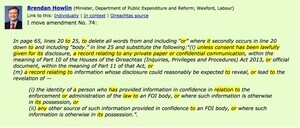
More importantly though, who introduced this significant extra protection for politicians (already benefitting from an incredibly opaque and non-transparent expenses system) when the FOI Act was being drafted?

Answer:
howlin

Read the decision in full here

New FOI Act added “significant protection” from scrutiny for expense claims by TDs and Senators (No Expenses Spared)

Freedom of Information Act 2014

Thanks Kildarestreet.com

Screen Shot 2015-11-24 at 11.38.35

Screen Shot 2015-11-24 at 11.39.10

Documents obtained by journalist Ken Foxe following a Freedom of Information request

Five Oireachtas politicians went to Hanoi, Vietnam in March of this year for a meeting of the Inter-Parliamentary Union Assembly which meets twice a year.

They were Fine Gael Cathaoirleach of the Seanad Paddy Burke, Fine Gael TD Michelle Mulherin, Labour TD John Lyons, Fine Gael TD Noel Harrington and Fianna Fáil’s Barry Cowen.

The total cost of the trip amounted to €23,295.80.

Last night, journalist Ken Foxe – who broke the story in yesterday’s Irish Daily Mail following an FOI request – spoke to Mary Wilson on RTÉ’s Drivetime about the trip.

He explained that the trip cost more than expected, saying:

“There seems to have been a problem with the original flights that had been booked, via London, whereby the Vietnamese government came back to the Oireachtas and basically said that they were block-booking certain flights. So some of the travel arrangements had to be changed at the last minute and a couple of people had to travel out a day earlier. So there was additional costs associated with the flights and then there was extra nights at a hotel. But, in general, the costs were extremely high for this sort of trip, certainly when compared to the last four or five years when costs had generally been kept to a minimum.”

He explained that Deputy Mulherin’s flight – at almost €3,000 – was more expensive than her colleagues as she had to change her business class flight at short notice and return to Dublin for parliamentary business.

All of the politicians stayed in the five-star Lotte Hanoi Hotel.

Speaking about the hotel, Mr Foxe reported:

“It’s in the upper floors of a 65-storey skyscraper in Hanoi. It promises a new standard of international five-star hotel. The standard rooms there offer luxurious marble bathrooms, Hungarian goose feather bedding, menus of pillows and, apparently, a touch of Vietnamese sophistication.”

While every politician on the trip is entitled to claim for substance expenses, only Labour’s John Lyons has done so, so far.

His claim was for €856.69.

TDs and Senators travelling abroad are entitled to claim a daily “conference rate” which is set by Department of Foreign Affairs – with different rates set for different cities visited.

The politicians can also receive a top-up for certain types of trips – a system which was first set up in the 1950s and one which the Department of Public Expenditure and Reform has refused to reform, despite requests to do so from the Comptroller and Auditor General.

Listen back to Drivetime in full here

Thanks Ken Foxe