



Minister for Housing Simon Coveney speaking to Seán O’Rourke this morning
This morning.
On the Today with Seán O’Rourke show.
Fine Gael’s Simon Coveney said he needed five members of the parliamentary party, who’ve already declared for Leo Varadkar, to switch their allegiance to him – in order for him to win the Fine Gael leadership contest tomorrow.
Mr Coveney also spoke of “hard-left” parties and “a dependency culture”, saying:
“I’m about representing people who don’t vote for Fine Gael, people who have felt excluded from economic recovery, people who need the State’s intervention today, whether it’s a housing or healthcare or education or whatever, they are the people, in my view, who in the future will see Fine Gael, as a party that’s there to help them.
“And by the way, this isn’t some kind of left-wing agenda. Many of the hard-left parties in Ireland advocate for a dependency culture, where people demand on their rights for free, high levels of social welfare and so on.
“What I’m about it actually helping people to contribute in a positive way to society and the economy and if people can’t get up in the morning to go to work, or they’re not motivated to do that or they come from a jobless household, Fine Gael needs to be the party that’s asking the question: why is that?”
Sound familiar?

Minister for Social Protection Leo Varadkar on RTÉ Six One on May 22
Readers may recall an interview Fine Gael’s Minister for Social Protection Leo Varadkar recently did on RTE’s Six One, in which he said:
“Well, I suppose, they’re people who do exist in Ireland, unfortunately, there is a degree of an entitlement culture. It mightn’t be many people but there are people who believe and, you know, they’re very often supporters of the far left, that believe that everything should be free. And that, you know, somehow, Apple or bondholders or somebody else should pay for it, or billionaires who don’t live in this country. And I don’t accept that culture.
“I think, I come from a very different political point of view. I think everyone who can should pay into the system and by paying into the system, we can all have a better society.”
“Yeah, they’re [a] pretty small [group] but they’re loud and they’re growing and the kind of politics they preach is the idea that we should have, you know, free education, free healthcare, free housing, free everything but you shouldn’t have to contribute to it at all. Somehow that, you know, billionaires living overseas or American corporations, that make their profits elsewhere, are going to pay for everything. I think that’s dishonest.”
Meanwhile…
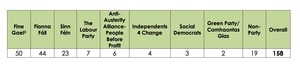
Readers may recall the 2016 general election results (above).
It saw Fine Gael win 50 seats – 26 seats fewer than it won in 2011.
It followed the party losing 105 seats in the local elections of 2014.
Following the results of the 2016 election, Fintan O’Toole wrote in The Irish Times:
If much of the political establishment is shaking its head in disbelief, at least it knows how the Irish public has felt for much of the last decade. Citizens have been told a story by the last two governments and by much of the media: Attacks on the most vulnerable were both necessary and salutary. Austerity works. The troika programme was like chemotherapy – unpleasant and at times sickening, but effective medicine. Putting tens of billions into dead banks was a good idea. The systems that failed so catastrophically have been reformed. And everything is getting inexorably better.
This was not just an Irish story – it was a European narrative: Ireland vindicated the tough love of the dominant centre-right ideology and made its disastrous response to the euro crisis look a lot better. Ireland is the anti-Greece. If only everyone had been as good as the Irish, Europe would be fine.
What voters said on Friday is in some ways highly complex but in relation to this dominant narrative, it is very simple: we don’t believe you. Over the past five years, most citizens have watched the little drama that has been scripted for them – a morality play of sin, punishment and redemption – with feelings ranging from mild scepticism to passive disgust to furious outrage.
…Indeed, there has never been popular consent to the combination of harsh austerity for the little people and astonishing generosity to bondholders. It was emphatically rejected in 2011 and at the local elections in 2014.
The strange thing is that the Government, for all its well-paid handlers, never grasped this essential fact. It was so convinced of its own heroic virtue that it simply could not believe that anyone beyond the ranks of the malcontents and the whingers could fail to share its enormously high opinion of itself.
The winner of Election 2016 is social democracy (Fintan O’Toole, February 29, The Irish Times)
Listen back to Simon Coveney’s interview here and watch Leo Varadkar’s interview here