



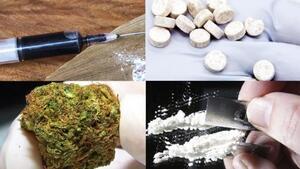

From top: banned substances: Dr Julien Mercille
Updating legislation on illegal drugs could minimise the health risks involved in taking them.
Prohibition makes everything worse.
Dr Julien Mercille writes
Have you heard of the drug 2C1? It’s the drug that killed Alex Ryan this weekend and turned five others into “zombies”, in the never-sensationalist language of the Irish Independent. The drugs were used at a party in Cork.
Also this weekend, we were reminded of the death two years ago of Olivia Beirne, 29-years old, after taking ecstasy. The Independent reported that her father, a retired garda, still believed that his daughter was responsible for taking those dangerous substances, just like all other young and less young who use drugs.
I know something about drugs, not so much out of intensive consumption but more because it’s one of my academic topics (I wrote a book about it).
The first thing you realise when you start reading about the problem of drugs and its solutions is that it’s all very simple.
The overarching point is that the current system of prohibition does not work. (Prohibition is simply when drugs are illegal, and you get arrested for consuming, selling or producing drugs).
What does work is a system that decriminalises or legalises drugs. There are many variations, but simply put, it makes it legal to possess, consume, sell and produce small quantities of drugs.
For example, you could legalise only the possession of up to 1 ounce of weed (marijuana), and allow individuals to grow, say, a maximum of up to six plants at home, in addition to having legal stores where weed can be bought, which would all be tightly regulated.
You can also ban smoking in public spaces, etc. This is what they did recently in Colorado and Washington state in the US. There’s a summary here of the measures by the Drug Policy Alliance, which is an excellent organisation on such matters.
For those who worry that legalisation would lead to a massive growth of drug use, and lots of people being stoned on the job, while driving, or all the time, the experience from places that have liberalised their drug laws (for example, Portugal) show that there may be small increases of consumption of some drugs (e.g., marijuana), but overall it’s absolutely not true that there is a massive rise in consumption. There’s an excellent report on Portugal’s experience here.
Also, big traffickers and producers would still remain illegal, and there wouldn’t be any advertising, and you could only buy drugs in specific stores. So there wouldn’t be packs of weed or heroin on sale on the shelves at Tesco or Spar.
What are the advantages of legalising drugs in such a way? (the following is not specific to Ireland, they’re general conclusions drawn from the experiences of many countries)
1. It saves the State a lot of money because the police don’t have to run around the country arresting students smoking pot or heroin addicts who are homeless and simply have an addiction problem.
2. It generates taxes for the State because drugs is now a legal business, just like tobacco and alcohol. It doesn’t mean we think that drugs are healthy products, it just means that the industry becomes tightly regulated. It thereby generates tax revenues for the exchequer, which can be invested in treatment for addicts.
3. Violent crime decreases. When drugs are illegal, they generate violence. For instance, if two gangs want to divide a neighbourhood to sell drugs and they don’t agree about which street corners belongs to which gang, they’re not going to go see the police or a judge to arbitrate, because they’ll all be thrown in jail! However, if drugs are legal and sold in specific stores, then the problem is solved: the gangs automatically go bankrupt and out of business.4. Quality is much better: under a regulated system, the State can regulate the quality of the drugs, as it does for all foods and alcohol. That gets right to the heart of this weekend’s tragic death. It would not have happened if the stuff had been of good quality.
5. Drug problems become public health issues, not criminal issues. This means that addicts are treated for their addiction instead of getting harassed by the police and arrested. It is proven that treatment of addiction (through clinics, therapy, etc.) is far superior to police operations to reduce drug consumption. In fact, police operation are often useless. You can catch a big trafficker and make it to the front-page of the Indo, but right away another new trafficker will replace the one who’s been arrested.
Finally, none of the above means that drugs are not dangerous. They are dangerous substances, by which I mean that if not used carefully, they can lead to very bad outcomes.
To make them legal simply minimises the risks involved. Prohibition, on the contrary, makes just about everything worse, and that’s why accidents and violence happen.
Julien Mercille is a lecturer at University College Dublin. Follow him on Twitter: @JulienMercille