
Tag Archives: Pleiades

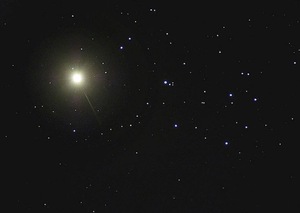
Behold: Mars. Right there – wandering along through the constellation Taurus, close (in the sky) to the Seven Sisters or Pleiades star cluster. To wit:

In fact, this deep, widefield view of the region captures Mars near its closest conjunction to the Pleiades on March 3. Below centre, Mars is the bright yellowish celestial beacon only about 3 degrees from the pretty blue star cluster. Competing with Mars in colour and brightness, Aldebaran is the alpha star of Taurus. The red giant star is toward the lower left edge of the frame, a foreground star along the line-of-sight to the more distant Hyades star cluster. Otherwise too faint for your eye to see, the dark, dusty nebulae lie along the edge of the massive Perseus molecular cloud, with the striking reddish glow of NGC 1499, the California Nebula, at the upper right.

(Image: Petr Horalek / Institute of Physics in Opava)

apod

One shot containing three very famous, very different celestial objects captured last month over Turkey. To wit:

On the upper left is the bright blue Pleiades, perhaps the most famous cluster of stars on the night sky. The Pleiades (M45) is about 450 light years away and easily found a few degrees from Orion. On the upper right is the expansive Andromeda Galaxy, perhaps the most famous galaxy — external to our own — on the night sky. Andromeda (M31) is one of few objects visible to the unaided eye where you can see light that is millions of years old. In the middle is bright red Mars, perhaps the most famous planet on the night sky. [On Tuesday] Mars [was] at opposition, meaning that [was] is opposite the Sun, with the result that it [was] visible all night long. In the foreground is an ancient tomb in the Phygrian Valley in Turkey. The tomb, featuring two stone lions, is an impressive remnant of a powerful civilization that lived thousands of years ago. Mars, currently [just past] its brightest, can be easily found toward the east just after sunset.

(Image: Cem Özkeser)

apod

Behold: an especially clear and pleasing image of the Pleiades, perhaps the most famous star cluster in the sky. To wit:

 …the bright stars of the Pleiades can be seen without binoculars from even the depths of a light-polluted city. With a long exposure from a dark location, though, the dust cloud surrounding the Pleiades star cluster becomes very evident. The featured exposure covers a sky area several times the size of the full moon. Also known as the Seven Sisters and M45, the Pleiades lies about 400 light years away toward the constellation of the Bull (Taurus). A common legend with a modern twist is that one of the brighter stars faded since the cluster was named, leaving only six of the sister stars visible to the unaided eye. The actual number of Pleiades stars visible, however, may be more or less than seven, depending on the darkness of the surrounding sky and the clarity of the observer’s eyesight.

(Image: Raul Villaverde Fraile)

Another view?

apod

That especially bright star in the evening sky of late is actually the planet Venus. This evening, it will begin to cross the beautiful Pleiades or Seven Sisters star cluster. To wit:

This digital sky map illustrates the path of the inner planet as the beautiful conjunction evolves, showing its position on the sky over the next few days. The field of view shown is appropriate for binocular equipped skygazers but the star cluster and planet are easily seen with the naked-eye. As views from Earth (top pic, 2004), Venus again passed in front of the Seven Sisters (pic 2) 8 years ago, and will again 8 years hence. In fact, orbiting the Sun 13 Venus years are almost equal to 8 years on planet Earth. So we can expect our sister planet to visit nearly the same place in our sky every 8 years.

(Image: David Cortner, Digital image: Fred Espenak (Bifrost Astronomical Observatory)

apod

Behold: the Pleiades and Hyades star clusters – proof that the longer you stare at the sky, the more insanely detailed it becomes. To wit:

 Long duration camera exposures reveal an intricate network of interwoven interstellar dust and gas that was previously invisible not only to the eye but to lower exposure images. In the featured wide and deep mosaic, the dust stands out spectacularly, with the familiar Pleaides star cluster visible as the blue patch near the top of the image. Blue is the color of the Pleiades’ most massive stars, whose distinctive light reflects from nearby fine dust. On the upper left is the Hyades star cluster surrounding the bright, orange, foreground-star Aldebaran. Red glowing emission nebula highlight the bottom of the image, including the curving vertical red ribbon known as the Eridanus Loop. The pervasive dust clouds appear typically in light brown and are dotted with unrelated stars.

(image: Hirofumi Okubo)

apod

Behold: M45 – the lovely reflection nebulae of the Pleiades star cluster, 400 light years away. To wit:

It lies in the night sky toward the constellation Taurus and the Orion Arm of our Milky Way Galaxy. The sister stars and cosmic dust cloud are not related though, they just happen to be passing through the same region of space. Known since antiquity as a compact grouping of stars, Galileo first sketched the star cluster viewed through his telescope with stars too faint to be seen by eye. Charles Messier recorded the position of the cluster as the 45th entry in his famous catalog of things which are not comets. In Greek myth, the Pleiades were seven daughters of the astronomical Titan Atlas and sea-nymph Pleione. Their parents names are included in the cluster’s nine brightest stars. This deep and wide telescopic image spans over 20 light-years across the Pleides star cluster.

(Image: Adam Block, Steward Observatory, University of Arizona)

apod