

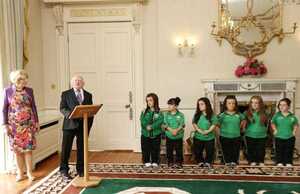
 President Michael D. Higgins and his wife Sabina receiving the Dwarf Sports Association of Ireland Team at Áras an Uachtaráin, who will be competing at the 2013 World Dwarf Games in Michigan.
(Laura Hutton/Photocall Ireland)



President Michael D. Higgins and his wife Sabina receiving the Dwarf Sports Association of Ireland Team at Áras an Uachtaráin, who will be competing at the 2013 World Dwarf Games in Michigan.
(Laura Hutton/Photocall Ireland)
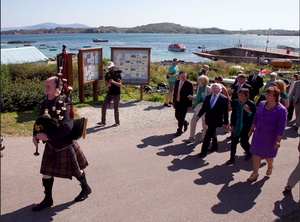
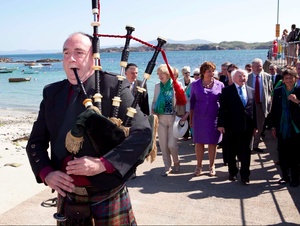
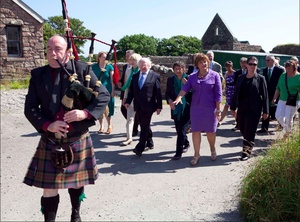 President Higgins and Sabina Higgins on the Isle of Iona, “the home of Irish monasticism” in the Inner Hebrides during Squee’s official visit to Scotland at the weekend.
Pic: Fennells
 President Higgins with the cast of the The Night Alive, Conor McPherson’s new-ish play at the Donmar Warehouse during a visit to London, yesterday.
From left: Michael McElhatton, Ciarán Hinds, Squee, Jim Norton, Caoilfhionn Dunne and, observing the Gleeson equity rule, Brian Gleeson,
Pic: Aras

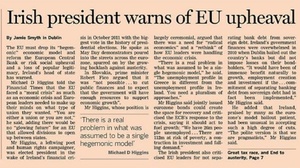 President Higgins in today’s Financial Times.
He’s dignifying the office again.
Mr Higgins, whose position is largely ceremonial, argued that there was a need for “radical economics” and a “radical rethink” of how EU leaders were handling the economic crisis.
“There is a real problem in what was assumed to be a single hegemonic model,” he said. “The unemployment profile in Greece is different from the unemployment profile in Ireland. You need a pluralism of approaches.”
Mr Higgins said jointly issued eurozone bonds could create the space needed for economic recovery and criticised the ECB’s response to the crisis, saying it should act to fuel growth: “We have 26m people unemployed . . . are 112m at risk of poverty, a contraction in investment and falling demand.”
The Irish president criticised EU leaders for not separating bank debt from sovereign debt. Ireland’s government finances were overwhelmed in 2010 when Dublin bailed out the country’s banks but did not impose losses on their bondholders. “It would have been of immense benefit naturally to growth, employment creation and investment if the . . . commitment of separating banking debt from sovereign debt had in fact been implemented,” Mr Higgins said. “It would give you the opportunity to breathe and create growth in the economy.”
Mr Higgins added that Ireland, praised by many as the eurozone’s model bailout patient, had been unusual in accepting such a high degree of cuts when compared to other states in the currency bloc. “The polite version is that we are pragmatists,” he said. “What we really need now is something that goes beyond outrage and recrimination.”
Gwan the Squee.

President Michael D Higgins addressing the EU Parliament in Strasbourg today.
They’re calling it Squee’s Ode to Freedom.
The logistical strand of economics which today holds sway and stands as a hegemonic model of economic theory, not only in Europe, is the flaw of our times. This strand of neoclassical economics is of course useful for limited and defined tasks. It is insufficient however as an approach for our problems and our future. We need new substantive pluralist political economic models and an emancipatory discourse to deliver them, and I suggest that this is possible.
The role of public intellectuals is also an urgent one. They are called upon, I suggest, to state publicly and unequivocally that the problems of Europe are not simply technical, and certainly not solely amenable to solution by technocratic measures at the expense of democratic accountability. The suggestion that citizens and their representatives are not fiscally or economically literate enough to carry the decision making necessary for policies that impinge on their lives – be it unemployment, housing, health, education or the environment – has the most serious implications in legitimacy terms. It is an assumption that challenges democracy itself.
-…If we were, as an alternative, to regard our people merely as dependent variables to the opinions of rating agencies, agencies unaccountable to any demos, and indeed found to be fallible on occasion, then instead of being citizens we would be reduced to the status of mere consumers; pawns in a speculative chess board of fiscal moves in a game derived from assumptions that are weak, untestable or more frequently undeclared.
Full credit (rating) though, in fairness.
Full speech here.
(Michel Christian/Photocall Ireland)
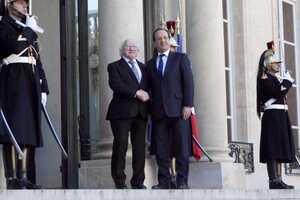
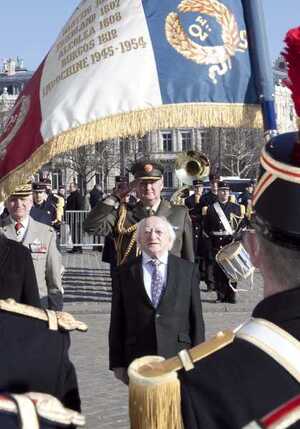
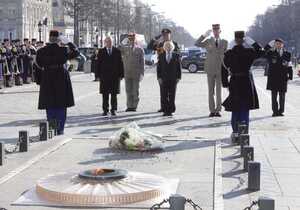
President Higgins, in Paris with from top: French President François Hollande, and with Irish generals at a wreath laying ceremony at the Arc de Triomphe .
Extracts From a speech President Higgins gave at the Sorbonne last night.
James Joyce’s manifesto to ‘Hibernicize Europe and Europeanise Ireland’ – was, we must remember, anticipated many centuries earlier by, for example, Columbanus and Gallus who brought precious scriptures and treatises from Bangor through France in the early 7th Century; John Scotus Eriugena who brought Greek back into Europe after the dark ages; travelling all the way to the French King in the 9th Century to translate the Pseudo-Dionysius from Greek into Latin, Peter of Ireland who taught Acquinas philosophy, and later Berkeley the ‘Irish Cartesian’ who engaged with French thinkers like Malebranche in the 18th Century – and since I am advocating a rethinking of economics – the Franco-Hibernian thinker Richard Cantillon, born in Kerry in 1680 whose essay ‘L’Essai sur la nature du commerce en general’ in 1730 was described by William Stanley Jevons as constituting ‘the cradle of political economy’ and which influenced Adam Smith and Karl Marx…
...I feel, now more than ever, at a time of economic crisis and loss of trust in institutions and decision-makers, that if Europe is to have a discourse informed with all the energy, concern and creativity that the times demand then surely, the lives, the conversations, the anguish, the hopes, the beliefs, and the commitment of those of previous centuries who believed, in their day, and in response to the circumstances of their times that not only was a world with the stamp of humanity necessary, but that it was possible, are relevant to us as examples of the moral courage we need in facing the contradictions of our times.
Fair play though in fairness.
Full text here
(Aras/Photocall Ireland)
Don’t raise your hand to Squee.
Etc.
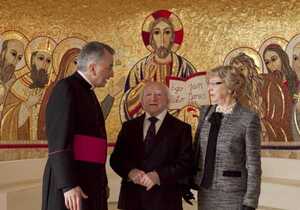
President Higgins and Sabina in the Pontifical Irish College, Rome, with Monsignor Ciaran O’Carroll, the college’s Rector, this afternoon.
(Aras/Photocall Ireland)

She’s Squee’s squeeze.
Graffiti in the ladies of the No name bar, Fade Street, Dublin, last night.
 “To redevelop the website of the Office of the President of Ireland to claerly communicate thge values and goals of the presidenty of POresident Michael D. Higgons”
Right so.
Previously: How Much?
Thanks Mr Slepp Chckr
