McDowell, eh…
The new issue of Village magazine, on shelves now.
They won’t be muzzled.
Nuzzled yes.
Muzzled no.



McDowell, eh…
The new issue of Village magazine, on shelves now.
They won’t be muzzled.
Nuzzled yes.
Muzzled no.
 The Law Society.
It’s a big club.
And you’re not in it.
Via Village:
“Self-regulation hasn’t worked and it is vital the vulnerable Legal Services Regulation Bill is enacted in full. The Law Society has sometimes operated hidden agendas, misled courts and given the appearance of insiderism…”
FIGHT!
On sale tomorrow.

 [Irish Times office (top) and Village magazine cover and (below] tweets from ‘Thomas59’]
“The ‘homophobe’ deluge might have been bearable if the Irish Times had behaved with a scintilla of integrity during it. Instead, it seemed to join gleefully in the witch-hunt, publishing a series of outrageously one- side articles directed at me or the Iona Institute, sometimes carrying splenetic or sarcastic asides in articles which had nothing to do with the controversy.
There were also frequent attacks on me by Irish Times ‘colleagues’ on Twitter, most notably the Consumer Affairs Editor Conor Pope, who had been tweeting in a derisive fashion about me, which I believe to be in direct contravention of the Irish Times social media policy. Following an intervention on my behalf, the Deputy Editor Denis Staunton instructed Pope to remove these tweets, which he did. On February 7th, a review of a movie by the paper’s film critic Donald Clarke included the following sentence: “Given recent, unhappy developments in domestic discourse, there could hardly be a better time for a film about a homophobic jerk – partly fictionalised and entirely dead, so he can’t sue”.
Nothing was done to discourage or inhibit the attacks. This was the newspaper for which I’d worked for 24 years. These people knew me and knew how far off the mark the depiction of me as a homophobe was. Everyone sat there enjoying the spectacle of me being savaged.
On February 4th, in the wake of Fintan O’Toole’s utterly cowardly and disgraceful attack, I resigned as a columnist with the Irish Times by sending an email to Denis Staunton at midnight. Staunton was my sole point-of-contact in the newspaper, the editor having all but ignored me since his appointment in 2011.
Following a discussion between Denis Staunton and Kevin Brophy, I agreed to put my resignation “on ice” and continue with a five-week leave period I’d negotiated to work on two books I was writing.
I believe I would have eventually withdrawn my resignation, as Denis Staunton indicated he wanted me to do, had it not been for what happened next.
Perhaps the most sinister development over the course of the entire saga was the unearthing of the phantom tweeter, Thomas59….


My internet sleuths followed Thomas59’s tweets back to the point when he initiated his Twitter account. There they found that, either carelessly or naively, he had given away his true identity in several ways, including by supplying his work email address for someone he was requesting to contact him. He had also neglected to disable the GPS facility on his mobile device, which meant that, every time he tweeted, he revealed his precise location – sometimes his flat in southside Dublin, sometimes his local public house, and some- times the offices of the Irish Times on Tara Street, Dublin. Thomas59 was revealed in all his glory as a longtime senior correspondent with the Irish Times [Irish Times Religious Affairs correspondent Patsy McGarry, whom the author had regarded as a friend]….
….It is clear to me that such attacks were provoked out of the deeply noxious atmosphere of antagonism which had been allowed to fester towards me for many years inside the Irish Times growing exponentially worse in the years since Kevin O’Sullivan became Editor.
His craven paralysis on this entire issue, and in particular his failure to enforce the company’s own alleged policies and social media guidelines, if only to protect the credibility of his newspaper, must call into question his stature and even his continuing tenure as Editor.”
An extract from an article by John Waters in Village magazine, out now.
Previously: I’m A Patsy
UPDATE:
Phoenix says the phrase ‘corporate bullying’ has started appearing in correspondence between John Waters’ solicitor and the Irish Times.
— Oireachtas Retort (@Oireachtas_RX) April 11, 2014
“I have now resigned from the Irish Times with many regrets, but nevertheless certain of the importance of protesting at the present drift of the newspaper towards an ideological orthodoxy that threatens its role as an esteemed journal of record and a bulwark of Irish democracy.
Over the years I’ve been involved in many intense debates in Irish life. That’s part of my job as a commentator. But, apart from the particular unpleasantness of the “homophobia” frenzy, there was also the fact that, this time, uniquely in my career, I was being targeted for things other people were saying I had said rather than anything actually said or written by me. And the nature of the frenzy – in social media, on blogging websites like broadsheet.ie, politics.ie and thejournal.ie, and most shockingly of all throughout the mainstream media – was such as to conceal this ungainsayable fact from the general public.
Anyone with the slightest concern for the health of Irish democracy must regard the deluge of hatred more or less stoked by the ‘national broadcaster’ and the Irish Times, and agitated in the lawless world of social media into a tsunami of bullying, with the utmost dismay.
By far the most worrying aspect, however, is that, unless urgent action is taken by those with the power to take it, there may soon be no audible voice left to raise itself against the corrupted clamour of the unrecognised, unaccountable fifth column now directing every twitch and nuance of our public life.
What is at issue is not, as some propose, the validity of any particular argument, but the capacity of the collective conversation much longer to accommodate.”
John Waters writing in Village magazine.
And there’s more.
In a seven-page article he takes on his critics, names names, defends his own, divulges unpleasantness at his former place of work and dramatically unmasks an unlikely ‘anonymous’ social media tormentor.
More as we are allowed get it.
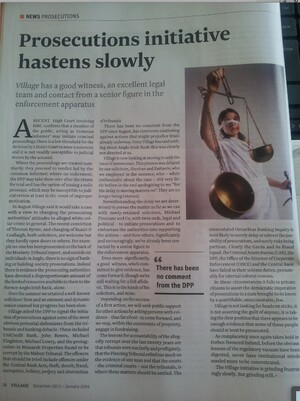
[From the current issue of Village magazine]
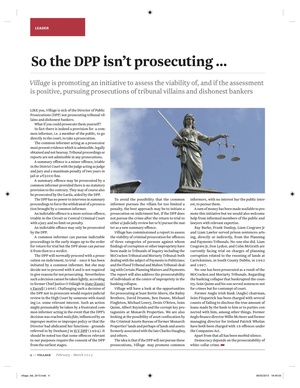
Village magazine’s struggle for accountability in a world gone unnaccountable continues at a somewhat frustrating pace.
We asked Legal Coffee Drinker what it’s all about.
Broadsheet: “Legal Coffee Drinker, what’s it all about?”
Legal Coffee Drinker: “The right of private prosecution is a common law right which traditionally gave a private individual the right to initiate a criminal prosecution and continue that prosecution up to a certain stage in the criminal process, at which point the Director of Public Prosecutions (DPP for short) could decide whether or not to continue.”
Broadsheet: “Up to what stage, exactly?”
LCD: “Well, traditionally, indictable offences (offences capable of being tried by jury, which are really the only ones anyone is interested in for the purposes of white-collar prosecution) were subject to an initial preliminary examination in the District Court for the purpose of deciding whether or not there was an adequate case to return for trial. The private prosecutor got to continue the prosecution up to the very end of the preliminary examination process – giving them the chance to put evidence forward as part of this preliminary examination which might pressure the DPP into continuing with the prosecution.”
As stated by the Supreme Court (O’Dalaigh CJ) in State (Ennis) v Farrell [1966] “[a] private prosecutor who had adduced sufficient evidence to effect a return for trial might, as a general rule, rest assured that the Attorney General would thereafter carry the case to trial before judge and jury”.
Broadsheet: “So what happened if the DPP didn’t agree that the case should proceed? Could the judge send it through nonetheless?”
LCD: “No. However the private prosecutor could, in such circumstances, apply to the High Court to compel the DPP to move the case forward, by way of an application for judicial review of the DPP’s decision. To succeed it would have to be shown that one or more of the grounds for judicial review was present: that the DPP was acting unreasonably (the standard of proof here is very high), had ignored relevant considerations or had taken into account irrelevant considerations; had failed to act in accordance with fair procedures, with the evidence adduced at preliminary examination being put before the court as part of this review.”
Broadsheet: “And is this still the case?”
LCD: “No. The difficulty currently faced by private prosecutions is that the preliminary examination procedure in the case of indictable offences has been abolished by the Criminal Justice Act 1999. In Kelly v Ryan [2013], the case involving a private prosecution of IRBC officials referred to in the Village article, it was argued that this removed the right of private prosecution in the case of indictable offences, by effectively rendering such right redundant – the private prosecutor no longer had the opportunity in preliminary examination to put evidence before the court which could either pressure the DPP into continuing with the prosecution or show her decision not to prosecute was unreasonable or based on an irrelevancy.”
Broadsheet: “And did this argument succeed?”
LCD: “No. The High Court judge hearing the case, Judge Hogan, took the view that the right of private prosecution survived the coming into effect of the 1999 Act – at least in theory. He pointed out that the Supreme Court in Ennis had held that the right could only be abolished by clear language and there is no express statement in the 1999 Act regarding its abolition. Accordingly it must be taken to still subsist.”
Broadsheet: “Wonderful. Full steam ahead for private prosecutions then?”
LCD: “Not that simple [Drains coffee] Judge Hogan’s judgment – which is under appeal to the Supreme Court – accepts that the right of private prosecution still exists in theory. However in practice its significance has been reduced by the 1999 Act. The abolition of the preliminary examination procedure reduces the ability of the private prosecutor to put forward a case strong enough to publicly pressure the DPP into continuing with the case and/or make her decision not to do so judicially reviewable.”
“Judge Hogan’s decision confirms that there remains a right of private prosecution in respect of indictable offences. What still has to be determined is the value of that right in the absence of a preliminary examination process. We’re unlikely to find this out for some time since the effect of the pending Supreme Court appeal against Kelly Vs Ryan is to effectively put all private prosecutions on hold for the time being. As mentioned in a previous post, Supreme Court appeals are currently taking some time to be heard. [Drains coffee].”
Broadsheet: “It sounds like another case of ‘justice delayed is justice denied’ as the old saying has it?”
LCD: “Are we done?”
Broadsheet: “We are. Thank you Legal Coffee Drinker. Happy new year from all of us at Broadsheet.”
LCD: “Right bye.
Previously: Village Vs State
 FIGHT!
With EVERYONE!
Yay!
*popcorn*
The already-controversial April/May issue of Village magazine, out today.
 Blimey.
The cover of the latest issue of Village magazine, on sale now.
Contemplative articles in a would gone brief ‘n’ snarky.
Also includes:
Gulp.

The latest issue, on newsstands now.
Long articles in a world gone brief.
 Seriousness. In a world gone silly.
Village magazine. Out today.