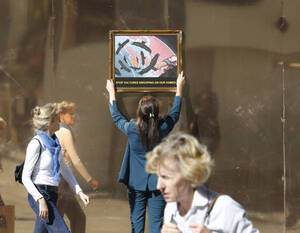




John Comer, president of the Irish Creamery Milk Suppliers Association (ICMSA)
This morning.
On Today with Sean O’Rourke
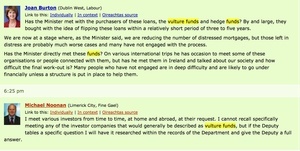
The show looked at farmers’ distressed loans being sold to vulture funds. Contributors to the discussion included solicitor John Murphy, of John A Sinnott &Co Solicitors in Enniscorthy, Co Wexford, and president of the Irish Creamery Milk Suppliers’ Association (ICMSA) John Comer.
From their discussion:
John Murphy: “I saw somebody, as recently as yesterday, getting a letter from a mainstream bank saying his loan had been sold to a vulture fund. If you read the bottom of the page, it says ‘and will be managed by’ a different firm involved. So, you know, you’ve gone from a bank to a vulture fund but you can’t contact the bank, you can’t contact the vulture fund. There is a management organisation in charge of it who are based in a warehouse, where you just can’t really call in.
“And the difficulty, I think, about a lot of places, is trying to get a name, try to get a face that you can talk to. Try and do a deal. Let me give you a quick example.
“A vulture fund buys a mainstream debt, approximately six months ago. Within, there was information freely available that the debt was bought for 25% of its value. Within three months, the farmer concerned offered that vulture fund, its managing receiver, offered him 100% profit on the debt. Now, 100% profit in three months, by my reckoning is 400% per annum. And it was refused.”
Sean O’Rourke: “On what grounds?”
Murphy: Because the receiver took the view that the asset was worth more than the offer because his client had bought the loan, and the loan was in arrears, he was entitled to the whole asset. And I had a conversation, we had a polite conversation, and I asked how the receiver proposed to realise this farm which is in rural Ireland obviously. And, you know, who was going to buy it?”
“And really, I got absolutely nowhere. The attitude was, ‘ah, I heard all these arrangements about rural Ireland before, we’ll see where we go’. Now that’s the best part of a year ago. And nothing really has happened since.”
O’Rourke: “And what’s been happening on the farm, John?”
Murphy: “Oh the farmers are farming away.”
O’Rourke: “Are they repaying any money to anybody?”
Murphy: “They’re doing their best to make some repayments, yes. But, you have to wonder why was that offer refused? Were the, there must be investors behind every vulture fund. And you wonder, were they told that they were in line for a 100% profit within three months. Because anybody I know, in business, over the years, if they were getting 100% profit at three months, there’s only one thing they’d do, they’d take it and run, and get out.”
O’Rourke: “On the other hand, the vulture fund, or the person you were dealing with, may believe that there’s a better offer if they just sit tight for a little longer.”
Murphy: “Well you’d wonder about that because the offer was very well presented. There was an accountant, a very experienced accountant involved, it wasn’t just a kind of stab in the dark, you know, ‘we’ll get a quick deal from the vulture fund’. It wasn’t that kind of situation at all, Sean. This was carefully put together and a realistic, maximum, serviceable borrowing for this particular farmer was put forward and it was demonstrated, you know, on past figures, how he could. And he’d sourced another mainstream bank, by the way, to come up with the money. It wasn’t accepted. Now you have to wonder, did it have anything to do with the continuation of the case? Which obviously would bring the receiver in much better fees than if he cleaned it out fairly quickly.”
Later
John Comer: “There is a lot of stress and anxiety out there in terms of, by the fact that we’re dealing with an unknown entity. There has been a lot of representations made to our office in Limerick, looking for advice on how to proceed. Obviously, the individuals involved were in a distressed situation anyway. But this has, as they say, added insult to injury. People, you know who had two or three generations of farming dealing with a bank, now find themselves in a situation where they don’t know actually who they owe the money to. They have no point of contact and they fail to understand why a bank would sell off these loans at 30, 40, we’re hearing different percentages of the value when, perhaps there was other options that could have been explored.
“We feel that I don’t think there was enough done overall to get loans that were, probably under performing, restructured and given to business people an opportunity to restructure their loans and essentially pay back the debt.”
“…we have met with all the pillar banks, you know, with an overall policy that we do not want to see a repeat of ugly scenes of farms and family farms, I stress, being sold in this manner. Because we believe, in most cases, there can be a resolution found if there was more engagement and if there was more recognition of the reality of the situation. Because, I can assure you, if vulture funds start selling off family farms in rural Ireland over the course of the next year or two, there certainly will be, you know, ugly scenes manifesting themselves because it’s ingrained in all of Irish citizens, I think, the repulsion of people being thrown out of their business and their home and there actual farm because of a history and I think people would be making a mistake if they felt there was going to be no resistance in that area.”
Listen back in full here