



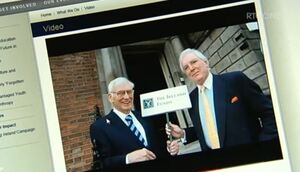

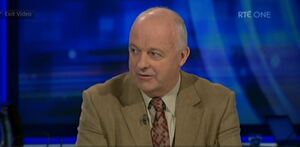


(From top: Members of the American Ireland Fund, the new O’Brien Centre for Science in UCD, Niall Crowley and Seamus Mulcrony and last night’s Prime Time panel in full)
In light of the CRC controversy and the launch of the One Percent Difference Campaign – with the goal of increasing the level of private investment in public good from about €500million to €800million by 2016 – Prime Time looked at the campaign itself and the idea of philanthropy in Ireland last night.
The One Percent Difference Campaign is pushing to allow for tax exiles to live more days a year in Ireland than they are currently allowed if they give to charity.
During the broadcast, audiences saw images referencing the American Ireland Fund and shots of the new O’Brien Centre Of Science in UCD, named after Denis O’Brien.
On the panel with presenter David McCullagh were Noel Smyth, philanthropist and businessman, Seamus Mulcrony, of Philathropy Ireland, Suzy Byrne, disability rights campaigner and Niall Crowley, former CEO of Equality Authority and now independent equality consultant.
David McCullagh: “Niall Crowley to you first, what’s wrong with philanthropy, what’s wrong with giving 1%?”
Niall Crowley: “Well I think philanthropy, per se, is fine but I think the issue that we have here is the model of philanthropy and how philanthropy is developing in Ireland. And it’s developing, I think, in very disturbing directions. It’s developing in directions where it’s effectively enabling a retreat by the State from publicaly-funded services. It’s turning community and voluntary sector organisations into small businesses. It’s, ultimately, I think, promoting forms of tax avoidance with these latest proposals and I think you can see that linked to the One Percent Campaign which has a very strong anti-tax message, which is funded by the Department of the Environment, the very same department that has disproportionately cut back by 35% community and voluntary sector endeavour, trying to replace that by this One Percent Giving Campaign, it’s absolutely cynical. And, the final problem with it is, this direction that it’s going in. If you look at the beneficiaries of the One Percent Campaign, it’s people like women’s refuges, youth services, services to people with disabilities. And we’re turning issues of human dignity, women’s safety, participation by people with disabilities in society, participation by young people into forms of charity that depend on the whims of rich people. That’s not acceptable.”
McCullagh: “Seamus?”
Seamus Mulcrony: “I think I’m astonished by Niall’s take on the campaign. Firstly, the One Percent Difference Campaign is part of the overall Forum on Philanthropy and Fundraising to raise an additional investment into good causes, from an estimated €500million now to, we hope, about €800million. The Irish people like to think that we are one of the most generous in the world and ordinary Irish people are indeed very generous. However, there’s strong evidence that corporate Ireland isn’t as generous as it could be and there’s very strong evidence that philanthropy in Ireland, trusts and foundations are very underdeveloped. If you look at a country like the Netherlands, which would have a similar population…In Philanthropy Ireland, I have 25 members. They will invest every year between 60 and 70 million [euro]. In the Netherlands, they have 320 members and they invest 210 million. And if you look at Finland they have 110 members and they invest 290 million. So we have a philanthropic sector that’s underdeveloped. We have businesses which could be much more generous.”
Crowley: “You’ve a philanthropic sector that’s going in the wrong direction as well. It might be underdeveloped but it’s going in the wrong direction and I’m not against a philanthropic sector, but I’m very worried about the direction that philanthropic organisations are moving, the business models they’re pursuing, the social innovation fund that’s essentially venture capital for voluntary and community organisations – a concept that’s alien to those organisations and will not enable them to do their work properly.”
McCullagh: “Quick response, Seamus.”
Mulcrony: “Quick response, what is wrong with a venture capital model where we fund innovative new ideas too tackle social problems. There are problems we’ve had for generations here. We need new ways of trying to do things and what’s wrong with funding good ideas. Secondly, you’ve said on a number of occasions that philanthropy is somehow backfilling for Government. I have 25 members, they have absolutely no intention of being in the business of backfilling for Government. We are about generating additional investment into the sector.”
Later
McCullagh: “One of the things you’re known for is your plan to build the National Children’s Hospital but surely of all things, that’s something that should be funded out of taxation?”
Smyth: “Yeah, absolutely, but, again, that’s a perfect example. That was being around the time of, you know, there was a need for the National Children’s Hospital, the doctors in Crumlin approached me, and I approached a number of other professionals and everybody agreed that they wanted to give something back and, in that instance, they said they’d give of their time and their expertise in order to build the Children’s Hospital. It didn’t happen but that didn’t take away from the fact that the people who wanted to get involved, wanted to be involved, because a) it was the right thing to do but there is a feelgood factor about giving and it’s not always about writing the cheque and putting your name on the side of a building. Most people who give to charity believe the left hand shouldn’t know what the right hand is doing and that’s the type of charity we’re talking about.”
Crowley: “The problem isn’t about giving, and I agree with Noel, I think the important point you made is this thing about tax breaks. Turning giving into tax avoidance is corrupting giving and corrupting the values that inspire giving and I think that’s really problematic in the recent proposals. Turning rights into charities is another serious problem because it changes the relationships, people are no longer rights holders, they’re supplicants, dependent on the generosity of somebody.”
Previously: Giving To The 1%
A Week Before The Night Of The Bank Guarantee
Watch in full from here