



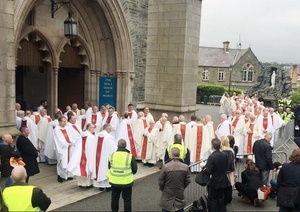
This afternoon.
Saint Eugene’s Cathedral, Derry.
A not-inconsiderable quantity of priests arrive at the funeral service for former Bishop of Derry Edward Daly who died on Monday aged 82.
A message of condolence from Pope Francis was read out during the mass for Dr Daly, who famously tended to the dying during Bloody Sunday,
Funeral hears Bishop Edward Daly dedicated his life to serving peace (RTÉ)
Sponsored Link
Speaking as a confirmed atheist am I the only one who finds the phrase “a lechery of priests” gratuitously offensive? Or just juvenile?
I’ve no great love for the catholic church but to use the phrase “a lechery of priests” at people attending a funeral is unnecessarily offensive and serves no useful purpose but to highlight your own bigotry.
That’s Broadsheet!
Jake38, that is a collective noun for priests. Sorry for any confusion.
If it is, it’s a collective noun that isn’t used particularly much. Put it like this, and I’m not saying http://www.oxforddictionaries.com is the be-all/end-all of definition, but if you enter ‘murder’ in their search thing, ‘group of crows’ comes up.
nowt similar for lechery.
I’m as atheist as they come, but there’s a bang of schoolboy sniggering off this…
…I’m sure it’s a ‘molestation of priests’ Bodger
Lechery can be used as a collective noun for priests
A man died.
The collective noun for monks is an ‘abomination’
agreed, Fellow atheist – found this juvenile and offensive.
Looks like a grinder party is about to start.
i just realised what this was… apologies.. he definitely was one of the good guys.
Cmawn, there’s no nayd for that lads. Show a bidda class. Shur half these collective nouns are Elizabethan parlour game insults, so they are.
We’ve got a particular Shakepearean insult for you but we’re not allowed say it on here.
Lads, this was one of the good ones, leave it alone.
+1
A notable absentee was the First Minister one Arlene Foster, had she not the
guts or the backbone to attend, this the death and burial of man who witnessed
the murder of civiians particpating in a march on on Bloody Sunday, it led to ignite
the Northern Conflict….another individual who should have attended is one
Dereck Wilford Commander of the Parachute Regiment whose troops fired 107
rounds and killed 13 unarmed civilians, it time he faced Judge and Jury.
Agree.
Plus U2!
Some people think that if a man wears a collar, they’re open to any insults. Daly was a good man but even if he’d just been an average one, it wouldn’t be appropriate to make jokes about paedophilia or sexuality.
Some priests are happy, many are not and have various mental health problems. Almost all would report that people sometimes randomly shout things like “paedo” at them when they walk down the street. You don’t have to be a theist or religious to know that while the institutional church may be powerful, many priests are grunts who are marginalised, mocked and bullied.
The tone of the article contributes to maintaining the belief that lesser standards apply to minorities. How many other articles has Broadsheet published covering funerals featuring flippant word-play and where comments make jokes about orgies and child rape?
Ivor and all, It was juvenile and badly misjudged. I am sorry.
Ivor, sometimes jokes in bad taste represent a way of discussing things people know exist but cannot discuss freely.
Daly may well have been a good man but the Church which he served was deeply and irretrievably corrupt.
It is impossible to read the reports on the Catholic Church without coming away with a deep sense that this organisation as it existed in Ireland at the time of Daly’s involvement – and, by default, many of its members, including by extension many of those attending his funeral – was deeply and irretrievably corrupt.
In the circumstances ‘a lechery of priests’ appears entirely appropriate.
If you want examples I’m happy to cut and paste from the Murphy report which i am just reading.
The Catholic Church in ireland as it existed in the 60s to 90s was a very evil force. There is no doubt of that. Anyone who was a member at the time is irretrievably tainted by that.
If Daly was truly a good man he would accept that and not be offended by this post.
“Ivor, sometimes jokes in bad taste represent a way of discussing things people know exist but cannot discuss freely.”
Why do you sag you can’t discuss it freely? Aren’t you discussing it right now?
“The Catholic Church in ireland as it existed in the 60s to 90s was a very evil force. There is no doubt of that.”
Yes there is.
“Anyone who was a member at the time is irretrievably tainted by that.”
That’s nonsense.
Bodger manned up and admitted his mistake and I don’t want to rub it in, so let me make it clear I’m not referring to him or the above article.
“Daly may well have been a good man but the Church which he served was deeply and irretrievably corrupt.”
I think that while I agree with the general thrust of this, I’d say that in part it depends on what you mean by “Church” and “irretrievably”.
“It is impossible to read the reports on the Catholic Church without coming away with a deep sense that this organisation as it existed in Ireland at the time of Daly’s involvement – and, by default, many of its members, including by extension many of those attending his funeral – was deeply and irretrievably corrupt.
In the circumstances ‘a lechery of priests’ appears entirely appropriate.”
Obviously, many members were corrupt. This is also through of other organisations. For example, Fianna Fail, Fine Gael, the Gardai, the HSE, the BBC, the Department of Education and all could be said to have had senior members who were corrupt and who acted and indeed act with contempt or indifference with regard to the suffering of abused and vulnerable people. There are senior members of all of these organisations who covered up the often criminal bad behaviour of their members in the interests of their organisation. Often, more junior members of these organisations were aware of these cover-ups and did nothing or actively supported them.
Does this mean that it would be appropriate to similar comments when covering the funeral of a politician, a Garda, a teacher or a HSE official?
If you believe it would be, then at least you are consistent. I think most people would disagree with such actions in those cases, but there is a cohort of people who think – or at least their actions suggest that they think – that while it would be inappropriate in those kind of cases, it’s okay in the case of priests.
“The Catholic Church in ireland as it existed in the 60s to 90s was a very evil force. There is no doubt of that. Anyone who was a member at the time is irretrievably tainted by that.
If Daly was truly a good man he would accept that and not be offended by this post.”
By member, do you mean just the priests and bishops, or are you including most readers’ parents and grandparents? Most priests joined because they were encouraged by their communities – many, if not most, of whom supported the RCC’s policies and general approach.
There were certainly aspects of what the hierarchy of the Catholic Church did during that time that most people would describe as evil. But “very evil”? Were they evil when they organised food for the hungry, both here and abroad? Were they evil when they comforted the bereaved?
When the actions of the RCC are looked back upon from the here and now, it’s usually because of scandals. It’s easy to forget that during the days you refer to, without the priests, nuns and others who propped up the state, a lot of good would have been left undone. I have no desire to go back to the days when the RCC was more powerful and where the state outsourced so many of its duties to religious agencies, but the good that was done is not cancelled out by the evil acts and abuses of power anymore than the good acts can redeem the bad ones. Put simply, life is more complicated than that.
And if a good man would not see this post as being inappropriate, then I guess the likes of myself, Bodger and many of the posters above, are not truly good people.
The Roman Catholic Church in Ireland in the 60s through to the 90s was an extremely powerful, cult-like organisation. You only have to read the reports of the various religious events which took place during this period to see this – the ceremony and deference accorded are shocking.
What is also shocking is to search for the names of individuals subsequently named as abusers in the Murphy report, and to find these names referenced throughout the 60s and 70s in positions of increasing significance within the church. These abusers were not isolated oddballs – to start with, at least, until the complaints began coming in, they were the golden boys of the Dublin church and this probably contributed to their initial protection.
In my view the Roman Catholic Church has failed in three crucial ways. Firstly, by contributing to the creation of the environment in which these individuals became abusers. I reference this not just in the general context of ‘creating a society in which abuse could flourish’ but also in a more specific context; it is notable when you do a search for the backgrounds of abusers referenced in Murphy that they had been heavily involved in the Church since childhood – were they themselves abused by someone in the Church?
The second way in which the Church failed – and was held to have definitively failed by the Murphy report – was how it dealt with allegations of abuse.
The third way in which the Church failed – and continues to fail – is in failing to accept the consequences of such abuse and cover-up – which is that faith in the Church – and by implication in its individual members – has been seriously damaged, by its own fault, and to show humility in relation to this. Part of such humility would involve exploring the causes and consequences of the events detailed in the Murphy report, and the abuse of power by the Church generally e.g. in relation to its treatment of women on medical matters.
I fully accept that other organisations in Ireland were corrupt – and indeed in relation to abuse there is evidence in the Murphy report giving rise to concern that the Gardai and the Church were involved together in suppression of abuse complaints.
However the level of sexual abuse as detailed in the Murphy – and other – reports and the failure of the Church to do anything to deal with it – makes it without a doubt the most corrupt organisation in the State – at least if you believe, as I do, that sexual abuse is the worst form of corruption. And where someone works – and prospers – within a corrupt organisation they are necessarily tainted by that corruption.
Corrupt and evil people may indeed do good things – as may good people within a organisation with corrupt members – but if the corruption of those other members extends to ruining people’s lives because that’s what sexual abuse does – it’s not possible to rid your organisation of the stench of their corruption without a wholesale cleaning out and exploration of why it happened.
This has never been done by the Catholic Church and until it is done all of us will inextricably associate priests and paedophilia. We may not say it, but it is what we will covertly think. And even the good priests will be tainted by this. Unfair, yes, but so are the consequences of their fellow priests actions for the victims who are still alive today – and for the families of those victims, who themselves suffer from the damage inflicted on their parents.
Saturday, nobody can dispute the fact that individual clerics in the church abused children and that the Catholic Church covered up sexual abuse and put children at risk. I don’t know of anybody who would regard these things as anything other than evil or who would dispute the fact that sexual abuse is a particularly vile form of evil.
“However the level of sexual abuse as detailed in the Murphy – and other – reports and the failure of the Church to do anything to deal with it – makes it without a doubt the most corrupt organisation in the State – at least if you believe, as I do, that sexual abuse is the worst form of corruption. And where someone works – and prospers – within a corrupt organisation they are necessarily tainted by that corruption.”
Okay, so if we believe that when somebody works within an organisation that has covered up abuse, they are tainted by that corruption and that it is okay to make flippant and potentially hurtful remarks when covering that funeral, do you believe that it is appropriate to make such remarks in the case of the death of a BBC journalist, a Garda or a teacher who worked at a school where abused was covered up?
“This has never been done by the Catholic Church and until it is done all of us will inextricably associate priests and paedophilia. We may not say it, but it is what we will covertly think. And even the good priests will be tainted by this. Unfair, yes, but so are the consequences of their fellow priests actions for the victims who are still alive today – and for the families of those victims, who themselves suffer from the damage inflicted on their parents.”
So two wrongs make a right?
Leaving aside the morality of collective punishment, associating priests and child abuse is a mistake if you want to avoid child abuse. I’m not aware of any Irish research, but international research indicates that they are no more likely to abuse a child than an average man and that the most common abuser is a relative. If you want to keep children safe, take exactly the same precautions as you would with a non-priest as a priest.
+ 1000 Saturday Night Newsround
Fair play Bodger.
+1