



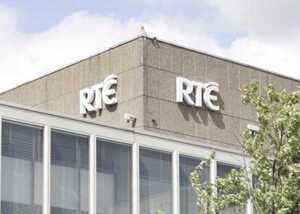

From top: RTÉ Studios, Montrose, Donnybrook, Dublin 4; Mark Cullinane
How did the public service broadcaster deal with austerity?
Mark Cullinane has completed a PHD on the response by the BBC and RTÉ to the economic crash.
Mark writes:
Academic research on the editorial coverage of and responses to crisis by national public service broadcasters on both sides of the Irish Sea is starting to come in and the emerging picture points to both the BBC and RTÉ as having fallen more or less in lockstep with the right-wing economics of their respective conservative governments.
As part of my own research I analysed a sample of the television and radio broadcast coverage by the Irish public service broadcaster, RTÉ, on some key aspects of what has become known as the Euro debt crisis between 2011 and 2013 – a moment where the future of the single currency seemed to hang in the balance.
The periods analysed encompassed a sequence of momentous and dramatic events in recent European history, including the aborted referendum in Greece on the country’s second bailout package, the subsequent ejection (through EU machinations) of prime ministers in both Greece and Italy and their swift replacement by technocratic administrations, as well as a series of tight elections in both countries in which radical anti-austerity political groupings surged and threatened to seriously disrupt Europe’s austerian masterplan.
My analysis aimed to explore how, when confronted with the travails of other peripheral crisis-hit ‘PIIGS’ nations, RTÉ’s framings of events implicitly and explicitly apportioned blame for economic crisis, legitimised or delegitimised the actions and proposals of different actors, and weighed up journalistically the electoral choices open to Greeks and Italians.
Analysis of the more than 150 separate broadcast items across the sample revealed some consistent features of crisis framings that confirm the general impression of public service broadcasting’s susceptibility to reproducing the preferred narratives of their political masters.
This is illustrated by, for example, the sustained blaming of Prime Ministers George Papandreou and Silvio Berlusconi, in Greece and Italy respectively, as key causes of crises; the horror expressed by journalists at the very prospect of opening up the decision on the second Greek bailout to its population in a referendum; the lending of tacit and explicit support for the anti-democratic statecraft that led to the ousting of both premiers on the basis that they represented threats to the integrity of the Eurozone; and the hailing of their EU-approved temporary technocratic replacements in the form of central banker Lucas Papademos and EU insider Mario Monti, as preconditions of national salvation in both countries.
So elevated was the official sense of emergency at the height of the Euro debt crisis that the studied journalistic performance of disinterestedness, often accentuated in coverage of foreign elections, instead went up a few octaves.
After entirely missing the electoral ascent of Syriza in the first, inconclusive Greek general election of 2012, during the subsequent second campaign its leader Alexis Tsipras was presented as a dangerous populist who had seduced a nihilistic electorate and was leading them to certain ejection from the Eurozone and perhaps even the EU.
Inconclusive election results in both Greece and Italy were assessed mainly in terms of their alignment with the best-laid plans of EU leaders and validated through the ever-present divination of market desires.
The views of those suffering the consequences of their austerian policies, however, remained a distant interest.
Irish viewers were even quietly invited to pull on the green jersey and cheer on the forces of technocratic fiscal responsibility in the face of those who would threaten ‘our’ recovery by causing market instability. So much for the prospects of an inter-PIIGS alliance!
As with the 2012 European fiscal compact treaty, the naturalisation of disciplinary neoliberalism as the new common sense segued seamlessly into a posture of seeing its challengers as quixotic dreamers at best or subversives at worst.
It was little surprise then, that when it emerged in late 2014, the largest Irish anti-austerity movement since the economy crashed – Right2Water – was given short shrift, not just by Ireland’s right-leaning commercial print and broadcast media but by the public broadcaster, too.
The movement, co-ordinated by unions and comprising affiliated political parties and autonomously-organised communities up and down the country, had formed in order to oppose the imposition of another Troika-mandated regressive charge – this time on water usage – as well as the new Irish Water utility which appeared to be established with a clear eye to medium term privatisation.
Both its sheer size – packing the main thoroughfares of towns and cities across the country on a consistent basis – and its broad constituencies of support made it a movement that no government could afford to ignore.
The coalition’s calculation that some concessions on the charging regime would dissipate opposition was proven misplaced as a large and sustained boycott of water bills throughout 2015, combined with a poor showing by the ruling parties in the general election of February 2016 produced a parliamentary arithmetic that swiftly forced the temporary suspension of water charges and imperilling the entire Irish Water project, for now.
For a broadcaster ensconced in its traditional political role as mediator of genteel parliamentarism, the street politics of an increasingly powerful anti-austerity movement were never likely to be warmly received in the circles of metropolitan Irish middle-class liberalism within which RTÉ is culturally immersed.
There are many contributing factors that might be cited to explain the journalistic failures of how the water wars were covered over the last few years.
Middle-class scorn at Right2Water’s subaltern base, for example, continues to play a role that should not be underestimated.
But most instructive of all, I suggest, is the sheer incompatibility of the movement’s very structure, modes of mobilisation and political demands with a broadcasting model whose conception of legitimate politics begins and ends at the gates of parliament, within whose perimeter political journalists resemble mere courtiers in thrall to its local dramas.
Mark Cullinane is a doctoral graduate in sociology from University College Cork. His research focused on the performance of the Irish public service broadcaster in mediating contemporary political and economic crisis.
Read on: Public service austerity broadcasts (OpenDemocracy.co.uk)

Isn’t news just supposed to be facts?
Or is media supposed to be pushing an agenda?
I hope news becomes entertainment. Like in America. Or on sky news.
In the autumn of my years I have come to the sad conclusion – trust nothing – verify as far as you can. Journalism (as practiced by the likes of bbc and in particular RTE) has become almost a thing of the past. Spin is everything, reality is nothing, , ask Campbell and the Prince of Darkness. Meanwhile in this neck of the woods we were greeted daily (until they went on their two month holiday) by Tory mantras, spouted word for word by our good friends in FG. This is not good, dear friends, not good at all.
“The ideas of the ruling class are in every epoch the ruling ideas, i.e. the class which is the ruling material force of society, is at the same time its ruling intellectual force. The class which has the means of material production at its disposal, has control at the same time over the means of mental production, so that thereby, generally speaking, the ideas of those who lack the means of mental production are subject to it. The ruling ideas are nothing more than the ideal expression of the dominant material relationships, the dominant material relationships grasped as ideas.”
In other words kow-towing to the banks and the Troika, the slaveish devotion to maintaining house prices, crashing the economy to save the areas of a small handful of developers who regularly paid homage to the Fianna Fáil tent, we can’t afford this, we can’t afford that, let”s all tighten our belts, but we can magically afford to piss nearly €100 billion into the banks via the bailout and NAMA.
this is just anti-EU propaganda the right have become emboldened by the Brexit vote and are now openly criticizing the EU we need to reject these voices the EU is the best thing to happen to Europe we are all Europeans now we need to stay together and ignore this type of negativity.
You sound like a Scientologist……..
Nothing to do with EU Jimmy.
No that’s right Tish – It’s merely a media bias that seems to favour the position of the European elite.
lefty person does lefty research gets lefty results. quelle surprise
That’s me told.
look maybe I’m being harsh but I just get a little bit bored when someone with obvious political leanings does research which concludes perfectly in line with those political leanings
it’d help if you covered that line off by explaining the rigor of your methodology
– how was the sample selected?
– how was it analysed?
– who analysed it?
– how was inter-rater reliability performed?
– were all of your hypotheses supported?
– etc.
That’s fine- all of that stuff you mention is important, and is covered in detail in the thesis chapter from which it is drawn. In a short piece like this for openDemocracy for a general audience, it wouldn’t make sense to focus on methodological minutiae. Can send on materials if you like though- am happy to explain and justify the sample selection, coding processes etc.
how about linking to it here? i.e. your thesis
What is your educational attainment ??
Fine Gael shill leaves Fine Gael shill comment.
Obvious comment is obvious.
+1
once I see someone using terms like “political masters” I already know how impartial they are going to be
Agreed, there’s a decent argument in there trying to get out.
“political masters” – democratically elected TDs. You don’t have to like their politics to respect the fact that they were elected in a free & fair election.
“prospects of an inter-PIIGS alliance” – when was that ever on the cards?
“in lockstep with the right-wing economics of their respective conservative governments.” The IMF, EU & ECB were providing cash to us when economy collapsed and open market rate was over 14%. In return, there was a severe culling of state spending that cut across the board. FG majority party so yes, the people elected a majority conservative government.
“co-ordinated by unions and comprising affiliated political parties and autonomously-organised communities ” – it is so much messier than that. You have the peed off citizens, the erigií, BPB/AAA social Trotskyist entryists using water as a wedge issue, SF using it for their own ends after doing u-turn. Lot of people supported the original aims but were annoyed at the political takeover by various groups masquerading as autonomous groups. None of whom have detailed plans for solving a €25billion infrastructure bill, the need for conservation and paid for based on amount used.
“The views of those suffering the consequences of their austerian policies” – so RTE did nothing on medical card crises, mass unemployment, mental health, food banks and housing problems? At all, ever?
+1
Dumb person makes dumb comments, sounds dumb, quelle surprise.
I suppose it’s up to the news media to report the facts and let the public make up it’s mind. But what we get is paid opinions. I saw the RTE reporter at the democratic convention in the US surrounded by Hillary supporters. No mention of the Bernie supporters who walked out and ended up protesting outside. Now that’s beyond bias.
No it’s not.
Yes it is.
RTE’s little girl next door reporter is never going to tell it like it is over there. She’s entirely compliant and docile in her reporting from the US.
The story is about a foreign country electing a president. Why waste any of the already limited time reporting on a non story about Sanders supporters performing a completely irrelevant walk out?
There was nothing really that untoward about Clinton’s nomination so the walkout thing is just local politics that doesn’t compare to the DNC circus story. If they had walked out and shot someone, or started a riot , then it might be a story alright.
“If they had walked out and shot someone, or started a riot , then it might be a story alright.”
Oh dear.
This Sanders – what has fried chicken got to do with American politics?
Sean O’Rourke’s voyeuristic reporter Paddy O’Gorman’s trips around the country began as the recession kicked in and usually featured Travellers being interviewed outside court houses or poverty stricken individuals leaving pawn shops.
All these so called reports did was to perpetuate negative stereotypes of the disadvantaged and add to the general blaming of the poor for being poor.
They are cynical divisive reports which serve right wing agendas and should never have been broadcast.
+1
O Gorman and Joe Duffy are misery junkies, The Savage Eye’s pisstake of Duffy cut close too the bone.
So they ignore the poor and are accused of peddling a right-wing agenda.
They talk to the poor and are still accused of peddling a right-wing agenda?
Welcome to Broadsheet Newspeak, Kieran!
Trish. you hit the nail on the head.
“the horror expressed by journalists at the very prospect of opening up the decision on the second Greek bailout to its population in a referendum”
mmmm re. above assertion I thought the media debate was much more considered and nuanced .
As I recall ,there was a lot of criticism leveraged at the confusing language used , the exact nature of the proposals on offer and the lack of clarification regarding the potential consequences of the vote .
PS: Mark looks like Glenn. Is Bodger operating some kind of BS breeding programme for graduates?
Oops Never saw the reference to ” second”. bailout. Thought you were referring to 2015 bailout.
but what does home want to be when he grows up with a degree like that?
he not home
Rather more ideological positioning than fact evident in this paper, if the broadsheet extract is anything to go by. RTE had lots of coverage of the anti water charge protests, which, let’s not forget, comprised a minority of citizens, in the face of greater numbers who paid their water charges. Not weighing in behind Right2Water didn’t make RTE news coverage ‘courtiers’, any more than their not weighing in behind the introduction of water charges made them ‘activists’. And Syriza’s policy platform in 2012 was indeed a recipe for disaster. A fact born out by the inevitable retreat into more pragmatic territory by Tsipras once the realities of governance became apparent. Syriza’s promises of 2012 were no less ludicrous than Trump’s 2016 commitment to build a wall, and have the Mexicans pay for it.
+1
Nobody wanted water charges ,most of those who paid were bullied into it, Your defence of RTE displays the same twists and spin as they used, same puppeteer?
Same paranoia? Nobody welcomes any tax with open arms, but water charge protests were the representation of a minority. Those are the facts.
+1
-10
How do you figure that? just because someone isn’t marching up and down the street doesn’t suddenly make them a supporter of the opposite argument, your notion that the main opposition to water charges was solely based on the money aspect and not the obvious dodgy set-up of Irish water or the questionable contracts awarded to FG’s benefactor would suggest you have an agenda. Water charges could have been part of LPT and there would have been little backlash as everyone expected rates to be the austerity tax of choice. IW is corruption squared and nothing will change that image
The Right2Water protests at best pulled out about a tenth of the numbers who paid water charges. The protests are the best indicator we have of an active opposition to the charges. It’s a small minority.
-1
You obviously were not paying attention to reporting on the water charge issue.
Glaringly, the state broadcaster did little to ask the obvious questions around the set up of Irish Water and the awarding of contracts. They failed the license paying public in such a manner.
Any talk now of Water Charges and all we get is Eamon Ryan from the Greens – Nothing from people within Right2Water or Right2Change, rarely from the Socialists and as usual rarely from the Shinners. So even though so many T.D’s were elected to scrap IW and at least pause the charges, the state broadcaster continues to skew the debate in favour of the government (FG/Lab/FF) position that we should have charges etc.
Eamon “Free Willy” Ryan is the perfect guest for these panels, he has zero credibility, a tenuous grasp on reality and a condescending personality, unless he’s on with someone vile like Noonan the other guests point will seem more plausible than Ryan’s
Total nonsense Alastair.
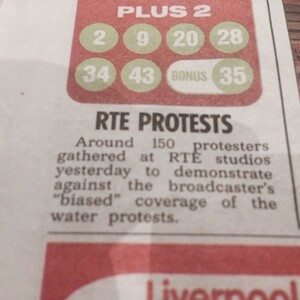
RTE covered the water protests (which were supported by a very large minority by the way with marches of over 100,000 people in Dublin) but they were biased and their current affairs and political chat on weekends was set up to undermine the movement at every opportunity. RTE were overtly pro Irish Water all the way. They failed to report on the intimidation of protesters and residents by masked men, instead preferring to highlight the occasional scuffle with Gardaí.
On Greece, Tsipras is still PM of Greece despite all the dirty tactics of IMF and EU to oust him. The IMF and EU extorted money from Greece and humiliated the Greek people for the poor economic policies and corruption of centre-right parties who were to blame for the Greek crisis. IMF insisted on the selling off of Greek national assets to pay their extortionate loan interest rates.
The centre-right and their banking masters are the ones who caused and maintained austerity. They are the ones who should be blamed and held accountable. Not the people who suffer as a consequence of their greed and avarice.
Which part of my comment is nonsense?
You are deluded if you really believe that RTE news coverage was pro Irish Water. There’s nothing whatsoever to support that contention, just as there’s nothing to support the claim that they didn’t give the protests coverage.
Sure Tsipras is PM of Greece, but he’s certainly not advocating the policy platform Syriza did in 2012 – you know, the one that public broadcasters (along with any other impartial observers) rightfully pointed out had more than a few issues.
Might I suggest that you’re ascribing your own bias onto, in the main, perfectly reasonable journalism.
http://waterfordwhispersnews.com/2015/03/09/bias-as-rte-refuses-to-run-water-meter-installers-are-lizard-men-story/
Pre-election David David Power was asked about the issue of water charges on The Week In Politics. “It seems to have gone off the boil if you’ll excuse the pun”, he quipped to guffaws of those around him.
He couldn’t have got it any more wrong even if he tried. Rte depends on taxpayers money so will not upset their pay masters.
Even the Met Office seem to suffer from this condition. The night before the first big protest all the way back in October, 2014 it was reported heavy rain would fall all over the country, yet the sun was splitting the stones that day.
rte in brownnose shock. noone is surprised.
=1
From the Julien Mercille school of rigorous analysis and objective reporting I see. Then again, I see he is coming from the world of sociology which is theoretical at best and just sloppy moaning at worst.
I’d love to see your PhD. Although you’re probably just an accountant which is more of a technical qualification than a true education.
Jeez. Talk about Trump level thin skin.
Childish but consistent.
Smarter than you though.
Bo*locks
To Tony, of course.
Bo*locks to what you illiterate idiot? What are you disagreeing with or is it just the post bank holiday hangover kicking in?
What hold on, so he basically completed a Phd on how he felt the news was reported. And people say going to college is not a waste of time.
You’re clearly not educated if you don’t understand the point of a PhD like this.
A better class of barista?
Yes exactly.
Please do explain. Back up the “head up your own arse” comment you made.
If you’ve read this far Mark, a large point. You write “had formed in order to oppose the imposition of another Troika-mandated regressive charge – this time on water usage – as well as the new Irish Water utility which appeared to be established with a clear eye to medium term privatisation.”
This is factually wrong on several levels:
1) The FF-Green government had already committed to charging for water in 2010, prior to EU-IMF arrival. It was then reflected in the agreement with the EU and IMF
2) The troika never took any view on whether charging should be progressive, regressive or otherwise
3) The troika never took a view on whether a volumetric or household-level charge should be introduced.
4) The troika was quite agnostic on the need for setting up a new utility
5) Privitisation of water infrastructure was ALREADY expressly forbidden by the existing legislation. The troika never had any interest in changing this
The reasons are that 3) was a Green party idea. They thought it was more equitable that people should be able to reduce what they pay through lower usage and you need meters for that.
4) was something that had been kept in a drawer in the Custom House for a long time.
So to sum up if it had been set up so that local authorities imposed a flat charge per household with generous income disregards the troika would not have given a hoot.
Otherwise there I sympathise with a fair bit of what you say. Political journalism (not just RTÉ) focusses excessively on Leinster House soap opera stuff and rarely goes into actual policy, you know, the stuff that impacts people’s lives.
A more general point for residents of politics faculty is to PLEASE engage with facts and empirical stuff. You’re bright enough to do so and it’s not that hard!
“Factchecker” HAAAAAAAAAAAAAAAHAAAAAA
@Sheik
I’m guessing you don’t believe fact checkers claims are accurate. I’d be interested to know which ones.
Large organisation with entrenched monopolistic position is conservative and mainstream in nature? And this is supposed to be revelatory? I’m thinking we didn’t get value for money with this particular PhD investment.
The point is not to amaze you Owen. The point is to make the public aware that their public broadcaster does not serve them. It does not operate according its own public charter. It is not fit for purpose.
Sez you. But you fail to support that opinion with anything persuasive.
I think the point is that if your on the far left everyone else is going to seem right-wing. The Tea Party in the US give out about the same thing, except they’re looking at it from the far-right so they think the media is run by pinkos and commies.
I went along to that discussion at The Beatyard on Sunday on journalists and readers which you plugged here last week. Gemma O’Doherty made a lot of sense on this very issue and other conflicts of interest throughout the media. Very good thought-provoking hour
Drivel, and dull drivel to boot, as only the Trots can churn it out.
Another Fine Gael troll using words like “dull” and “trots”. Off the shelf anti free speech right wing narrative.
Some people clearly don’t the truth about RTE being laid out plainly for all to see.
Such nonsense! Surely anyone can see that all the guests on the Saturday and Sunday talkfests on RTE radio are raging left-wingers from the slums, and the presenters rampant Maoists? (what was that sarcasm font again?)
Looking for it meself,Turgenev.
The irony of a post complaining about media bias being completely biased.
Ehh, it be Tuesday or at least i think it is last time i looked, the day after the bank holiday and hangover so it be back to reality, the grim reality of Ireland.
Think general shock that RTE, would ever be so low and base as to try and put a spin on events, surely not or that they be essentially middle class and inward looking.
Where everyone knows everyone kind of thing.
Though lucky for Ireland then that most major policy is made in the EU, thanks Germany.
So no worries.
How can they actually award someone a PhD for what is essentially a long form blog post about Irish Water.
I thought theses were supposed to be factual and objective. Did this guy actually get a Pass Grade for this?
Interesting, though seems based more on feeling than fact.
An analysis by UL academics with a similar political viewpoint as this author, studying only media coverage of water charges, found RTE’s coverage of the issue was more balanced and considered and less scare-mongering than others… Also, that Journal factcheck on Pat Rabitte claiming that RTE were protest-nutters is of some relevance, don’t have it here.
https://ulir.ul.ie/handle/10344/4481
I recall reading that Brian Lenihan getting on Joe Duffy to tell them to stop talking hysterically, that they were driving the bond markets mad. But I remember cycling close to Leinster House most evenings and seeing mid-size protests, and noticing that RTE weren’t covering these (and it was usually more than two bearded lefties hitting an oil drum).
I would assume it’s relatively safe to say that RTE might have decided what to report based on what they saw to be in the interests of social and political stability. On the other hand, this probably stemmed organised protest, for good or for bad.
The only properly organised/mainstream protests we had was the “March for a Better Way”, organised by ICTU. It was supposed to be about the Troika deal but given the personnel involved, it seemed more about how public sector people were being affected than the situation itself.