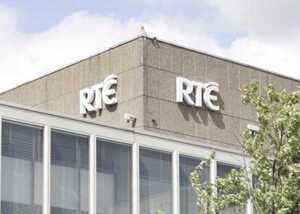

From top: RTÉ Studios, Montrose, Donnybrook, Dublin 4; Mark Cullinane
How did the public service broadcaster deal with austerity?
Mark Cullinane has completed a PHD on the response by the BBC and RTÉ to the economic crash.
Mark writes:
Academic research on the editorial coverage of and responses to crisis by national public service broadcasters on both sides of the Irish Sea is starting to come in and the emerging picture points to both the BBC and RTÉ as having fallen more or less in lockstep with the right-wing economics of their respective conservative governments.
As part of my own research I analysed a sample of the television and radio broadcast coverage by the Irish public service broadcaster, RTÉ, on some key aspects of what has become known as the Euro debt crisis between 2011 and 2013 – a moment where the future of the single currency seemed to hang in the balance.
The periods analysed encompassed a sequence of momentous and dramatic events in recent European history, including the aborted referendum in Greece on the country’s second bailout package, the subsequent ejection (through EU machinations) of prime ministers in both Greece and Italy and their swift replacement by technocratic administrations, as well as a series of tight elections in both countries in which radical anti-austerity political groupings surged and threatened to seriously disrupt Europe’s austerian masterplan.
My analysis aimed to explore how, when confronted with the travails of other peripheral crisis-hit ‘PIIGS’ nations, RTÉ’s framings of events implicitly and explicitly apportioned blame for economic crisis, legitimised or delegitimised the actions and proposals of different actors, and weighed up journalistically the electoral choices open to Greeks and Italians.
Analysis of the more than 150 separate broadcast items across the sample revealed some consistent features of crisis framings that confirm the general impression of public service broadcasting’s susceptibility to reproducing the preferred narratives of their political masters.
This is illustrated by, for example, the sustained blaming of Prime Ministers George Papandreou and Silvio Berlusconi, in Greece and Italy respectively, as key causes of crises; the horror expressed by journalists at the very prospect of opening up the decision on the second Greek bailout to its population in a referendum; the lending of tacit and explicit support for the anti-democratic statecraft that led to the ousting of both premiers on the basis that they represented threats to the integrity of the Eurozone; and the hailing of their EU-approved temporary technocratic replacements in the form of central banker Lucas Papademos and EU insider Mario Monti, as preconditions of national salvation in both countries.
So elevated was the official sense of emergency at the height of the Euro debt crisis that the studied journalistic performance of disinterestedness, often accentuated in coverage of foreign elections, instead went up a few octaves.
After entirely missing the electoral ascent of Syriza in the first, inconclusive Greek general election of 2012, during the subsequent second campaign its leader Alexis Tsipras was presented as a dangerous populist who had seduced a nihilistic electorate and was leading them to certain ejection from the Eurozone and perhaps even the EU.
Inconclusive election results in both Greece and Italy were assessed mainly in terms of their alignment with the best-laid plans of EU leaders and validated through the ever-present divination of market desires.
The views of those suffering the consequences of their austerian policies, however, remained a distant interest.
Irish viewers were even quietly invited to pull on the green jersey and cheer on the forces of technocratic fiscal responsibility in the face of those who would threaten ‘our’ recovery by causing market instability. So much for the prospects of an inter-PIIGS alliance!
As with the 2012 European fiscal compact treaty, the naturalisation of disciplinary neoliberalism as the new common sense segued seamlessly into a posture of seeing its challengers as quixotic dreamers at best or subversives at worst.
It was little surprise then, that when it emerged in late 2014, the largest Irish anti-austerity movement since the economy crashed – Right2Water – was given short shrift, not just by Ireland’s right-leaning commercial print and broadcast media but by the public broadcaster, too.
The movement, co-ordinated by unions and comprising affiliated political parties and autonomously-organised communities up and down the country, had formed in order to oppose the imposition of another Troika-mandated regressive charge – this time on water usage – as well as the new Irish Water utility which appeared to be established with a clear eye to medium term privatisation.
Both its sheer size – packing the main thoroughfares of towns and cities across the country on a consistent basis – and its broad constituencies of support made it a movement that no government could afford to ignore.
The coalition’s calculation that some concessions on the charging regime would dissipate opposition was proven misplaced as a large and sustained boycott of water bills throughout 2015, combined with a poor showing by the ruling parties in the general election of February 2016 produced a parliamentary arithmetic that swiftly forced the temporary suspension of water charges and imperilling the entire Irish Water project, for now.
For a broadcaster ensconced in its traditional political role as mediator of genteel parliamentarism, the street politics of an increasingly powerful anti-austerity movement were never likely to be warmly received in the circles of metropolitan Irish middle-class liberalism within which RTÉ is culturally immersed.
There are many contributing factors that might be cited to explain the journalistic failures of how the water wars were covered over the last few years.
Middle-class scorn at Right2Water’s subaltern base, for example, continues to play a role that should not be underestimated.
But most instructive of all, I suggest, is the sheer incompatibility of the movement’s very structure, modes of mobilisation and political demands with a broadcasting model whose conception of legitimate politics begins and ends at the gates of parliament, within whose perimeter political journalists resemble mere courtiers in thrall to its local dramas.
Mark Cullinane is a doctoral graduate in sociology from University College Cork. His research focused on the performance of the Irish public service broadcaster in mediating contemporary political and economic crisis.
Read on: Public service austerity broadcasts (OpenDemocracy.co.uk)