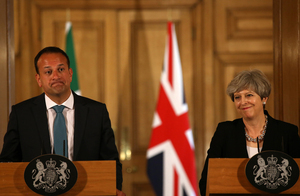

From top: Taoiseach Leo Varadkar and British Prime Minister Theresa May MP at No. 10 Downing Street on Mr Varadkar’s first official engagement outside of Ireland after becoming Taoiseach in June, 2017: Anthony Sheridan
It is grotesquely hilarious to witness Irish journalists, commentators and politicians condemning the British political system over its handling of the Brexit crisis. Here, for example, is Irish establishment journalist Alison O’Connor:
‘Who are these people who have risen through the ranks of British politics who don’t know their history, their geography or their arse from their elbow?’
The suggestion here is that Irish politicians, unlike their British counterparts, do know their arse from their elbow. There are millions of Irish citizens with ruined lives who would beg to differ.
And here’s Michael McDowell ignorantly suggesting that British politicians should adopt the same dishonest, anti-democratic strategy favoured by the corrupt Irish ruling elite when the people don’t do as they’re told – hold a second referendum:
‘Obviously our government has to pay lip service to accepting the outcome of the first British referendum, but others in Ireland should, in a friendly and decent way, publicly encourage the people’s vote cause. It would be honourable and honest to do so – provided it was not done in a counterproductive way.’
This sly, manipulative, patronising and dishonest attitude to how politics should be done is the norm in our dysfunctional democracy and therefore the likes of McDowell, in his ignorance, thinks it’s the norm in real democracies.
There is no doubt that the whole Brexit episode is a complete disaster for the United Kingdom. There is no doubt that stupidity, extreme nationalism, selfish party politics and cowardly political leadership are the main ingredients that led to the catastrophe.
But there is one element of the crisis that no mainstream Irish politician could possibly recognise or understand – British democracy is alive.
British democracy is a living, breathing, dramatic, often toxic, always passionate, sometimes uplifting, sometimes disastrous, but most importantly, always, always alive to the awareness that democracy belongs to the people, that in the end it is the people, for better or worse, who will decide the fate of the nation.
Ireland, on the other hand, is a dead democracy and has been since independence. Irish democracy is a rotten corpse that goes nowhere.
It performs just one function – it feeds and fattens the political maggots of the main political parties that have been crawling all over its putrid body since independence.
The principal difference between so-called Irish democracy and that of genuine democracies is evident in how ordinary citizens interact with their political systems.
Citizens of functional democracies such as the UK, France and Germany are aware that ultimate power rests with them, with the people.
They are aware that elected representatives are servants of the people, servants of democracy. In other words, in functional democracies, power flows from the bottom up and when that power is abused there is accountability and consequences.
That’s why there’s a virtual revolution going on in France. That’s why British politicians are extremely wary of dismissing the will of the people as expressed in the Brexit referendum.
In Ireland, the complete opposite is the case.
Unique among Western democracies, Irish citizens, for the most part, see power as residing in their elected representatives and government officials. They see power as coming from the top down and are forever grateful when the powerful throw them a few crumbs from the table.
There are historical reasons for this mindset that are too complex to go into at this time. Sufficient to say that this attitude, that the citizen is powerless and dependent on favours doled out by public representatives, has morphed into a system of political gangsterism that has destroyed the lives, wealth and hopes of millions of Irish citizens over the decades turning Ireland into a virtual banana republic.
History is the key to understanding how all this came about.
Prior to the English civil war of 1642 Parliament had very little power. At the time the divine right of kings to rule was absolute. But that all changed when King Charles I attempted to force Parliament to do his bidding.
When Parliament refused the king entered the House of Commons [the House of the People] with 400 soldiers and attempted to arrest five members. Charles Lenthall, the Speaker of the House, displaying great courage, told the king that he stood by [the people’s] Parliament and not the monarchy.
Not only did the king lose the ensuing civil war, he also lost his head when he refused to accept that power resided in the people and not in his person. The English monarchy never regained absolute power and the English people, to this day, are very aware that they are the real power of the land.
Just the other day, nearly 400 years after people power first challenged royal power, the current Speaker of the House, John Bercow, told those who sought to abuse the people’s parliament, to take a hike.
The evolution of Irish ‘democracy’ could not be more different.
When independence was achieved in 1922 power was usurped by an extremely conservative political class that created a fake democratic system based on parish pump politics and gombeenism.
Hughe swathes of power and influence were handed over to the Catholic Church that led directly to a holocaust of abuse and criminality that continues to this day.
Ireland has never had a functional democracy. Instead we have a political ruling class made up principally of Fine Gael, Fianna Fail and the near extinct Labour Party.
This is why there has never been a Right/Left wing political divide in Ireland as there is in almost all functional democracies. You cannot have such democratic balance in a country where there is, effectively, just one ruling class [party] masquerading as three political parties.
In Ireland we have a political system that is nothing more than a diseased corpse where the stench of corruption, lies, secrecy, cynical political manipulation and outright state criminality daily chokes the lungs of any hope of a genuine democracy emerging into the light of day.
Yes, British democracy is in crisis. Yes, total catastrophe is a distinct possibility, even the possibility of revolution. But that has happened before, it has happened in many countries over many centuries.
But the very fact that such chaos exists is testament that British democracy is a living, breathing entity where the people are fully engaged and ultimately supreme.
Only in countries like Ireland do we witness politicians and their toadying supporters in mainstream media say:
‘Look at the chaos that reigns in the UK in comparison to our stable political system here in Ireland.’
They little realise that apart from the stench and rot a [political] corpse is always stable.
Anthony Sheridan is freelance journalists and blogs at PublicEnquiry.