
Author Archives: Derek Mooney

derek

From top: Former Italian Prime Minister Matteo Renzi leaves an EU summit last June; Derek Mooney

A bad weekend for Europhiles?

Not a bit of it.

Derek Mooney writes:

I know it is a hackneyed old phrase and gets trotted out in almost every election discussion, but there is a very good reason Tip O’Neill’s “all politics is local” maxim gets so much airplay: it’s because it’s true.

Yet, somehow, commentators, pundits and even politicians forget this.

Take yesterday’s referendum result in Italy. No sooner had the exit polls showing a heavy defeat been announced but the Euro-sceptics, including Nigel Farage, were out in force to claim the result as a continuation of the Brexit/Trump trend.

Isn’t it curious how those styling themselves the biggest supporters of national sovereignty and the greatest opponents of EU integration are the ones who see every political development in terms of a pan European trend and not individual nation decisions? Mightn’t the factors underpinning the Italian result have more to do with local Italian politics than what is happening in the UK or France?

As it turns out, they do. While the lazy analysis will see it as just another phase of the Brexit/Trump populist train, the reality is that the Italian result was not about populism versus the establishment.

There were as almost many members of the establishment on the No side as on the Yes, including the centrist former Italian prime minister and EU Commissioner, Mario Monti, hardly your archetypal populist!

Though the winning No side also included the anti-establishment Five Star movement, they were not the insurgents – the No side were arguing the status quo. They were urging a rejection of Renzi’s proposals to make Italian decision making easier by reducing the size and power of the Senate and taking power back to the centre from the regions.

While the Italian result was widely predicted, including by pollsters, the Austrian Presidential result was not.

Right up to the last minute the polls in Austria were forecasting a very tight race with many pundits concluding that the far right’s candidate, Norbert Hofer, would emerge the winner. In the end, the moderate Van der Bellen had a comfortable win.

Not only does his victory deal the simplistic “populist wave” argument a blow, it also reduces the size of the headache facing Brussels today.

But before they start the celebrations in the Berlaymont, the far right FPO party is still on course to make significant gains in the 2018 Austrian parliamentary elections – though these are the same polls that called the presidential for the FPO, so maybe take that with a pinch of salt.

Before we reach the 2018 Austrian elections, we have 2017 to get through – and 2017 brings a series of crucially important general elections; in the Netherlands, France and Germany. The timeline is as follows:

March 15 – general election in The Netherlands

April 23 and May 7 Rounds I & II in the French Presidential election

Mid-June French parliamentary elections (2 Rounds)

Sept/Oct – German federal elections, polling date yet to be determined

And, remember, just after the Dutch elections and before Round I of the French presidential election we will likely have the UK’s triggering of Article 50, commencing formal Brexit negotiations.

Next year will be an important one for Europe, though I suspect those seeing it as the year that Europe starts to finally and irrevocably fall apart may not get their wish.

As with yesterday’s results, the outcomes will likely be a mixed bag of confusing signals. While it still looks unlikely – at least from this remove – that the far right or ultra-nationalists will end up in office in either France or Germany, the possibility of Geert Wilders PVV party ending up in coalition government in the Netherlands cannot be ruled out.

Meanwhile, what lessons will Brussels take from yesterday’s Italian and Austrian results?

Not only was the Italian result the clearer and more decisive of the two, it is the one that will likely have the most immediate impact in Brussels. Italy’s financial sector was in a precarious enough position before the referendum, so the result coupled with the instability that will follow Renzi’s resignation can only make an already bad situation worse.

As for the Austrian result, if it had gone the other way and the far right had won, then much of the focus that is now on Italy would have been on the far right’s victory and the alarm bells that it was setting off in Brussels. The response in Brussels will be a sigh of relief that they just have Italy to deal with and it is hard not to imagine that they had already factored the Italian defeat into the mix.

So, the Brussels response will likely be: as you were. This will also be the probable Brussels response to any emerging crisis over the coming year. The EU is set to effectively go into stasis or suspended animation until after the German elections next, with the Commission President Juncker appearing to have already personally commenced the process.

This should not be a period of inactivity here. The triggering of Article 50 negotiations in March 2017 should kick start a debate on this island as to how we see our EU membership and which way we want to see the EU go.

A good starting point for such a debate could be found in comments made by Scottish First Minister Nicola Sturgeon during her address to Seanad Éireann and in some of the responses from our own Senators. The First Minister spoke of:

“The sense that small countries can be equals in a partnership of many is something that appeals to us about the European Union”

This theme was picked up on by several Senators, including Fianna Fáil’s Mark Daly and independent Alice-May Higgins with Michael McDowell reflecting opinion across the Chamber saying that

“…the partnership of independent states in the EU echo the feelings of most Irish people towards the EU. It is not a super state but a partnership of individual states.”

He is right and it should inform our approach to the Brexit talks and what we want a post Brexit EU to look like, after all: all politics is local.

Derek Mooney is a communications and public affairs consultant. He previously served as a Ministerial Adviser to the Fianna Fáil-led government 2004 – 2010. His column appears here every Monday. Follow Derek on Twitter: @dsmooney

Earlier: A Limerick A Day

Pic: Getty

000d392c-614

cyvopdpuaaenkb1derek

From top: Castro tribute; President Higgins arrives at the Cuban Embassy this morning; ; Derek Mooney

The human rights abuses in Cuba are not some historic inconvenience that can be poetically euphemised.

Derek Mooney writes:

There are several immutable rules in politics. One of the most important ones says: when you are in a hole: stop digging.

The rule applies outside the rarefied atmosphere of the corridors of power. It even extends to those residing in 18th century palatial residences in the Phoenix Park.

Trying to pretend that President Higgins’ statement on the death of Fidel Castro was anything other than fawning and unbalanced is to toss aside the silver shovel and bring in a JCB.

Defending the President’s statement from criticism a spokesman said that the statement had clearly referred to the price paid for social and economic development in terms of civil society and the criticisms it brought.

Clearly? Really?

The relevant sentence reads: “The economic and social reforms introduced were at the price of a restriction of civil society, which brought its critics.” Twenty (20) words in a statement that was about 430 words in length. That is hardly balanced, especially when you consider the passivity of the language employed.

Styling the use of murder to acquire and maintain power as just a “restriction of civil society” is naive dissimulation at best and an insult to defenders of human rights at worst.

While some may question the scale of the horrors Castro inflicted, like Stalin or Mao he had absolutely no compunction about lining up thousands, if not tens of thousands, of men and women in front of the infamous ‘paredón’ (the wall) for summary execution. These included former revolutionary comrades such as William Alexander Morgan.

The human rights abuses in Cuba are not some historic inconvenience that can be poetically euphemised. They continue to the present day. In its 2016 report on Cuba the noted human rights NGO Human Right Watch states:

Human Rights Defenders: The Cuban government still refuses to recognize human rights monitoring as a legitimate activity and denies legal status to local human rights groups. Government authorities harass, assault, and imprison human rights defenders who attempt to document abuses.

Check the President’s twitter feed and you will find that President Higgins’ eulogy to Castro came just two hours after posting a link to his Mansion House speech given on Thursday last as part of the inauguration of the first global memorial to murdered human rights defenders.

What a contrast. How incongruous. Side by side on the President’s media page is a speech praising human rights defenders and a statement eulogising a man who systematically oppressed human rights defenders.

I do not for even one second doubt the sincerity of the President’s ongoing commitment to human rights or of his lifelong work in this area, but I do question his judgement.

He damages these causes when he puts his simplistic and romanticised notions of the Castro legend ahead of the more complex reality – even under the guise of “de mortuis nihil nisi bonum” (don’t speak ill of the dead).

Castro was a divisive figure. To some he was the “scourge of the west” and the great liberator, to others he was a megalomaniac autocrat who preached socialism while living like a king with his own private island.

The fact is that he was probably both.

Sadly, our President does not see it this way. So, instead of issuing a statement that observed the diplomatic niceties by extending the sympathies of the Irish people to the Cuban people on their loss and noting Castro’s place in world history, our President opted to go much further. He decided to internationally proclaim a glowing and lengthy tribute – and all in our name.

President Higgin’s finished off his homage to Castro with an effusive flourish, stating that:

“Fidel Castro will be remembered as a giant among global leaders whose view was not only one of freedom for his people but for all of the oppressed and excluded peoples on the planet.”

I can understand how many young people in the 1950s and 1960s initially fell for the idealised version of Castro. He overthrew a corrupt, puppet regime in the face of US opposition and introduced massive agrarian and education reforms.

This was also the golden age of photojournalism. The early black and white photos of Castro and Guevara are iconic, portraying two young men standing up against the odds.

But there comes a point when you get past the bedroom poster version of world politics and see things as they really are. The real world is not so photogenic. It is murkier and less stark with many confusing shades of grey. In the real-world politics is conducted in prose, not in poetry.

I don’t like seeing our President, or more correctly his views, being compared with those of Jeremy Corbyn and I don’t like that it is our President who has put himself in that position.

The Áras brings many privileges, but they come at the price of the loss of many personal freedoms. This includes having to temper your own personal views and recognise that when you speak you no longer do as just a private citizen.

While the President has seemed not to grasp this point on several occasions in the past, something usually dismissed as Michael D. being Michael D., this time he has strayed further across the line.

This is not a resigning matter – but it does make one wonder if we want another seven years of these particular lines being tested?

Derek Mooney is a communications and public affairs consultant. He previously served as a Ministerial Adviser to the Fianna Fáil-led government 2004 – 2010. His column appears here every Monday. Follow Derek on Twitter: @dsmooney

Pic 2 via Tom Moran

hamilton

derek

From top: The cast of Broadway show Hamilton address Vice President-elect Mike Pence after the show during the weekend; Derek Mooney

As dramatic events on Broadway dominated the news cycle Donald Trump and his key aides played us all for fools.

Derek Mooney writes:

As I sat sipping my early morning coffee and flicking through the news alerts on my phone, I came across this headline from a story in the business section of today’s Belfast Telegraph: “Applegreen moving ahead with expansion in Northern Ireland despite Trump’s win“.

By coincidence I was reading this as I sat in the Applegreens on the Stillorgan Road. It was too enticing to resist.

Had the Donald tweeted something overnight to put the future of the North’s motorway service station industry in jeopardy?

Eh no. It was some sub-editor’s attempt to put an even bigger spin on a decent good news story about Applegreen planning to build additional service stations by mentioning the fact that they have some outlets in the U.S.

In terms of putting a local spin on an international event it doesn’t quite match the way the Buchan Observer, a local Scottish weekly paper in the area when Trump owns a golf course, announcing his election: “Aberdeenshire business owner wins presidential election”. It does, however, remind us that events many thousands of kilometres away can have ramifications here, even if they are tangential.

In terms of the Applegreen story the Brexit angle would have been the bigger one as the company has a significant presence there, but at the moment Trump is a much bigger and more colourful story than Brexit and just maybe Trump’s orange hue gave it an added local dimension to counter the green.

Either way Trump is impossible to ignore. He is larger than life and he knows it. Shoe-horning him into a story or an event adds an extra bit of oomph and helps transform a mundane run of the mill announcement into something that seems more significant.

The problem is that we risk trivialising something serious. Donald Trump is going to be the next President of the United States and the decisions he takes on a range of issues from climate change to U.S. protectionism to whether or not to back Assad will impact us over the coming years.

So too will other developments due over the coming months; including the March 2017 commencement of Britain’s Art 50 negotiations; the outcome of the French Presidential Election in May 2017 and the continuing rise of the likes of Geert Wilders.

Between Trump, Brexit, Le Pen etc. we are in for a period of instability, especially over the next few months when the uncertainty and transition in the EU and the US allows the likes of Putin a window of opportunity to take advantage.

This is a fraught time, yet so much of our newsfeeds are filled up with trivia such as the booing of VP elect Pence at a Broadway play and Trump’s Twitter reaction to it.

cxo_wfjxcaaj-uw

The Hamilton tweet is good example of how we way underestimate both Donald Trump personally and the team around him.

The fact that he got selected as the Republican nominee and then elected as their candidate should have been proof enough of his ability and his acumen. So too is his ability to use the self-righteous anger of others to dodge far more serious issues and to also turn it back upon his critics is something to behold.

When the news agencies ran with the footage of the cast of the Hamilton musical using their curtain call to say a few words to Pence, Trump took to Twitter to say:

“The Theater must always be a safe and special place. The cast of Hamilton was very rude last night to a very good man, Mike Pence. Apologize!”

Up to the time of Trump’s Hamilton tweet the trending news topic online was Trump’s sudden settlement of the Trump University fraud suit against him for €25 million, without admitting liability.

The media – and people like me – see the Hamilton tweet, become self-righteous and indignant about how he, of all people, could slam others as being rude, and suddenly a real and substantial issue, namely his settling a major fraud case slips easily into the background.

Like many others I was on Twitter reminding people how Trump’s rallies were hardly a safe and special place for freedom of speech – or for minorities or those with disabilities – and was helping Trump bury the news item he wanted buried.

And it worked for him. The Trump University story even ended up way down the homepages of the Washington Post and the New York Times – two outlets not known for aiding and assisting Trump. So too, did the story of how the Trump organization was encouraging foreign diplomats into staying at one of its hotels.

It is a mistake to dismiss Trump and his key aides as just master manipulators. Yes, they have those skills, but they have a lot more than that. They have a political agenda too.

Trump’s senior adviser Steve Bannon, gave a potential insight into what underpins this agenda in a Skype talk to the Dignitatis Humanae Institute in June 2014.

It is a serious agenda which needs to be challenged and scrutinized seriously. We need to stop playing Trump’s three card twitter trick and focus on what is serious and leave the trivia to the trolls.

Derek Mooney is a communications and public affairs consultant. He previously served as a Ministerial Adviser to the Fianna Fáil-led government 2004 – 2010. His column appears here every Monday afternoon. Follow Derek on Twitter: @dsmooney

Pic via Twitter; Graph via PBS

trumpderek

From top: Donald Trump; Derek Mooney

Winning the Presidency while not getting more votes than your opponent does suggest that Trump the populist is not so popular.

Derek Mooney writes:

I closed last week’s Broadsheet column with the line:

“…the furore and turmoil of this divisive and nasty campaign will not end with the result. If anything, it is likely to get worse. The next President may well be faced with a task and a challenge which the conduct of the campaign has ensured they cannot fulfil.”

Though this came at the end of a piece where I predicted that Hillary Clinton would win, this part will remain the case for some time to come.

While, as Micheál Martin observed this morning on RTÉ’s Today with Sean O’Rourke, there is some evidence of moderation in the interviews that Trump has given since his election, that evidence is slight and is very far from conclusive. At the moment it is a hope, rather than a firm belief.

You know you are clutching at the faintest straws of hope when you view the appointment of the ultimate GOP and Washington inside Reince Priebus as Trump’s Chief of Staff. It is a key appointment and does suggest that Trump grasps the realities of the balance of powers in Washington, but its truer significance may lie in the opprobrium Trump was prepared to endure by this appointment.

As one of the more right wing and strident of Trump’s original band of political advisers, Roger Stone, tweeted when word of the announcement leaked out: “the selection… would cause a rebellion in Trump’s base. #RyansBoy”. Stone’s anger abated when he later learned that Trump was also appointing alt-right, anti-semite Steven Bannon as a senior adviser and strategist.

The signals coming from Trump so far are mixed, at best. He may ease off on his plans to scrap Obamacare and his wall with Mexico may not be a wall, but he does not plan to quickly shift to the centre and be the President of those who voted for him and those who didn’t.

Which brings us to one of the myths of the recent election, namely that Trump has created some mass popular political movement in the United States. As I have been saying here since last June Trump was riding a zeitgeist not of his own making.

While there was a sizeable chunk of voters, including the deplorables, attracted by his Putin-esque strong man message that he alone could save the US, the key swing voters viewed him a way to remind Washington and the big cities that their communities could no longer be ignored.

The division in America is as much geographic as it is class based. Look at a map showing the voting levels county by county and you will see that the main schism in today’s USA is between the big urban centres and small town/rural America: the so called “fly-over” communities.

These are the areas who feel both left behind and looked down upon, literally and figuratively. They are seeing what economic activity there is being concentrated on the big urban centres. It is a phenomenon we can relate to here.

As Enda Kenny discovered a few months ago, you cannot sell the “Keep the Recovery Going” message in areas which have yet to feel the recovery. Not only does the message not chime with these voters, it smacks of protecting the status quo

Trump did not start a movement, but he very effectively tapped into a great deal of hurt. He reached out to those disappointed by how trade agreements had shipped their jobs to Mexico and beyond and spoke out for them. He did the same on globalisation, on social change and offered to be their champion. The “those” and “them” in the last two sentences primarily refers to white, smalltown/rural Americans.

But while his appeal worked and he did undoubtedly switch people who voted Obama in 2012 to support him in 2016, Trump’s appeal was not as widespread and far reaching as he and his surrogates would have us believe.

This part of the story will slowly emerge as the full and final details of the results come in. As it stands (at the time of writing this), on the national popular vote – Hillary Clinton is about 1% ahead of Trump – approximately 600,000 votes. According to projections by Nate Cohn and others she may end up ahead by over 2 million votes – a margin of 1.5%.

Clinton leading Trump nationally by 1-2% is in line with most of the main polls and is certainly within the margin of error.

My own “Hillary will win” prediction here last week was based on my own guestimate that she would get 64 million votes and Trump would win 62 million – on this calculation I gave her 290 Electoral College Votes. I felt he would win Florida and Ohio (and said so on Twitter), but was confident she would hold traditional Democrats states like Pennsylvania, Michigan and Wisconsin. I got that part wrong.

This is precisely where Trump won the Presidency and, when the final numbers are in, he may have done it by about getting less than a hundred thousand people in these States who voted Obama in 2012 to swing to him.

This was a specific and targeted operation – not some massive popular groundswell.

The Trump shift was not limited to this, he did gain more votes from Hispanics than expected, esp in Florida, but without those 100,000 so voters in WI, MI and PA he would not be President. But the fact is that he did and that a much weaker Democratic party campaign and disconnected messaging in these States allowed this.

This does not invalidate the result. Presidential elections are decided State by State with a weighted (not proportional) Electoral College deciding the result. Donald Trump will be President – there is not a doubt about that. He won the election based on the rules agreed and decided well in advance. But – winning the Presidency while not getting more votes than your opponent does suggest that Trump the populist is not so popular.

As a colleague of mine remarked on Twitter yesterday:

“The victory of Trump resembles the victory of Morsi in Egypt: suddenly their bigoted supporters think the country is theirs & act like it.”

Trump will need to do a great deal more than look down the lens of a TV camera and say stop. It will take a lot more and a lot longer to calm the turmoil stirred up by the campaign of the past year and a half.

Derek Mooney is a communications and public affairs consultant. He previously served as a Ministerial Adviser to the Fianna Fáil-led government 2004 – 2010. His column appears here every Monday afternoon. Follow Derek on Twitter: @dsmooney

Pic: AP

hillary

derek

From top: Hillary Clinton; Derek Mooney

He called Brexit wrong.

But know Derek has some ‘hard evidence’.

Hillary Clinton will steal win tomorrow’s US election.

Derek Mooney writes:

A week before the UK’s Brexit referendum I wrote an analysis piece for Slugger O’Toole  in which I criticised, at length, the poor preparation and campaign messaging of the Remain side.

But, for reasons attributable to the triumph of hope over experience, I ignored the evidence I had just presented and concluded – on the flimsiest of evidence – that Remain would still win.

I was wrong.

Now, with one day to go, I may be about to do the same thing again by predicting that Hillary Clinton will win the U.S. presidential election – though this time I think the hard evidence is on my side.

realclear

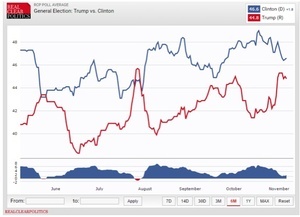
US election polls six month average via Real Clear Politics

If you look at a graph (above) of the US presidential public polls over the past 6 months you will see that there have only been two brief points where Donald Trump was ahead. The first was in June and the second was just after the Republican Convention.

For all the rest of the time she has been in front.

But you notice something else. Whenever the polls start to show him as getting close to winning, her support rises. When he seems out of contention, as he briefly did after the release of the “bus” video, her voters slip away. They only re-emerge, reluctantly, when they realise that he is once again back in contention.

Trump or, more correctly, the prospect of a Trump win has become a better motivator of Hillary’s supporters than the candidate herself. It is as if she has a cohort of ‘supporters’ who are more motivated to support her to stop Donald than they are to support her to make her President.

As we saw from Brexit, there are dangers in depending too much on public polls – and I stress the word public. Political parties do not do poll in the same way as news media.

Political party polling is more targeted and more refined – it looks for movement in specific sectors (demographic/geographic) of the electorate, not the whole mass.

Fortunately, for Hillary, there is evidence beyond the public polling which suggests that she will prevail.

The first is the changing nature of American society. The demographics suit her. Her supporters are mainly college educated, they are also non-white. These two groups are on the increase – more Americans are now college educated and a higher percentage of the America population is non-white.

Trump’s supporters are mainly white, male and non-college educated. For reasons I have explored here several times before; white blue-collar workers (and ex-workers) are angry and disillusioned with the system.

Perhaps some see Trump as their last best chance of having a white and male President, but most just want to stop globalisation and trade deals that have seen their jobs shipped out to Mexico and China. This includes a chunk of blue collar workers in the rust-belt states who supported Obama in 2012 and are now backing Trump.

The other factor favouring Hillary is the way that campaigns are organised and the critical importance of voter databases. These databases are vitally important to US elections in a way that they are not here, due to our increasingly strict data protection rules.

In America both parties know who they need to get to the polls in fine detail. Clinton’s campaign knows county-by-county just how many voters it needs to get out to vote and precisely who they are. Their ground war over the past few days and weeks has been focused on get out the vote (GOTV) operations in a way that much of Trump’s own campaign has not.

Trump himself prefers the air campaign, conducting big rallies and using the media to reach out to the voters. Corey Lewandowski, Trump’s one-time campaign manager, has been dismissive of these ground campaigns, calling them old fashioned.

While the Republicans (GOP) also have a strong ground campaign, especially as it has so many Senate seats to defend, its capacity and/or its willingness to assist the Trump effort varies from State to State. In many areas the GOP is using the probability of a Clinton win as a way to motivate its base to back its Senate and House candidates to counter balance a Clinton White House.

The third factor favouring Hillary Clinton is the Electoral College. Tight elections are the norm in the US. Obama’s margin of victory over Romney in the 2012 popular vote was 5 million out of the 129 million votes cast. Obama was the winner in 26 States, plus Washington DC, while Romney won in the remaining 24. In terms of the Electoral college Obama won by 332 to 206.

In 2000 George W Bush was the winner in 30 of the States, but just shaded the electoral college winning 271. In terms of the popular vote he lost to Gore who won 51 million votes to Bush’s 50.5 million.

The point of these examples is to show that Democrats are traditionally stronger in the States that have the higher electoral college votes – the so called Blue states – another factor giving Hillary the advantage.

Trump’s third campaign manager Kellyanne Conway conceded this point on CNN yesterday acknowledging that Hillary started the race with a secure 240 electoral college votes, based on safe Democrat states.

For these reasons, I think Hillary Clinton will be the 45th President, though I would not be willing to bet on the margin. My own best guess is that she will get 290 electoral college votes, but it all depends (once again) on Florida.

The one thing I am prepared to bet on, is that the furore and turmoil of this divisive and nasty campaign will not end with the result. If anything, it is likely to get worse. The next President may well be faced with a task and a challenge which the conduct of the campaign has ensured they cannot fulfil.

Derek Mooney is a communications and public affairs consultant. He previously served as a Ministerial Adviser to the Fianna Fáil-led government 2004 – 2010. His column appears here every Monday afternoon. Follow Derek on Twitter: @dsmooney

Top pic: Getty