
Author Archives: Harry Warren

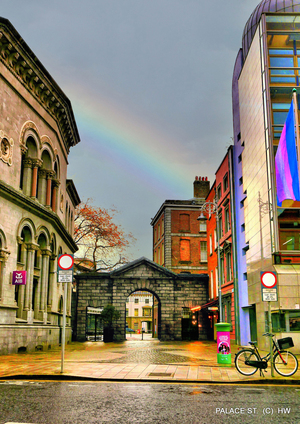
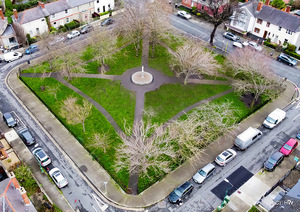
Come Friendly bombs. From top: Oscar Square Park entrance, Dublin 8. aerial view of Oscar Square Park; copies of ‘The Protection of your Home against Air Raids’ was supplied to every home in Dublin; St Patrick’s Park, Dublin 8; Merrion Square Park, Dublin 2

Hiding in plain sight.

Harry Warren writes:

I love walking through Dublin parks. City parks are a vital place of respite and rest. It’s good for the soul to take a leisurely stroll among the peaceful trees and greenery to unwind, perhaps take a seat and watch the world go by. Dublin’s parks have many historic features of interest that are hiding in plain sight but first let us point out where some these interesting features are located.

How about that nice hill in Merrion Square park where young and old run up and down at play, or the location of the normally beautiful view of St. Patrick’s Cathedral from the Bride St. side of Patrick’s park. I say “normally” as the Cathedral is being re-roofed and covered in scaffolding. Or that lovely little park in Oscar Square in the Tenters area in Dublin that has steps at its four corners? They all have one thing in common and their history should be told.

When World War II occurred Ireland being neutral declared an “Emergency”, perhaps ‘one of the understatements of the century. The population needed to be protected. A volunteer Corp known as the Air Raid Precautions was set up, generally referred to as the ARP. It was to be controlled by the local authorities, county councils and city councils.

Thousands volunteered. Dublin Corporation, being the largest of those authorities had full-time officials running the ARP. They produced a copy of a British publication “The Protection of your Home against Air Raids” that was supplied to every home and a decision was taken to build some public air raid shelters for fear of aerial bombing by Germany.

The historic features? The hill in Merrion Square park was built as an air raid shelter and the park in Oscar Square also had an air raid shelter. The Oscar Square shelter is in living memory of the older local folk in the area and they say the entrance to the shelter was along the steps at the entrance of the park. St Patrick’s park?

If you are enjoying the view of St. Patrick’s Cathedral from the Bride St. side of the park you are standing in the location of the original shelter. The above photos of the parks will give you a general idea where the bomb shelters were located.

Many areas around Ireland were bombed by Germany during WW II. Three bombings in Dublin of note were: –

The bombing in Rathdown park Terenure and on the corner of Lavarna Grove and Fortfield Rd on the 2 January 1941 with two homes destroyed, some injuries and damage to nearby homes.

The bombing raid on the morning of the 3 January 1941 in what was then Donore Tce. in the South Circular Road area. Fortunately, there was no loss of life but twenty people suffered injuries. There was extensive damage to property, three homes were completely destroyed, many more were damaged along with a nearby Jewish synagogue and a Presbyterian church.

And worst of all, the 1,000-yard swathe of destruction caused by two German aircraft killing 28 people with hundreds injured in the North Strand area on 31 May 1941.

So, the next time you are in those parks enjoy the fact we are living in more peaceful times and the parks now have more children’s playgrounds than bomb shelters.

All pics by Harry Warren

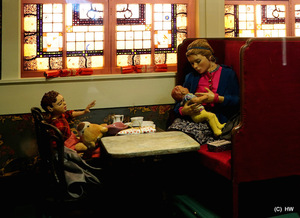
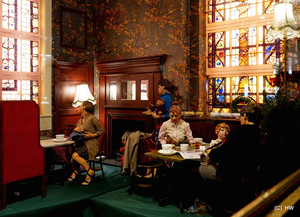
Bewley’s Christmas window (featuring a miniature Bewley’s).

Harry Warren writes:

In light of Johnny Ronan claiming that he owns the magnificent Harry Clarke stained glass windows in Bewley’s Cafe Dublin. I wonder will he also claim that he owns the miniature versions on display as a backdrop to the beautiful sculptures by Paddy Campbell currently on display in Bewley’s Cafe front windows?

All pics by Harry Warren

Earlier: Hate To be A Pane

Portobello Art Installation.

Harry Warren writes:

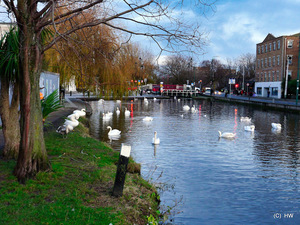
Portobello harbour in Dublin is a very nice area with its canal lock and a flock of very tame swans. Strolling along the canal I was very pleased to see the good use that has been made of the ugly hoarding around the building site of the new controversial 178 room hotel.

Despite widespread opposition An Bord Pleanála granted permission for the hotel despite its own inspector strongly recommending that planning should be refused on multiple grounds, but that is another story.

The hoarding has been turned into an outside art installation in a collaboration between Waterways Ireland and the National College of Art and Design. The NCAD students studying illustrations and graphics has resulted in a contemporary Zibaldone, or miscellany of artistic observations by the students, all of excellent quality inspired by our inland waterways.

The students artwork is playful and imaginative as well as creating some beautifully rendered information panels on nature and wildlife. So, if you find yourself in Portobello the art on display is well worth seeking out to enjoy.

Pics by Harry Warren

The Heart of The Liberties, Dublin 8

Harry Warren writes:

The Liberties area around the Coombe in Dublin is always worth a stroll, apart from it being a vibrant area in the heart of Dublin there are multiple items of cultural and historical interest to be enjoyed. Just off the busy shopping area of Meath St, there are two intersecting streets, Reginald St and Gray St.

The charming red brick houses in this part of the Coombe were built by the Dublin Artisan Dwellings Company in 1880-1882, chaired by the Victorian philanthropist, Sir Edward Cecil Guinness. Originally many of the houses were rented by the employees of the nearby Guinness brewery.

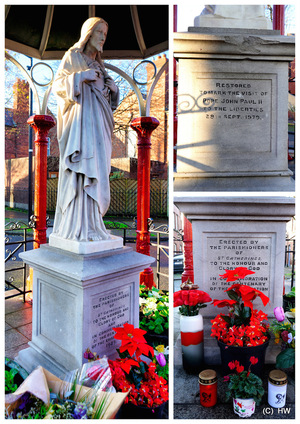
At the junction of Reginald Street and Gray Street there is a fine ornate structure with a statue of the sacred heart of Jesus at its centre. Perhaps surprisingly in these days of advancing secularisation, there are still many religious statues dotted around Dublin, particularly Marian statues, but this one is a statue of Jesus and it bears closer examination.

The statue is centred on beautiful wrought iron work set on an octagonal limestone base. In my over active imagination it always reminds me of a miniature Victorian band stand. I have heard it referred to as the Fountain, the Catholic Emancipation Monument or simply the Sacred Heart statue. Now a religious shrine it was originally a water fountain.

The fountain was commissioned in 1897 by the Earl of Meath, Reginald Brabazon to commemorate the visit of Queen Victoria to Ireland. The fountain was one of a large number celebrating Queen Victoria that were erected in Ireland and other British colonies of the time to a standardised design by Glasgow manufacturers Walter Macfarlane & Co. Manufactured at the Saracen Foundry, Possilpark, Glasgow, Scotland. There is a similar Victorian fountain at the bottom of Marine Road, Dun Laoire, but I personally prefer this one in the heart of the Liberties.

The water supply at the time was of poor quality so the fountain was installed to provide a source of clean water for the surrounding houses. Queen Victoria’s fountain did not last too long and as the words of the song “Dublin in the Rare auld Times” reminds us, there was a rebel streak in the Liberties. “A rogue and child of Mary, from the rebel Liberties,”.

During the War of Independence, there were skirmishes in the area and the fountain and canopy were severely damaged. There was an eagle originally mounted on the roof of the canopy but it was shot off by the Black and Tans and it is now replaced by a cross.

The copper canopy was once again damaged in the late twentieth century by a lorry. The current version of the shrine was restored to commemorate the visit of Pope John Paul II in 1979.

A plinth on the statue notes: –

“Erected by the parishioners of St. Catherine’s to the glory and honour of God and in commemoration of the Centenary of the Emancipation, 1929″

“Restored to mark the visit of Pope John Paul II to the Liberties 29th Sept. 1979″

So, the next time you are in the Liberties it is well worth diverting for a few minutes to enjoy this piece of street furniture. Proudly well maintained and kept in excellent order by local residents.’

Pics by Harry Warren’

The Grand Canal at Lullymore Terrace, Dublin 8 last Summer (top) and now (above)

Is this your bicycle?

Harry Warren writes:

Apologies in advance for implying that Broadsheet readers would convey themselves around Dublin on a bicycle, but did anyone perhaps have a heavy party night some months ago and forgot where they left their bike?

This biologically propelled device is parked for months beside the allotments along the Grand Canal at Lullymore Terrace, Dublin 8.

I photographed the top picture last Summer and promptly forgot about it, note the bicycle has a rather tasteful floral camouflage with just a portion of the handlebars visible The bottom picture was photographed more recently, note the bicycle is now quite visible.

Anyone?

St. Kevin’s Park, Camden Row, Dublin 8.

Harry Warren writes:

Dublin has some beautiful well-known parks but one of my favourites is the petite St. Kevin’s Park on Camden Row. It is usually bypassed by tourists but favoured by locals. St Kevin’s Park is unusual in having the ruins of a church and being a half park and half graveyard.

The grounds were redeveloped some years ago and the cemetery became todays park. It has a long history, the first mention of a church on the site dates back to the 13th century. The church ruins in the park today are a later addition built in 1750. This church was closed in 1912.

The park grounds still have some notable headstones in situ but the majority have been removed. The old headstones now line the perimeter of the park and more are around the walls of St. Kevin’s church.

Unsurprisingly the park is reputed to be haunted. Archbishop Dermot O’Hurley was buried there after being executed for treason in the 16th Century. He secretly baptised Catholics during penal times in St Kevin’s. He was eventually arrested, imprisoned and tortured and was sentenced to death. The authorities had him executed by slowly hanging him until dead. He was buried in St. Kevin’s but his grave is unknown today.

His spirit is said to be seen in the park where he performed the baptisms. During the transformation of the graveyard into today’s park, the owners of graves that could be traced were offered to have the occupants remains exhumed and buried elsewhere but many graves were unidentified and their bones still lie there today. The angry souls of these disturbed graves reputedly haunt the park.

Notable existing graves on view in the park are:

The Moore Family, relatives of Thomas Moore the poet and composer.

Hugh Leeson, brewer, and whose family gave its name to Leeson Street in Dublin

Jean Jasper Joly captain of the Irish Volunteers in 1798.

John Keogh, friend of Theobald Wolfe Tone, he once owned the land that is now Mount Jerome Cemetery in Harold’s Cross

Also, of note, the 1st Duke of Wellington of the Battle of Waterloo fame, was baptised in St Kevin’s.

During the 18th century the cemetery was a hunting ground for body snatchers, a very lucrative business. After dark a fresh grave with loose soil was sought out. A hole was quickly dug down to where the head lay . On reaching the coffin, two broad iron hooks under the lid, pulled forcibly up with the rope, broke off a sufficient portion of the lid to allow the body to be dragged out.

The body was stripped of the grave clothes, which were scrupulously buried again. The body was then put in a sack for transport and the soil was restored. The body was then sold to one of Dublin’s many medical schools, Trinity College, the Royal College of Physicians and the Royal College of Surgeons.

There is a dark history to the park as well. Tommy Powell a six-year-old child, was tragically murdered here in 1961. Broadsheet had an excellent 2017 article about the unsolved murder that you can read at this link here.

Today St. Kevin’s is a haven for wildlife. There are many species of birds including wrens, blue tits, robins, magpies, blackbirds and wood pigeons as well as mammals like hedgehogs, urban foxes, squirrels and wood mice.

Three species of bat are to be found in the park, Leisler’s bat, the common pipistrelle and the soprano pipistrelle. These bats make use of the ivy around the old church ruin as a roost. It is a lovely place to visit but perhaps for those of a nervous disposition, not after dark.

Pics by Harry Warren
Previously: Harry’s Dublin on Broadsheet

The Iveagh Gardens, Dublin 2.

Harry Warren writes:

I created this collage (above) of the same trees in the Iveagh Gardens in Dublin over a few seasons. Nature doing what it does best. The photos were taken during Summer, Autumn and now what I fear for some, is going to be a long Winter.

Because of the worldwide outbreak of COVID-19 it has been a rough year for many up to now. One can see how fractious many of the posts on Broadsheet have become but hope is on the horizon, everything comes in cycles and I do look forward to Spring blossoming when it arrives. All things come to pass and the current scenario will fade away in time. Watch out for the photo when Spring returns.

Pics by Harry Warren

From top: Palace Street, Dublin 2 (pics 1 and 2); Dean Street and Kevin Street Cross, both Dublin 8

On Dublin’s shortest streets….

…Harry Warren writes:

Just before one of the last lockdowns, I was happily enjoying a coffee outside of the lovely French restaurant Chez Max on Palace Street, Dublin 2. An American gent at the table beside me, in all seriousness said to his lady friend, “so what do they have to be indignant about? “Maybe the name is Olde English”, she replied”.

I couldn’t resist joining in the conversation. “Are you admiring the building? The Sick and Indigent Roomkeepers Society was a charity and its now a listed building”.  “Were they indignant because they were poor?”, he replied. Then badly paraphrasing G.B. Shaw, I offered “two nations divided by a common language”, gently advising that “indigent” now a rarely used word meant “poor”.

The penny finally dropped, we laughed and we had an enjoyable conversation about the locale and Palace Street. They were quiet taken with Palace Street and said it was the smallest street they had ever seen.

Palace Street. is one of the shortest streets in Dublin, it links Dame Street to one of the entrances to Dublin Castle. One side of the street has a fine elegantly designed building now an AIB bank. On the opposite side at number one is Chez Max and number two was the home of Dublin’s oldest charity, The Sick and Indigent Roomkeepers Society. It was founded in 1790 “for the relief of the poor without religious discrimination.”

Number three is a hideous Lego block lump of architecture, oversized, grimly designed and lacking in any finesse, popularly known as Robocop on Dame Street.

Palace Street. is one of the shortest streets in Dublin, followed by Dean Street in the Liberties [Dublin 8] but I would argue that Kevin Street Cross has to be the shortest of them all. Kevin Street Cross joins Bride Street. with New Bride Street on the way to St. Patrick’s Cathedral. Other short streets in Dublin? There is a hint in my name of my favourite one. I am sure there are more.

If any Broadsheet readers know of any shorter street or road in Dublin than Kevin Street Cross, I would love to read a comment in the Reply section.

Anyone?

Pics by Harry Warren

St Patrick’s Tower (and pear tree), Roe Lane, Dublin 8.

Harry Warren writes:

If you are strolling along Thomas St in Dublin, walking past the St. James Gate Guinness Brewery entrance, perhaps dreaming of the halcyon days pre COVID-19 of quaffing a creamy pint, have you ever noticed that odd looking tower across the road topped with a green dome and where else in Dublin would you find a pear tree outside of a private garden?

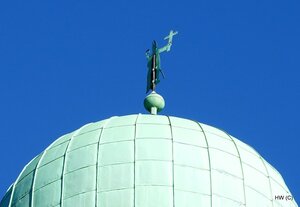
St Patrick’s tower was built in 1757 and was and arguably is, the largest smock windmill with a revolving top in Europe, today its sails are long since gone. The tower itself is 135 feet high and the width of the base is 70 feet. A smock mill is a type of windmill that resembles the shape of the smocks, the clothing originally worn by farmers in the Netherlands where these type of windmills were first erected. Why the moniker of St. Patrick’s Tower? If you look closely at the dome the wind vane on top is an effigy of St. Patrick.

The windmill was built to grind corn for the Roe Distillery that produced in excess of two million gallons of whiskey annually. The Roe family were very successful whiskey producers, by 1887 the distillery had expanded to 17 acres making it Europe’s largest distillery. Roe Whiskey was exported to the United States, Australia, Canada, as well as all over Europe.

The wealth of the Roe family became so great that they funded £250,000 (€20 Million euros in today’s money) for a major restoration of Christ Church Cathedral. Unfortunately, by the 1920’s the worldwide global whiskey market was in serious decline and by 1949 the distillery and its grounds were finally sold off to Guinness.

The pear tree? It is located at the base of the tower and in Autumn it produces a large crop of juicy pears. Perhaps someday it will be used in the manufacture of a nice pear liquor if they ever open a new distillery here again.

Today the tower is a feature of The Digital Hub in Thomas Street, the tech and media enterprise centre. There is seating in front of the tower and it is a lovely spot to enjoy a coffee in the Autumn sunshine.

Pics by Harry Warren

Meanwhile…

Oh.

The Iveagh Markets, Dublin 8.

Harry Warren writes:

A cheeky grin adorns the face of an excellent sculpture that winks at you as you walk past the Iveagh Market building in the Liberties area of Dublin 8. Beautifully detailed, the limestone carving is one of eight very individual faces of various ethnic groups that peer out upon the street at passers-by. Who or what do they represent?

There are various theories but according to Samantha L. Martin-McAuliffe, a lecturer in the School of Architecture at University College Dublin, they are described as being representations of the nationalities that traded with Ireland at the turn of the twentieth century, as noted in The Ethics of Giving and Receiving: a Study of the Iveagh Markets, Dublin.

According to the Irish Georgian Society, following the demolition of buildings in what is now St Patrick’s Park, next to St Patrick’s Cathedral, “Street traders lost their traditional market rights”

As a result, Lord Iveagh, Edward Cecil Guinness, built the iconic building of 30,000 Sq. ft on Francis St. and John Dillon St. to house their trading stalls and on completion handed it over in trust to Dublin Corporation.

The markets consisted of, “two covered markets for the sale respectively of old clothes and fish, fresh fruit and vegetables”. The building of the Iveagh Markets began in 1902 and were completed in 1906.

Like many modern building projects costs soon over ran the budget. Originally budgeted for £45,000, the final cost was about £60,000 a very substantial sum in those days. For many decades the Iveagh Markets once housed a bustling market activity of new and second-hand clothing as well as a food market selling grocery and meats.

Over the years the markets were gradually allowed to fall into disrepair by Dublin City Council. In 1997 they were closed and sold to a private developer. Disgracefully, for twenty years the market building was left to rot instead of being developed.

In January 2018, Dublin City Council repossessed the market site, now in an advanced state of dereliction but apart from securing the building no further development has happened.

Dublin and Dubliners deserve better. So, the next time you pass by look up and enjoy the sculptures and wonder at the inaction of Dublin City Council allowing an architectural gem fall into ruin.

Pics by Harry Warren