
Author Archives: Harry Warren

Dublin’s Diving Bell.

Harry Warren writes:

Strolling along Dublin’s Docklands today and being of a certain age you may notice that the city quays have changed so much over the years that it can be hard to recognise them. Old dilapidated once busy warehouses and depots are now modern apartments and office blocks.

Standing along the North Wall Quays and looking across the other side of the river Liffey, I often noticed what I incorrectly thought was the remains of an industrial chimney of some sort on Sir John Rogerson’s Quay. On closer inspection it is an amazing piece of Dublin’s industrial maritime heritage and its story should be told.

The orange painted Dublin Diving Bell was used in the building of Dublin Port and its quays and walls. It is a remarkable feat of Irish engineering. The bell was designed by a Victorian port engineer with the wonderful name of Bindon Blood Stoney and it was constructed by Grendon and Co. in Drogheda. It went into operation in 1871 and was used in the building and maintenance of Dublin Port and the Port’s quay walls right up until 1958.

Bindon Blood Stoney was a superb engineer, not only did he design the Diving Bell and its associated equipment, he also engineered the Boyne Viaduct in Drogheda, the renewal of Dublin’s O’Connell Bridge (then Carlisle bridge) and the quay walls including Sir John Rogerson’s Quay and North Wall Quay Extension.

Stoney became Chief Engineer at Dublin Port in 1867 and his engineering expertise transformed the port. Half the quays along the Liffey were converted into deep-water quays using his new and ground breaking method of underwater construction which he had first advocated in 1861.

Huge concrete blocks weighing an amazing 350 tons were constructed on a purpose-built block wharf and then positioned into place utilising a specially engineered crane, a “floating shears” designed by Stoney. Workers in Stoney’s Diving Bell had levelled the Liffey river bed readying it for the placement of the massive concrete blocks.

Stoney described his method in a paper, ‘On the construction of harbour and marine works with artificial blocks of large size’, delivered to the Institution of Civil Engineers in London in 1874, winning the Institution’s Telford Medal and Premium for that year.

Stoney also designed the largest in their day, hopper barges, for dredging the port to keep it free from silt which was collected and deposited out at sea. Unusually for the time he was also responsible for introducing a graduated pensions scheme for his workers.

Standing in front of the ninety-ton Diving Bell along Sir John Rogerson’s Quay you will see it is quite large. The height from the top of the access shaft to the base of the air-lock chamber is forty-four feet. The bell chamber where five men worked in very harsh conditions is twenty feet square in area and the access shaft with its airlock chamber is three feet in diameter.

The bell had six and a half feet of headroom inside. A steam powered barge with lifting gear and a horizontal air pump accompanied the Diving Bell, pumping compressed air into the bell chamber at 20lbs per square inch. Even though the surrounding water cooled the air going to the bell chamber, men working in the chamber found the air and temperature oppressively hot.

In later years the chamber had an electric light and a telephone connection and the men worked in five-hour shifts. They also had to take account of the tides, resulting in going down in the bell in the small hours of the morning or very late at night.

Working in such harsh conditions and such high pressure, many men suffered burst ear drums and bleeding from their nose and ears. The effects of the air pressure on men’s lungs were severe and coughing was very painful. As a result of working in the bell it was said one individual could whistle through his ear!

Despite the very harsh working conditions and throughout the history of the diving bell, there is no recorded instance of any serious accident or fatality. Not only was the Diving Bell used in Dublin Port it was also used in laying the foundations for the Bull Wall Lighthouse and laying concrete reinforcing blocks around the Poolbeg lighthouse.

Today, the Diving Bell sits atop a two-metre-high plinth. When it is again open to the public the plinth allows visitors to walk under the bell chamber and experience a sensory water feature that gives a hint of what it was like working in the chamber. There is also audio-visual information telling the story of the bell and the brave workers who built Dublin Port.

So, the next time you are in that part of the Quays enjoy a marvellous piece of Victorian engineering and give a nod to the hard-working Dubliners who courageously worked under the Liffey’s waters.

All pics by Harry Warren

Meanwhile…

Al writes:

Further to Harry’s article about the Diving Bell…please see this short documentary (above) The Coop produced for Dublin Port about same…

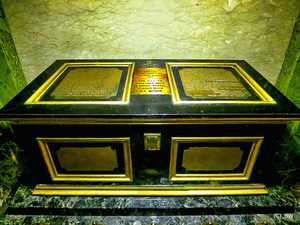
Whitefriar Street Church, Dublin, containing St. Valentine’s bodily remains

St Valentine and Dublin.

Harry Warren writes:

Ambling around Dublin during the pandemic lockdown there are not too many places opened to enjoy, but for the romantically inclined this weekend on the 14th of February, St Valentine’s Day, perhaps consider a visit to Whitefriar Street Church. It has an interesting history, as it is somewhat surprisingly the resting place of the man himself, St. Valentine.

Whitefriar Street Church in Dublin is located between Aungier Street and Wexford Street and is just a few minutes’ walk away from St. Patrick’s Cathedral and park. The church building has a rather dull exterior but the interior is quite beautiful.

It was built by George Papworth, a noted architect, and was consecrated by Dr. Murray on November 11, 1827. Built of stone and covered with Roman cement it measured 200 feet long, 34 feet wide and cost in those days a princely sum of £4,500. In 1950 a statue and shrine were built to honour St. Valentine and they were installed in the church.

Walk half way down the church on the right-hand side and you will find the statue and reliquary of the saint. The reliquary contains Valentine’s bodily remains and a plaque informs, “This shrine contains the sacred body of Saint Valentinus the Martyr, together with a small vessel tinged with his blood “.

Be mindful that on February 14, the Reliquary is removed from beneath the shrine and is placed before the high altar in the church and venerated at the Masses where there is a ceremony of the Blessing of Rings for couples hoping to be married.

Believer or unbeliever, you would have to be a hardened cynic not to be moved by the loving comments made by visitors in notebooks placed beside the saint’s altar.

Most commentators sign their surnames and note their country of origin, the visitors are from all over the globe. Heartfelt petitions are wrote invoking the saint to heal and bless their loved ones and for love, “For Paula and Ben to be in love forever”, “To love one another always like today”, “That she will accept my proposal on St. Valentine’s Day”.

But how did the remains of a Roman St Valentine come to rest in Whitefriar Street in Ireland?

Throughout the middle ages, the relics of Saint Valentine were kept in the Church and Catacombs of San Valentino in Rome, later they were relocated to the church of Santa Prassede during the pontificate of Nicholas IV.

During the nineteenth century a famous Whitefriar St Carmelite preacher was renowned for his oratory. Fr John Spratt was a native Dubliner who was born in Cork St. Dublin. He visited Rome in 1835 and because of his powers as a preacher he became known to Pope Gregory XVI who gifted his Church St Valentine’s relics.

The bodily remains of Valentine contained in a casket were brought to Whitefriar Street Church in 1836, and since then have been venerated especially around the Feast Day of St. Valentine on February 14th. The flower-crowned skull of Saint Valentine remained in Rome and it is on display in the Basilica of Santa Maria in Cosmedin, Rome.

There are many legends associated with St Valentine and how Valentine became associated with lovers and here are a few. Like many Christian saints we have to go back to the Roman era. In Roman culture polygamy was popular but the church’s teaching promoted monogamy, a marriage between one woman and one man.

St Valentine was a priest during the reign of the Roman Emperor Claudias II, who persecuted the church during that time. Claudias II, wanting to strengthen his army, passed an edict that forbade the marriage of his young soldiers based on the idea that unmarried soldiers fought more fiercely than married soldiers, surmising that married soldiers would fight less fiercely being afraid of what might happen to their wives or families if they died.

Against the Emperor’s wishes Valentine encouraged couples to marry and he secretly married them in direct contradiction of the edict. According to legend, in order “to remind these men of their vows and God’s love, Saint Valentine is said to have cut hearts from parchment”, giving them to these soldiers, a possible origin of the widespread use of hearts on St. Valentine’s Day.

For performing such marriages Valentine was imprisoned and tortured and put on trial. One of the men who was to judge him under Roman law was a man named Asterius, he had a daughter who was blind. Valentine was supposed to have prayed with and healed the young girl’s blindness. As a result of this, Asterius converted and became a Christian.

In the year 269 AD, Valentine was found guilty and condemned to a three-part execution of a beating, a stoning, and finally decapitation because of disobeying and denying the edict of Emperor Claudias II. The legend tells that the last words that the soon to be martyred Valentine wrote were in a note to Asterius’ daughter. He inspired today’s romantic missives by signing it, “from your Valentine“.

So, if you are lucky to have a significant other, keep the tenderness of a good heart, share your love and squeeze their hand a little tighter this Valentine’s Day.

All pics by Harry Warren

From top: James Connolly, Anna Livia Plurabelle, Phil Lynott, Patrick Kavanagh, Oscar Wilde with Constance Wilde (top inset) and the torso of a young Dionysus (inset below) and ‘Best Night Ever’ in the Botanic Gardens

Dublin statues.

Harry Warren writes:

If you are having a stroll around Dublin you are bound to pass some wonderful sculptures. Many are worth a visit and it is a good opportunity to stretch your legs and get some fresh air. If you are lucky to be abled bodied, Dublin is a lovely city to explore on foot, being relatively flat and with plenty of sculptures within walking distance to enjoy.

Most European cities have statues of their kings and queens and politicians but in Dublin along with our political figures, we also give pride of place to our cultural heroes our poets, dramatists and even some mythical creatures.

In no particular order here are some of my favourite statues and I am sure Broadsheet readers may be kind enough to share their favourites in the reply section below.

Anna Livia Plurabelle, the lady of the river, as she is portrayed in James Joyce’s Finnegans Wake as a personification of the River Liffey. Some years ago, in a bout of religious fervour many people all over Ireland genuinely believed that they witnessed statues of the Virgin Mary move and that is another story, but this statue really did move!

The sculptor Éamonn O’Doherty was commissioned by Michael Smurfit to create the statue that would celebrate Dublin’s Millennium. It was originally sited in a fast-flowing fountain in Dublin’s O’Connell Street. Unfortunately, it became a target for litter louts along with the occasional box of washing up powder being dumped in resulting in the street being covered in foam. To Dublin City councils shame they removed the statue in 2001 and hid it away for ten years in a crate in St Anne’s Park in Raheny.

Eventually, in consultation with Éamonn O’Doherty who wanted her to be located near the Liffey in water, in February 2011, Anna Livia was finally relocated to the Croppies Acre Memorial Park, Wolfe Tone Quay. Her journey to the park was very appropriately by boat. The Ringsend Boat Club proudly floated her down the River Liffey to a purpose-built pond when she reclines very elegantly today.

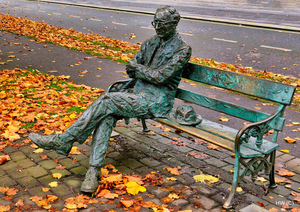
Patrick Kavanagh
, a superb poet and whose poem “Raglan Road” was immortalised in song by Luke Kelly of the Dubliners. After leaving what was then Parson’s bookshop on Baggot Street Bridge, Patrick often sat along the Grand Canal contemplating the water deep in whatever thoughts a poet may have.

The sculptor John Coll took his inspiration from the Kavanagh poem, “Lines written on a Seat on the Grand Canal”. He created a superb life-sized sculpture of Kavanagh sitting on a bench that you can view at the Baggot St end of the canal. A plaque quotes “Leafy-with-love banks and the green waters of the canal Pouring redemption for me”.

James Connolly
, Socialist and Commandant of the Dublin Brigade in the Easter Rising, his statue is on Beresford Place. Sculpted in 1996 by the Éamonn O’Doherty, it is a fine bronze life-like statue of Connolly proudly standing in front of a curved wall with a sculpted plough and the stars replete with one of his best-known quotations, “The Cause of Labour is the Cause of Ireland / The Cause of Ireland is the Cause of Labour”.

Connolly was born into poverty in Edinburgh, Scotland, to Irish parents and for his part in The Rising, was sentenced to death. If the mortally wounded Connolly first tied to a chair and then strapped to a stretcher to enable his execution, wasn’t so cowardly executed by a British firing squad, I often wonder how different modern Irelands politics would have been if a true socialist had been elected to government during the formation of the state.

Phil Lynott
, Phil was best known as the lead singer and bass player for the Rock band Thin Lizzy. He was an excellent frontman and lyricist. “When I’m in England I say I’m from Ireland, when I’m in Ireland I say I’m from Dublin, when I’m in Dublin I say I’m from Crumlin, when I’m in Crumlin I say I’m from Leighlin road, when I’m in Leighlin road I say I’m a Lynott”.

Paul Daly‘s superb bronze sculpture of Phil Lynott is outside of Bruxelles Pub on Harry St reet just off Grafton Street. You may have to wait a moment to view the statue as so many fans commandeer it to take selfies. Daly managed to capture the swaggering essence of Phil whose life ended tragically far too early in 1986.

Unfortunately, like many of the cut throat deals that permeate the rock business Paul struggled to receive any royalties for the hundreds of miniatures of his work that have been subsequently sold. Today Daly is continuing to create new art and is selling it on his website , including wonderfully detailed miniatures of Lynott, Freddie Mercury and Rory Gallagher.

Dublin’s Botanic Gardens has several statues but I love the statue of two women by local sculptor Bob Quinn, located near to the entrance in front of one of the wonderful Victorian glass houses. It is titled ‘Best Night Ever’. The two women are sculpted walking arm in arm on what I like to imagine, a girl’s nights out, looking blissfully happy in each other’s company, one carrying her hand bag, the other her shoes. There is a joyful animation to it that almost makes the sculpture appear to be moving.

Oscar Wilde’s sculpture in Merrion Square park, A three-part masterpiece by sculptor Danny Osborne, sited across the road from 1 Merrion Square, Wilde’s childhood home. Today Wilde is one of Irelands most popular and loved writers. Echoing his life, if you look at Oscar’s face notice that the left side of his face has a sardonic grin, while the right side is sad.

His sculpture is accompanied on two separate columns by his pregnant wife Constance, and on the other, a torso of a young Dionysus. The two columns are covered in quotations of Wilde’s witticisms and writings. The quotes are personal favourites by a mixture of poets, politicians and various artists, people like Christy Moore, Seamus Heaney, Michael D Higgins and Robert Ballagh. All are well worth a read.

So, as you ramble across Dublin ponder a while and enjoy the statues, they all have a tale to tell.


All pics by Harry Warren

Ranelagh Gardens Park, Dublin 6.

Harry Warren writes:

If you are passing through Ranelagh in Dublin, I would heartily recommend a stroll through Ranelagh Gardens Park. It is a delightful small park somewhat hidden in plain sight making it easy to bypass.

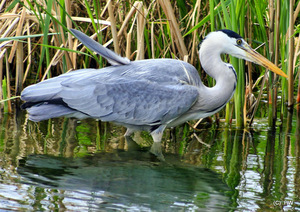
The main entrance to the park is via a fine granite archway underneath the Luas line. It also has a few little-known entrances around the side roads of Ranelagh that are mainly familiar to locals. The gardens consist of an ornamental pond surrounded by green space and mature trees with plenty of wildlife, swans, ducks, Leisler bats and fish whose stock was depleted on the day I visited by a hungry heron.

At the Chelmsford Ave end of the park there is a commemorative statue of Richard Crosbie. The park is well worth a visit and it has a very interesting aeronautical history whose story should be told.

Originally the site of the 18th century Willsbrook House, the house and its gardens were bought by the entrepreneur, William Hollister, who created a five-hectare pleasure garden and opened them in 1769 for the enjoyment of Dublin’s gentry, featuring carnivals, balls and such like pleasures.

Hollister named the gardens after Lord Ranelagh from Co Wicklow who owned similar gardens by the Thames in London. He was a canny businessman always on the lookout for new attractions and publicity, hitting gold when he allowed Richard Crosbie to attempt the first balloon ascent in Ireland from his gardens on January 19th, 1785. Crosbie was a pioneering aeronaut and was born at Crosbie Park, Co. Wicklow, in 1755.

Richard Crosbie has an interesting history. When he was a student at Trinity college, he was the leader of the notorious Pinking Dindies, one of the many armed gangs in Dublin at the time along with the Bucks and the Cherokees. Their members were from the upper echelons of society and they terrorised “single men and citizens who neither wore fine clothes nor swords” also extorting money from brothel madams and their customers whilst still finding time to engage in duels and fights with their gang rivals.

The “Pinks” were armed with short swords from which they derived their name, they also carried knives, falchion and shillelaghs. When they weren’t fighting one another, they had vicious battles with members of the city’s Night Watch.

“They were of imposing appearance, being handsome and well made in general; so that, individually, you could not suspect them: it was by their acts only you could convict them, and they commonly pursued their schemes in parties, and by night; and they were so well prepared for battle that the ancient and quiet watchmen, the only protectors of the citizens of Dublin at that period, were worsted in almost every attempt made to subdue them…”

Outside of being a leader of the Pinking Dindies, Crosbie was described as being:

“…beyond all comparison the most ingenious mechanic I ever knew. He had a smattering of all sciences and there was scarcely an art or trade of which he had not some practical knowledge … he was very good tempered, exceedingly strong and as brave as a lion – but as dogged as a mule. Nothing could change a resolution of his when once made and nothing could check or resist his perseverance to carry it into execution’”

Inspired by the first ever hot air balloon ascent by the Montgolfier brothers in France in 1783, Crosbie constructed a balloon his own “Aeronautical Chariot”. Displaying his scientific knowledge, he chose hydrogen gas rather than hot air to create lift in his balloons. His ascent was to take place in Ranelagh.

Prior to his manned flight he tested his balloons. To entertain his audience and to drum up publicity, he used a tethered balloon to send up various animals culminating in a free flight with a cat on board. The balloon floated away and was reported being visible off the coast of Scotland. Carried by the wind it eventually descended into the Irish Sea near the Isle of Man. Fortunately the cat, presumably having lost one of its nine lives, survived its adventure and both the cat and balloon were recovered by a passing ship.

On the 19 January 1785 thirty-year-old Richard Crosbie; wearing an extravagant outfit of a long robe of oiled silk, lined with white fur coupled with a waistcoat and breeches of white quilted satin, red Morocco boots and a Montero cap of leopard skin climbed into the gondola of his balloon in Ranelagh Gardens.

The balloon flamboyantly decorated with the Arms of Ireland and images of Minerva and Mercury soared aloft. A huge audience for its time, over 30,000 spectators witnessed Crosbie’s ascent, the first successful human flight in Ireland. He had set himself the task of flying across the Irish Sea but he got no further than making a safe landing in Clontarf. His flight was a great success and it was a truly remarkable feat coming only 14 months after the first-ever manned balloon flight by the Montgolfier Brothers in November 21, 1783.

Crosbie now an established aeronaut, made several other flights in Ireland and America. In July 1785 he again attempted an Irish Sea crossing but inclement weather forced him to land in the sea just off the Welsh coast. Crosbie became famous in Ireland and abroad for his aeronautical exploits.

A few years later in 1787 the new Rotunda Gardens opened on the North side of Dublin and they began to draw the fashionable set, Hollister losing business decided to sell the gardens. They were soon reopened by another entrepreneur but the gardens gradually became less successful over time.

In 1788, Ranelagh Gardens were sold off to a community of Carmelite nuns who moved into Willsbrook House. It was an enclosed order resulting in Ranelagh Gardens being closed to the public for close on 200 years. After the Carmelites left Ranelagh for pastures new, various portions of the gardens were sold off to developers and what was left of the gardens, now shrunk to 1 hectare were taken over by Dublin City Council who now maintain them today.

So, if you find yourself in the gardens pause for a moment and spare a thought for the remarkable aeronautical pioneer Richard Crosbie who made the first successful human flight in Ireland.

All pics by Harry Warren

Sunlight Chambers.

Harry Warren writes:

Walking along Wood Quay towards the city centre on a miserable rainy January day, I couldn’t help but glance through the grey drizzle at the architectural monstrosities of Dublin Civic Offices.

They were erected in one of the greatest acts of cultural vandalism in Dublin’s history. The most historically significant area of Viking Dublin was literally destroyed by the then Dublin City Corporation in the name of progress during the late 1970s and early 80s.

The offices, visually having as much merit as some hideous wartime command bunkers, were dumped upon and destroyed one of the greatest and best-preserved Viking settlements anywhere in Europe.

My mood dampened. Ironically a parked cars radio was playing Morrisey’s “Every Day is like Sunday” with the classic lines “In the seaside town, That they forgot to bomb, Come, come, come, nuclear bomb”. Never a more appropriate sentiment I thought.

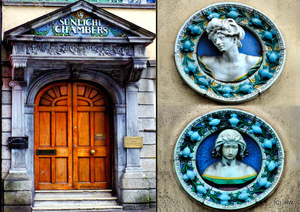
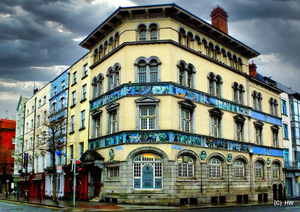
My spirits lifted when I reached Capel St Bridge (Grattan Bridge). The delightful Florentine style Sunlight Chambers building came into view on the corner of Parliament Street and Essex Quay.

Originally it was the Irish headquarters of Lever Brothers and it was elegantly designed by Edward Ould of Liverpool in 1899. The building was named after their most successful product Sunlight soap. It was one of the first soaps to be made on an industrial scale and brought the company huge success. It is still on sale today in Europe. Levers later merged with a Dutch manufacturer and became Unilever. Today you probably buy their supermarket products like Domestos, Surf, Persil, etc.

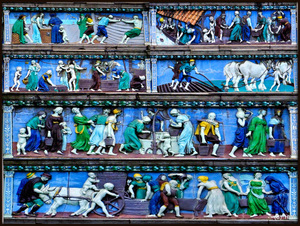
Sunlight Chambers was built to impress being Lever’s Dublin headquarters, with its renaissance stye windows on the upper floors, a red terracotta roof with wonderfully sculpted glazed terracotta faience’s or friezes on two levels. They depict animated scenes of agriculture and industry and the making of soap, along with some delightfully sculpted ladies doing washing. Sexist? perhaps by today’s standards but it is of its time and the detail and colours of the friezes are wonderful.

The sculptor, Conrad Dressler, designed and crafted the series of four roundels and twelve panels around the three faces of the building. The glazed ceramic friezes were made in 1902 in Dressler’s pottery works in Buckinghamshire. They were commissioned to fit in with W. H. Lever’s philosophy that “good art should enrich everyday life“.

So, the next time you are in that part of Dublin City, look up and reward yourself with a bit of time to enjoy the beauty of the sculptures and the story they tell.

All pics by Harry Warren

The Royal Hospital Kilmainham grounds include the faded headstone of the grave of a horse (above) buried in June 1899

Royal Hospital Kilmainham’s cemeteries.

Harry writes:

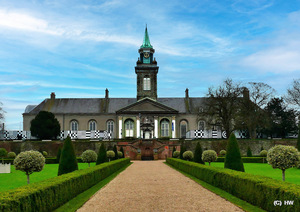
The Royal Hospital Kilmainham, now the home of the Irish Museum of Modern Art is well worth a visit. Designed by the architect William Robinson, the classical design of the building was inspired by Les Invalides in Paris. It was built as a retirement home for old soldiers. The foundation stone was laid in 1680 and it took on its first pensioners in 1684.

During the 243 years after it was opened, thousands of military pensioners lived out their final days within its walls. The last pensioner resident there was in 1927. Shortly afterwards it became the Garda Headquarters until 1949 when it was vacated as the building had many structural defects. It was used for storage facilities until it was beautifully restored during 1980 to 1984 and then reopened as the home of the Irish Museum of Modern Art.

The surrounding grounds include a couple of very historic cemeteries and a “long walk” where the retired veterans took their exercise. There is also a beautifully restored formal garden to enjoy, with ornate pathways, fountains and flowers. Tucked away in a corner of the gardens a very interesting grave but more about that later.

Down at the western ends of the grounds there are separate cemeteries for the hospital’s former residents, officers in one, rank-and-file soldiers in the other. Sited at the Kilmainham entrance is the easy to miss Bully’s Acre Cemetery as it is surrounded by high walls. One of Dublin’s oldest cemeteries, there is at least a thousand years of Dubliner’s beneath its soil.

The number of burials in the cemetery has been estimated to be at least 200,000. Brian Boru camped here on the eve of the Battle of Clontarf in 1014. Both his son and grandson were slain in the battle and are thought to be among the graves.

After the revolutionary Robert Emmet was hanged outside of St Catherine’s Church in Thomas Street on September 20th, 1803, his head was displayed to the crowd by the hangman Thomas Galvin. The remains of Emmet’s body were then taken to Bully’s Acre and he was temporarily buried there. Emmet’s remains were later secretly removed from Bully’s Acre and allegedly reinterred in St Michan’s Church in Church Street, Dublin, due to its associations with the United Irishmen. No one knows where his actual grave is sited and its location today remains a mystery.

Bully’s Acre was on “common” ground and burials could be performed without any fees being paid so it made it very popular with the poor of Dublin for interring their loved ones…and reputedly quite convenient for disposing of bodies that met a violent end. By the 1790’s most of the burials were in shallow graves little more than a few centimetres below ground level.

There are gruesome historical reports of “swine devouring human bodies while in the most pernicious state of putrefaction, and the torn remains of males and females left exposed to public view”. It was also a burial ground ripe for its picking by body snatchers and “resurrectionists” due to its shallow graves and plentiful supply of pauper burials. Many bodies were stolen on behalf or by the medical profession to study anatomy.

Cholera broke out in Dublin in 1832 and during a 10-day period over 500 bodies were buried in the graveyard. Over time the graveyard fell into a terrible state of squalor and there was a closure notice by the then Board of Health for the city of Dublin that noted, “the immense number of bodies buried there”, “many bodies lying exposed without any covering”, which eventually ended in its closure. Today the Office of Public Works now maintains the graveyards and they are kept very well by them.

And the grave that I mentioned earlier in the Royal Hospital Gardens? It is the grave of a horse buried in June 1899. The headstone notes that the horse’s name was “Vonolel”. He was decorated repeatedly by Queen Victoria for his services in Afghanistan and other battles in India, Burma, and South Africa.

He was the white coloured charger of the Anglo-Irish military man, Lord Roberts, the chief of staff of the British army during the heyday of empire. Lord Roberts estimated his faithful horse had travelled 50,000 miles during his career and was never sick or lame until the day he passed away in Kilmainham. A painting of Vonolel and Lord Roberts hangs in the Tate, London

A sentimental verse on the now faded headstone displays: –

“There are men both good and wise

Who hold that in a future state

Dumb creatures who have served us here below

Shall give us joyful greeting when we pass the golden gate.

Is it folly that I hope it may be so?”

So, the next time you visit IMMA at the Royal Hospital Kilmainham, enjoy a stroll around the grounds, you are surrounded by history.

All pics by Harry Warren

St Stephen’s Green on New Year’s Eve

St Stephen’s Green Park.

Harry Warren writes:

St. Stephen’s Green is arguably the prettiest of Dublin’s parks, looking at its elegant design and beautiful gardens it’s hard to believe that it was once a marshy bogland on the edge of the city. It was a “common”, where people brought their livestock to graze free of charge.

In 1663, the city government closed off the centre and the rest of the land was used for development. Private homes were built to surround the edge and what was left of the green space was kept for the wealthy residents who used it and developed it as a private park for their exclusive enjoyment.

Despite many attempts by civic minded folk to open the park to the public it remained in private ownership until 1887.The city passed a new act at the urging of A.E. Guinness (of Guinness brewery fame) to open the park to one and all. Guinness paid for the modern redesign of the park and it formally opened to the people of Dublin in 1880 with some fanfare.

During the 1916 Rising, the park became a battleground when rebel freedom fighters dug trenches and blocked off the roads forming a stronghold against British troops.

Surprisingly in the midst of the carnage of battle, both sides called a short ceasefire to allow the groundskeepers to come and feed the ducks in St. Stephen’s Green pond!

Today unfortunately the duck population has been decimated by seagulls and very few ducks are to be seen in comparison to even a few years ago.

St Stephen’s Green is named after a church (and a leprosy hospital) also called St. Stephen’s which were founded in the area in the 13th century.

Pics by Harry Warren

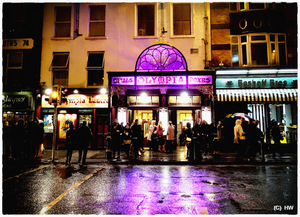
The Olympia Theatre Ghosts.

Harry Warren writes:

Christmas time has long been associated with magic and supernatural happenings that have no rational explanation. During the mid-winter solstice when the veil between this world and the afterlife grows thin, Dublin has many ghost stories to tell. None more so than the wonderful old-world theatre, The Olympia on Dame Street.

Originally known as “Dan Lowrey’s Star of Erin Music Hall”, the theatre opened in 1878.It changed ownership over the years and in 1923 it emerged as The Olympia Theatre. Artists from Laurel and Hardy to Noel Coward and Alec Guinness or Obi-Wan Kenobi for Star Wars fans, have all performed there, but apart from an annual Christmas pantomime performance it is now mainly used as a music venue.

It has seen performances from Adele, REM, Barenaked Ladies, Big Country, David Bowie, Johnny Cash, Tom Waits, Florence and the Machine, Foo Fighters, OMD, Radiohead and Kraftwerk to name but a few of the superlative performers that have graced its stage.

The Olympia does have a disquieting side. Over the years there have been many well attested, reports by staff, of an unearthly presence on the third floor of the theatre, along with phantom orbs of light being witnessed. Poltergeist activity has been rife over the years.

When closed for the night the upper circle bar has suffered unearthly disturbances with glasses and bottles being knocked over. There are tales of knocks on doors, ghostly footsteps echoing throughout the empty theatre and even the violent destruction of a dressing room by a discarnate entity. Most disturbingly cleaning staff have heard the sound of a child crying when the lights are low and the theatre is unoccupied.

A few years ago, an electrician friend of mine was working on a step ladder on the upper circle wiring some light fixtures, apart from the floor he was on, the only other thing lighting the theatre was the appropriately named “ghost light” an electric light that is left switched on the stage of a theatre when the theatre is closed to prevent accidents as otherwise it would be completely dark. It also allows a stage hand to navigate the theatre to find the lighting control console.

My friend was working away in the dimly lit theatre when he saw from the corner of his eye a gentleman sitting in the circle balcony facing the stage. He said a friendly “Hi” to him but had no reply, thinking nothing of it and assuming the gent was a security man he then continued working until it was time for a coffee break.

Afterwards he returned to the now empty circle, finished his job and was then joined by the theatre manager to close the premises. He asked about the other individual and the manager looked at him puzzledly and assured him he was the only one present on site. They walked the theatre from top to bottom checking all the locations and they definitely were the only ones at least, visibly there.
So, the next time you visit the Olympia and you are the last one leaving the building, look behind you and that shadow you see in the corner may not be a shadow at all.

All pics by Harry Warren